Some deliveries may take a little longer than usual due to regional shipping conditions.

Descargar la aplicación


Servicios al cliente
Sobre nosotros
Copyright © 2025 Desertcart Holdings Limited
Descargar la aplicación

🚀 Hack the system, own the knowledge, lead the future.
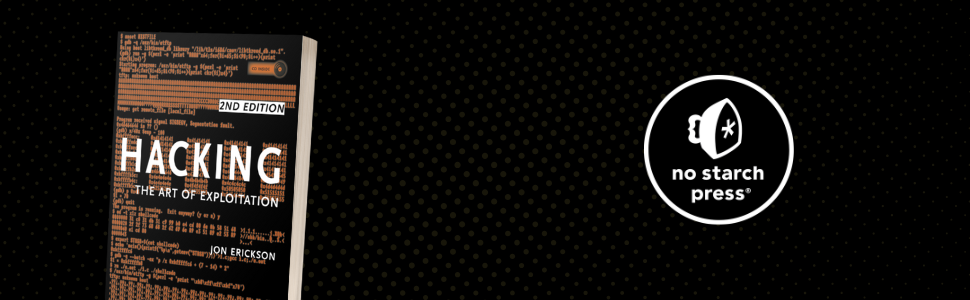
Hacking: The Art of Exploitation, 2nd Edition by Jon Erickson is a top-ranked, highly rated book that teaches hacking from the ground up. It covers assembly and C programming, network attacks, and cryptography with a hands-on approach, empowering readers to build and exploit their own systems. Ideal for beginners to advanced learners, it emphasizes deep understanding over tool reliance, making it a timeless resource for mastering cybersecurity fundamentals.


| Best Sellers Rank | #76,125 in Books ( See Top 100 in Books ) #19 in Computer Hacking #31 in Computer Network Security #66 in Internet & Telecommunications |
| Customer Reviews | 4.6 4.6 out of 5 stars (1,575) |
| Dimensions | 7.13 x 1 x 9.25 inches |
| Edition | 2nd ed. |
| ISBN-10 | 1593271441 |
| ISBN-13 | 978-1593271442 |
| Item Weight | 1.77 pounds |
| Language | English |
| Print length | 488 pages |
| Publication date | February 1, 2008 |
| Publisher | No Starch Press |
R**L
A hacking book that teaches you mindset
I've read quite a few books on hacking, many of which focus on specific technologies—such as using tools to perform reconnaissance on websites and identify potential attack targets. This book, however, takes a different approach. It starts by teaching the fundamentals of assembly and C programming, then moves on to help you identify programs vulnerable to buffer overflows. You'll learn how to write shellcode to exploit these vulnerabilities. What sets this book apart is its minimal reliance on abstractions. For instance, it teaches you how to build your own simple web server, which you can then exploit. Need to perform a SYN flood against a target? No problem—you'll write your own in C to fully understand the process. This hands-on approach will give you a solid understanding of networking. There's even a chapter dedicated to cryptography, which will deepen your knowledge in this critical area. To top it off, the book culminates in a project where you'll learn to crack WEP encryption—not with third-party tools, but by exploiting weak initialization vectors (IVs) and doing it all yourself. While some of the examples, such as the buffer overflow scenarios, may not work in real-world environments, this book is still an invaluable resource. It covers essential foundational knowledge that will serve you well on your hacking journey. There are books that quickly get outdated because they teach you how to use tools. This book is a classic. It teaches you understanding. After reading this, you’ll have a better understanding of how third-party tools work, or you can write your own!
J**N
Covers Everything. Be Warned.
I picked this book up a number of years ago when I got interested in understanding exploits. I've got experience writing code, and even some basic knowledge of networking. However it was difficult to get past the first 3 chapters. I stopped, and started elsewhere. This book will cover everything you need to know, and while that sounds great it's not for beginners or people looking to start quickly. I recommend seeking introductory knowledge elsewhere, C, OSI, TCP/IP, operating systems etc. Penetration Testing a Hands on Guide by Georgia Weidmam is a good way to get started with just getting hands on practice. Once I went back and got a grip on these concepts and had some practice the book was easier to understand and I came to appreciate it much more. Its not an easy read, and you need to have some solid understanding of the machine as a whole. After I played with buffer overflows in a VM I went back and appreciated chapter 0x200s coverage of registers and what they do. Buy this book only if you have a solid understanding of the computer as a whole, or will develop it alongside. The book will not get you started. It will definitely help you develop the understanding of why a buffer overflow script written in Python works, and how. If you want to get up and running quickly look elsewhere. But that doesn't mean it's a bad text, it's well done, insightful, and will help you understand the why of exploiting software.
S**W
Regained my lost book
I had the first edition copy of this book that I studied. This second edition has a lot more knowledge and sets the mindset to have. It’s very insightful and tackles concept in an easy to grasp way. The first edition had a CD in the back, but since then they have gone away with the physical disk and have a link in the back of the book to set up your vm or machine to practice the concepts in a safe environment. This is a great addition to anyone curious about computers and wanting to do a hands on approach. I’d recommend for beginners up to advanced. It’s a handy reference and great for getting your feet wet.
L**R
Find out how deep the rabbit hole really goes
The easiest way to sum up this book is simply "wow." Erickson discusses the fundamentals of exploits (hacks) on local machines and remote machines, and also hits on a bit of cryptology. The meat of book is sandwiched by something of an inner dialogue and history of hacking, which alone are worth the cost of the book. This book is not for the layman or the faint of heart- you have to know how to write code, and you have to at least know how to read Intel x86 assembly, if not write it. It also doesn't hurt to know how programs are actually executed- beyond just double-clicking an icon- I'm talking about stacks and heaps and everything else. The second chapter is possibly the most elegant summary of programming and the C language I have ever seen, ever, but nothing beats a few years "in the trenches." So once you've refreshed your basics of programming, Erickson gets right into it, discussing buffer overflows. He builds up from the most simple concepts into more and more complicated tools- which seems to be exactly how we have arrived at modern exploits; the hackers and the anti-hackers have been co-evolving over the years. Next comes hacking remote machines, including how to cover your tracks- which I found to be some of the most devious ideas presented. If you take your time, and run some of the exploits yourself on the included CD, you will come away with an incredible knowledge of how many exploits work from their most fundamental level. If you're anything like me, you will enjoy the "hunt" of trying to counter the exploit before Erickson explains the solution. Also, if you're anything like me, you will walk away from the book shaking your head at the rut called ASCII that we've worked ourselves into. <rant> I think this is another one of those books that needs to be on a mandatory reading list for all CS bachelors degree. It seems to me that most of the exploits wouldn't be a problem if programmers were a bit more diligent in their coding. strcpy() is your enemy, strncpy() is your friend. Always always ALWAYS be 100% suspicious of any input supplied from a user- check for illegal characters. Instead of if(functionThatReturnsTrue), try if(functionThatReturnsTrue == True). The list goes on and on. Computers do only what they are told, and if you leave a hole in your program that allows someone else to tell the computer what to do to save yourself the second or two it takes to hit a few more keys, well then you deserve to be hacked and summarily lose your job. Due diligence: do it- maybe then the real engineering disciplines won't be so mad when code monkeys call themselves engineers. </rant> From what I can gather, the first edition was too terse. I think the second edition was a bit long-winded at times. And there's no discussion of hacking a Windows machine. However, this is still by far the best general hacking book out there.
M**S
Il libro spiega molto bene i vari argomenti. Qualcuno potrebbe pensare che essendo il libro un po' datato non sia più utile. Ma non è così. Le tecniche che si utilizzano e le vulnerabilità sono le stesse e vengono spiegate molto bene. Consigliato a chiunque voglia imparare/approfondire gli argomenti che vengono spesso utilizzati nelle CTF.
E**T
It’s still a good book to read and with the time it’s become very clear to me
E**A
Excelente!!!!
Z**0
ハッカーの精神と基礎を学べる書籍である。 日本語版を購入後、良い本だったので原本も 購入した。内容も非常に濃くて本気で ハッカーになろうとするなら是非読むべき本 だと思う。この本を完全に理解出来たらハッカーの中級者くらいになれる。 自分は日本語版を一度読んでから英語版を読むことでより深く理解できた。 注意点としては日本語版に比べて薄い分、 大きいので持ち歩きには日本語版の方が良いと思った。もし第3版が出たら買う予定である。
A**X
Esta escrito en inglés pero tiene comprensión fácil aunque no seas bilingüe. Empieza desde lo más sencillo hasta casos Complejos entendiendo el lenguaje C desde sus inicios, y como se estructura los sistemas operativos desde su núcleo. Recomendable.
Trustpilot
Hace 3 días
Hace 3 semanas