
Descargar la aplicación


Servicios al cliente
Sobre nosotros
Copyright © 2025 Desertcart Holdings Limited
Descargar la aplicación

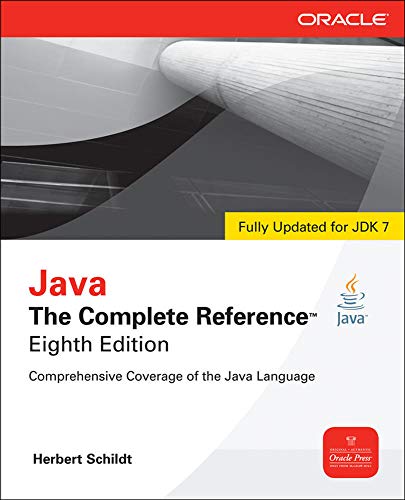
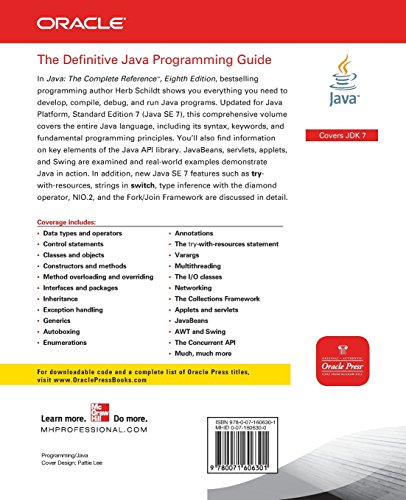


Java The Complete Reference, 8th Edition [Schildt, Herbert] on desertcart.com. *FREE* shipping on qualifying offers. Java The Complete Reference, 8th Edition Review: Well structured, great book!! - I studied Java programming as part of my third level college course and I really enjoyed it and was quite good at it too so when the course finished I didn't want to lose my Java skills, I wanted to expand them, so I went looking for a book to help me do that and I bought this. Right now I'm still reading through it and the parts I already know I just skim over, but I have to say, the book is very well structured and laid out. A non-programmer could pick this up and start learning Java programming. The book starts out simple enough and takes each Java command in turn, explaining the command and offering sample code so you can see the command in action. I would have loved to have worked form this book on the course. Later on the book will venture into graphics and networking, areas I did not study on the course and am interested in studying myself from this book. Given how well structured the book is, I am optimistic of the quality of the subject matter when I get to it. If you are a complete beginner or a novice who has some knowledge of Java and want to build on it, or even a professional Java programmer and just want a good reference manual to have at hand, I highly recommend this book!! Review: Misses Some Key Points - The Good: I use this book as a reference for very clear examples on how to do something. If the book does cover a topic, you can be sure that the explanations are concrete and very easy to understand. The book absolutely shines for its intended purpose. It makes a great supplemental book for most folks learning Java as an additional resource. There is an absolutely fabulous example of a Swing application at the end of the book. It shows how to implement the Observer pattern, manage button states and threading within a Swing application. You can also get a general idea of how to architect a moderately complex Swing application from this example. The table of contents is very well organized. For those without an electronic copy, this is of great value. The Bad: I do not solely recommend this book for someone completely new to Java. It misses on some key areas. For example, the chapter on Inheritance does not cover using @Override when overriding methods. Yet, in the same chapter it discusses how you can accidentally Overload a method without even mentioning this annotation. @Override is briefly mentioned later as a type of annotation but it does not explain good practices, how to use it, etc. Examples that use overriding themselves, do not use @Override! The concept of downcasting is not covered specifically. It's not until the chapter on I/O that isinstance is covered and its very briefly explained. While I pointed out a great Swing example above, the book completely excludes any reference to SwingWorker. This is a great feature that was added in Java 6 for threading Swing applications. There are no details on how to write hashCode methods for data objects. Again, I believe this points back to the weak coverage of Overriding methods. If your read this book end-to-end, you will have no idea what this entails when you start to manage collections of objects. Even a more antiquated book such as Ivor Horton's "Learning Java" covers this topic with great detail.
| Customer Reviews | 4.5 4.5 out of 5 stars (339) |
| Dimensions | 7.4 x 2.2 x 9.1 inches |
| Edition | 8th |
| ISBN-10 | 0071606300 |
| ISBN-13 | 978-0070435926 |
| Item Weight | 4.15 pounds |
| Language | English |
| Part of series | Osborne Complete Reference |
| Print length | 1152 pages |
| Publication date | July 13, 2011 |
| Publisher | McGraw Hill |
P**D
Well structured, great book!!
I studied Java programming as part of my third level college course and I really enjoyed it and was quite good at it too so when the course finished I didn't want to lose my Java skills, I wanted to expand them, so I went looking for a book to help me do that and I bought this. Right now I'm still reading through it and the parts I already know I just skim over, but I have to say, the book is very well structured and laid out. A non-programmer could pick this up and start learning Java programming. The book starts out simple enough and takes each Java command in turn, explaining the command and offering sample code so you can see the command in action. I would have loved to have worked form this book on the course. Later on the book will venture into graphics and networking, areas I did not study on the course and am interested in studying myself from this book. Given how well structured the book is, I am optimistic of the quality of the subject matter when I get to it. If you are a complete beginner or a novice who has some knowledge of Java and want to build on it, or even a professional Java programmer and just want a good reference manual to have at hand, I highly recommend this book!!
T**X
Misses Some Key Points
The Good: I use this book as a reference for very clear examples on how to do something. If the book does cover a topic, you can be sure that the explanations are concrete and very easy to understand. The book absolutely shines for its intended purpose. It makes a great supplemental book for most folks learning Java as an additional resource. There is an absolutely fabulous example of a Swing application at the end of the book. It shows how to implement the Observer pattern, manage button states and threading within a Swing application. You can also get a general idea of how to architect a moderately complex Swing application from this example. The table of contents is very well organized. For those without an electronic copy, this is of great value. The Bad: I do not solely recommend this book for someone completely new to Java. It misses on some key areas. For example, the chapter on Inheritance does not cover using @Override when overriding methods. Yet, in the same chapter it discusses how you can accidentally Overload a method without even mentioning this annotation. @Override is briefly mentioned later as a type of annotation but it does not explain good practices, how to use it, etc. Examples that use overriding themselves, do not use @Override! The concept of downcasting is not covered specifically. It's not until the chapter on I/O that isinstance is covered and its very briefly explained. While I pointed out a great Swing example above, the book completely excludes any reference to SwingWorker. This is a great feature that was added in Java 6 for threading Swing applications. There are no details on how to write hashCode methods for data objects. Again, I believe this points back to the weak coverage of Overriding methods. If your read this book end-to-end, you will have no idea what this entails when you start to manage collections of objects. Even a more antiquated book such as Ivor Horton's "Learning Java" covers this topic with great detail.
T**T
Excellent, but "complete" is impossible!
This is one of the clearer computer books which I've read. It gives complete programs when illustrating points. These are also available for download. Having complete programs makes the context clear. Often with computer books, there isn't enough context, so you don't know when you're allowed to use a particular construction. As an eighth edition, it shows some of its history. Sometimes, there is a more modern way to do something, so the reader should be alert for this before investing too much time reading a part in great detail. For example, AWT vs. Swing. Java has so many classes and definitions that the idea of a "complete" reference is a bit silly. There are many predefined variables and methods which are not mentionned in this book. Oracle has quite a bit of documentation on line. The book is an excellent starting point. After a month, I feel pretty comfortable programming in Java. (I have experience in C++. But the book often notes differences between Java and C/C++.)
S**O
Good as a textbook or a reference
I got this book as a textbook for an Intro to Java class. I use Java at work, so I was hoping that the book wouldn't leave me bored. I was pleasantly surprised by how readable and informative this book is. It explains everything from that ground up, providing insight into how things work on the back end which I hadn't come across from tinkering with Java. This book is great for someone just learning Java, and also as a reference book as many methods are discussed in detail. I plan to keep it at work to refer to as needed.
J**R
Thorough reference for the Java Language
This book is well organized, well written, and thoroughly describes the Java Language with clear descriptions and many examples. Part I (~350 pages) describes the Java language, Part II (~550 pages) describes the Java Library, Part III (~85 pages) describes Software Development using the Java Beans IDE, and Part IV (~60 pages) develops two applications from start to finish, one developing financial applets and servlets, and the other developing a download manager for the Internet. There is also a six page Appendix describing the use of documentation comments (/** comments) with 19 embedded commands. I expect to use this book as a primary reference for years.
A**I
Java the complete reference 8th edition
Provides a decent reference book that I wish to have as an occasional Java Programmer. And it is not just a "reference manual" but also explains things in an understandable way.
N**H
5 Star Rating For The Book Quality And Delivery !! Bought This Book At 30Th March And Got The Delivery With Proper Packing On 1St April. Best For Learning JAVA From Beginning !! All Program's Are Well Explained !! All Concepts Cleared With Sutiable Examples !! About Author And Some Features :- • International Bestseller: the previous editions have sold over 100,000 copies. The previous editions have also earned more than $705,000 in international rights royalties. • Covers the new features of Java 7 including: closures, superpackages, reified generic types, Swing Application Framework, the use of strings in a switch statement, chained invocations, extension methods, and enhanced catch statement. • Author Herb Schildt's programming books have sold more than 3.5 million copies. • New chapter on language level XML support . • Covers Swing Application Framework.
V**O
Ho letto poche pagine perchè devo preparare altri esami. Questo sarà il testo principale del mio corso. Non ho nulla da dire se non elogi elogi elogi. Il miglior libro su Java. Molto fluido nel linguaggio (seppur inglese si capisce bene), molto pratico e che ti tiene incollato a capire i concetti. Prossimamente compreró la 12th edition.
N**G
This book isn't for beginners to programming but it is well written and covers most of the essentials of Java in sufficient depth. By nature it is more of a reference book that you dip into as required rather than one that you read from cover to cover. I've given it 5 stars as it does what it sets out to do but I think that alot of the information in there can be found on the Web in Oracles Java documentation
T**T
This is a great book for learning Java or referring back to something you are rusty on. It covers everything I need to know and has a great index/table of contents to quickly jump to a specific page. Not to mention the great service from Amazon, I received this book in perfect condition. I'll be looking forward to future releases. The disappointed thing was no exercises are in this book, but I guess that is why they call it a reference.
H**G
Me sorprende lo mucho que Oracle ha intentado cambiar la historia de Java en este libro. También, en él se encuentran párrafos importantes sobre puntos a tener en cuenta en la tecnología a los que no se les da la importancia de etiquetado que deberían tener. Por lo demás, es una décima parte del API de Java SE 7 encuadernado. Los que deseen prepararse con este libro para la certificación no obtendrán nada de él.
Trustpilot
Hace 2 semanas
Hace 1 mes