We remain fully operational. Our teams are working around the clock to ensure your deliveries continue safely.

Descargar la aplicación


Servicios al cliente
Sobre nosotros
Copyright © 2025 Desertcart Holdings Limited
Descargar la aplicación
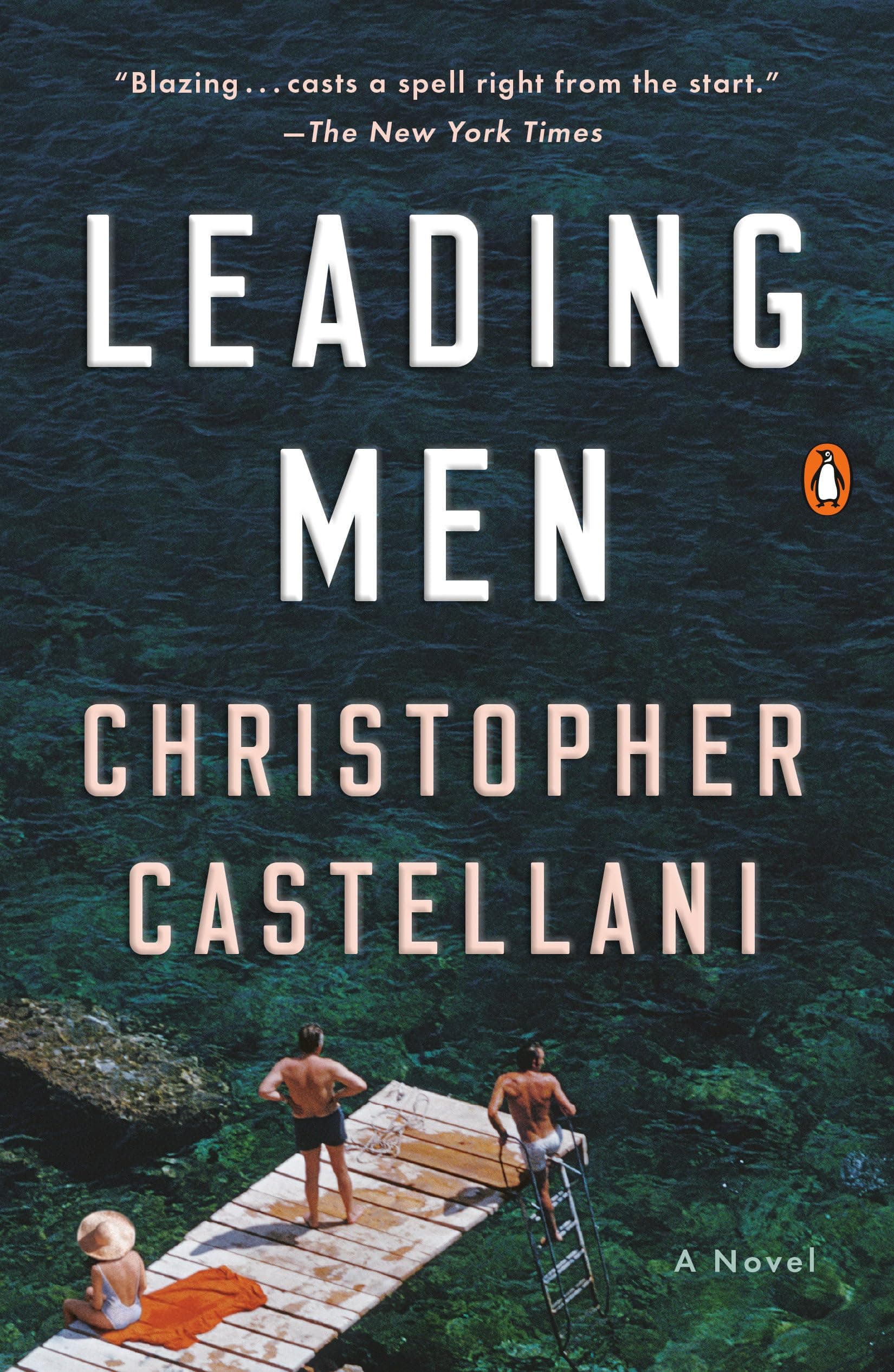
Buy Leading Men: A Novel Reprint by Castellani, Christopher (ISBN: 9780525559078) from desertcart's Book Store. Everyday low prices and free delivery on eligible orders. Review: Loved it - I didn't want to finish this poetic, Italian dream of a novel. Sad, worrying but life affirming . I loved it. Review: Undeniably great, but inevitably a little remote - Christopher Castellani delivers a devastatingly honest and perceptive treatise on love and sacrifice in this novel, a mostly fictionalised account of the relationship between Tennessee Williams and his partner of 15 years Frank Merlo. Beautifully written, it also captures effortlessly the feel of its settings, from Italy in the 1950s to the United States in the present day. Aspects of the characters' lives are interwoven through time, with each chapter changing the temporal perspective, making for absorbing and rewarding progression throughout. And yet my one issue with the novel is that, like many that inhabit the same or similar genre, its tropes and its tendency for its characters to take such a psychoanalytical approach to everything in their lives put it somewhat out of reach: an examination of their lives rather than immersion in them. That said, it is still a very good novel I am glad to have read.
| Best Sellers Rank | 2,952,848 in Books ( See Top 100 in Books ) 1,294 in Biographical & Autofiction 3,302 in Drama (Books) 25,425 in Literary Fiction (Books) |
| Customer reviews | 4.0 4.0 out of 5 stars (536) |
| Dimensions | 13.97 x 2.36 x 21.44 cm |
| Edition | Reprint |
| ISBN-10 | 0525559078 |
| ISBN-13 | 978-0525559078 |
| Item weight | 299 g |
| Language | English |
| Print length | 368 pages |
| Publication date | 1 Jan. 1900 |
| Publisher | Penguin Publishing Group |
D**D
Loved it
I didn't want to finish this poetic, Italian dream of a novel. Sad, worrying but life affirming . I loved it.
G**N
Undeniably great, but inevitably a little remote
Christopher Castellani delivers a devastatingly honest and perceptive treatise on love and sacrifice in this novel, a mostly fictionalised account of the relationship between Tennessee Williams and his partner of 15 years Frank Merlo. Beautifully written, it also captures effortlessly the feel of its settings, from Italy in the 1950s to the United States in the present day. Aspects of the characters' lives are interwoven through time, with each chapter changing the temporal perspective, making for absorbing and rewarding progression throughout. And yet my one issue with the novel is that, like many that inhabit the same or similar genre, its tropes and its tendency for its characters to take such a psychoanalytical approach to everything in their lives put it somewhat out of reach: an examination of their lives rather than immersion in them. That said, it is still a very good novel I am glad to have read.
G**L
Superb novel...
American author Christopher Castellani has written an almost epic novel about male authors and the men who loved them. The book, "Leading Men", features real people - Tennessee Williams, Frank Merlo, Truman Capote, Jack Burns, among others - while adding to them a cast of fictional characters. (It's handy to read this book on an Ipad or other devise which makes it easy to refer to Wiki when you have a question about a character in the book.) The book is perhaps a little too long, but the relationships between the characters need a fair amount of space to develop. Castellani has invented characters as he is writing a fictionalised version of real events. Not an easy concept to either write or read, it's the only way he can tell his story. The book takes place in the 1940's to the 1960's Tennessee Williams and his lover/aide Frank Merlo live the good life in Italy. Williams is writing during the day, while Merlo keeps Williams' life and household in running order. The two men are not necessarily faithful to each other and they do fight a fair amount, but the reader can easily discern the love between them. Their friends (and rivals) Truman Capote and Jack Burns - both with their own lovers - come in and out of the story. And added to the story as fictional characters are a Swedish mother-and-daughter, Bitte and Anya Blomgren - who meet up with Williams and Merlo in Portofino and are sort of added to their lives. Anya is based on Liv Ullmann, the Norwegian actress and director. Frank Merlo and Anya become life-long friends. But Frank Merlo, who I think is the main character in the book, does not have a long life-time. He dies of lung cancer in a New York hospital in 1963, after his relationship with "Tenn" has withered. Tennessee Williams knows and acknowledges his creative juices flourished during his 20 or so years with Frank Merlo. Still friends with Anya - who has go on to become a highly regarded actress - he writes a short play about Frank he gives to Anya. What Anya does with this not-particularly-well-written play is explored near the end of the book. Christopher Castellano's book is character-driven. A bit of a plot but what's there mainly exists to service the characters. The Frank Merlo character is a particularly well-drawn, nuanced look at a man who is comfortable with his sexuality but is uncertain about his place in his world. He may book airline tickets to Spain for Williams, but he has not-so-secret desires to become an actor/singer/dancer and find success in his own right. Castellani's book is a wonderful read, though not for every reader. Make sure you read all the reviews you can before you buy the book or take it out of the library. As always with well-written fiction, I'm left with the urge to find out as much as I can about the "real people" and their stories.
M**D
Slightly disappointing
Slightly disappointing. The 1950s sections were far more engaging than the contemporary sections which I sometimes found overdrawn and pretentious.
S**1
A book that stays with you
I found Leading Men one of those books that really stays with you after you've put it down, a beautifully told love story that rewards you for your attention. There's a wonderful sense of place, particularly the glamour of 1950s Italy, and the enticing experience of being a fly on the wall in the world of legends Tennesse Williams and Truman Capote. It's curious not knowing, until the notes at the end, what's real and made up but thematically what this invented history gives you is a very thoughtful examination of what it's like to be close to fame and conversely what fuels exceptional talent. It's a fair observation to say that the book is not about relentless plot in a Dan Brown kind of way but as you get to know the characters you're drawn into their story on a powerful emotional level. And, as I say, it leaves you thoughtful and a little bit changed in a very good way.
J**S
But best copy you can afford
Perfect. No problem.
M**R
I wanted to like this novel more than I actually did. The jumping between time periods was a bit confusing at times, requiring a mental reset before embarking on the next chapter. And I kept getting two of the characters confused - Anna, Anja. When true stories are fictionalized, an author can lead readers in directions that are going to result in some confusion: it is so with this book - a more straightforward telling without the invented characters would have been just as effective.
T**S
I can’t shower enough praise on this novel: about how skillfully, lovingly written it is or how completely absorbed and moved I was by it. Christopher Castellani has created a very complex, multi-layered novel about time and what the passing decades do to love, fame and reputation. It’s about being very much in love and losing love. It’s about being very famous and talented and about losing fame and experiencing the dread of talent disappearing. About the proximity to fame and talent when you have neither, and how that eats at the soul. And inevitably it is also about aging, sickness and death. And though the last chapter destroyed me, completely laid me out with its heartbreak, loss and the lesson of the everyday persistence of love felt by couples of longstanding, this book is never depressing. It feels true and human and beautiful. It’s also a fun and dishy read: Castellani has perfectly imagined gossipy cocktail hours between Tennessee Williams and Truman Capote, emotional throwdowns between Williams and a world famous actress over lunch at the Waldorf, the precise atmosphere of visits to the set of Visconti’s romantic film epic “Senso,” and every detail rings completely true. He gets the minutiae of midcentury cultural life exactly right, he is a master of the concrete, of the accretion of detail and the tactile setting of scenes, whether it’s a fateful dinner with diva Anna Magnani or preparations for a long, lonely drive to a beach town in Italy. So it’s remarkable that he is equally adept at what is so much more elusive and mysterious and unspoken, such as the emotional turmoil and back-and-forth of gay relationships which were important and substantial while largely invisible to the world at large when they weren’t actively scorned. This is part of Castellani’s message, that these men lived in a vague zone in which even the famous and very talented were always on probation, always on shakey ground because they were men who loved men. We learn about these Leading Men through the eyes of the famous actress (fictional though based on a real star) who knew them as a young girl and is now dwindling into old age and retirement while forming her own new relationships to contemporary gay leading men. At first you may resent her intrusions into the glamorous world of Tenn and Frank — I did. But Castellani’s unerring eye and ear and his enormous talent soon creates a credible life and career for her, and I was won over. This is a great and ambitious novel, and two successive readings have still not revealed to me exactly how Christopher Castellani pulled it off.
G**P
Fascinating nostalgic trip into the fifties. After reading it I bought The Gallery written by the character who dies of drinking too much (Jack Burns who was a real writer ) and that was a fascinating experience based in Napoli during the American invasion of Itay in 1944.
L**G
Christopher Castellani's "Leading Men" was a strong reading experience for me. As a theater major and an avid reader, I enjoyed encountering both Tennessee Williams and Truman Capote in this fiction that probes what the relationship between Williams and his long-time companion Frank Merlo may have been like. While I am very well versed in Williams' theatrical work, I had only a titular knowledge about his private life. I found the European settings to be exotic, giving me a glimpse how the other "jet set" half lives. Castellani demands a lot from his readers with numerous characters weaving in and out of various times lines, often leaving me momentarily uncertain as each chapter began. That said, I did enjoy the book and was sorry to say goodbye to these characters. Enjoy!
J**O
Notes for book review As a child The Count of Montecristo so enthralled me I would take it with me to Sunday Mass until my father figured out it was not a missal and ripped it out of my hands. In young adulthood John Kennedy Toole’s A Confederacy of Dunces held the same mermerizing attraction (by then I was not Catholic). Those were books I could not put down and read several times. In advanced maturity I did not think another book could have the same effect. Christopher Castellani has proved me wrong. Leadng Men has that same spellbinding hold on the reader: you cannot put it down any of the three times you read it. You will come to resent sleep and chores for pulling you away from it. A thriller of a unique kind, Leading Men bases its narrative on the relationship betweenTennessee Willliams and his partner Frank Merlo . The enigmatic character of Anja, a Swedish actress, enhances the story as it focuses on her impact on that relationship and the effect it had on her throughout her life. In the meantime we are treated to apocryphal (are they?) anecdotes about John Horne Burns, Truman Capote, Anna Magnani, Luchino Visconti, Paul Bowles and other contemporaneous celebrities. Told from the point of view of Frank Merlo, even when the focus seems to be the character of Anja, Leading Men is a touching and empathetic psychological study of the dynamics of emotional interdependence, unrequitted or unexpressed love and striving to be more than life allows us to be while existing in the umbered shadow of a famous, insecure, overwhelming and self-absorbed partner and yet being powerless to let go of the binds. In Tennessee Williams’ absence, in a moment that reveals the complexity of the character’s feelings, Frank feels him to be “less like a habit than an affliction,” even after affirming to Sandro, John Horne Burns’ lover: “And to be used to someone, to settle into his moods and demands and affections, wasn’t that something? Wasn’t that the best you could hope for…?” This appreciation of his own state is in itself a manifestation of Frank Merlo’s possible explanation for relinquishing his own artistic aspirations, not particularly productive in 1953, the temporal focus of the story. (Merlo had a film career that consisted, between 1947 and 1949, of twelve minor roles, seven of them uncredited; in 1959 he was a member of the operating-room audience during the lobotomy scene in Suddenly Last Summer, also uncredited. That knowledge makes the chapter titled “Gabriele Rossini” difficult to read in its dramatic irony.) At each narrative step the novel seems to attempt to answer the question: What becomes of the self once it is delivered onto the will of another with abnegation unrewarded and even unacknowledged? Frank’s epiphany (rationalization?) following the death of another writer whose lover is in similar circumstances is that he is there to keep Tennessee alive. From that optic, the ending is painfully ironic. Perhaps the plot would have been just as gripping if Castellani, instead of identifying the main characters as Tennessee Williams and Frank Melo, had called them Bubba Culpepper and Guido Gotti. The author could have also written a thin roman-a-clef in the style of Truman Capote and let the reader, as did Capote’s scandalized friends, figure out who everyone was. His choice to put known faces to the two main characters evinces his meticulous reseach and respect for the subject matter, for two real-life men who gave rise to this quasi-fiction. The rest of the real-life characters in this story need no fictionalization to make their lives compelling, yet Castellani manages to recreate each one to fit the thematic focus. The names of so many luminaries come up without condescension to the reader through explanations of who everyone is, until they become contextually familiar and turn into part of the narrative quilt, each panel stitched to overlap another, including a quick reference to Franco Zeffirelli as an assistant to Luchino Visconti. Three aspects of Castellani’s narrative style stand out. First, Castellani’s Tennessee Williams is Tenn throughout the text. This choice of name for the writer pulls the reader closer to the narrative events and intimacy implied in Frank’s point of view, by using the nickname his acquaintances gave him. It is an instance of Castellalni’s uniquely perceptive stylistic strategy. In the novel’s interplay between fiction and reality eventually what is real becomes irrelevant: what matrters is the depth of the impalpable expositon of dependence as the breeding medium for resentment. Second, the nonlineal sequencing takes the reader back and forth, ironically putting events, cause and effect in their proper context. The gradual disclosure of Anja’s evolution is skillfully presented in flashbacks that bring her to the present, when she points out that her glory days are buried deep in the fabric of the carpeting. Third, Castellani’s use of punctuation allows the reader to penetrate Frank’s point of view without the need for obtrusive quotation marks. Within a paragraph the reader perceives Frank’s views and thoughts through the selection of verbal tenses and pronouns: the reader does not need a “he said” or a “he thought.” Within that framework Castellani includes remarks on the aesthetics of literary creation that are difficult to ascribe to Frank Merlo, but are plausibly the author’s own. Most striking is Castellalni’s use of language, his felicitous turns of phrase that mirror Tennessee Williams and even Truman Capote’s legendary wit without necessarily quoting directly. It is doubtful that those writers’ acuity could have been any sharper than Castelllani’s. More amazing yet is that Castellani’s dialogue is so realistic that the words he puts in his characters’ mouths fit perfectly the personality he has developed for each. Every word in Leading Men is exactly where it needs to be. Castellani’s prose is lyrical, never flowery; it is always elegant rather than overwraught. His imagery, often impressionist verbal paintings, dazzles the reader evocatively for its sensibility and creativity: “The light through the leaves mottled their faces, for a moment…,” “… bathed in the cooling mercy of the sunset…,” “The colored lights strung from the lampposts blurred in the mist.” Leading Men is the book that makes me wish I were still teaching writing and literature. It would be required reading. --Joseph F. Delgado, 4/27/2019, Columbia, SC
Trustpilot
Hace 3 semanas
Hace 2 semanas