We remain fully operational. Our teams are working around the clock to ensure your deliveries continue safely.

Descargar la aplicación


Servicios al cliente
Sobre nosotros
Copyright © 2025 Desertcart Holdings Limited
Descargar la aplicación
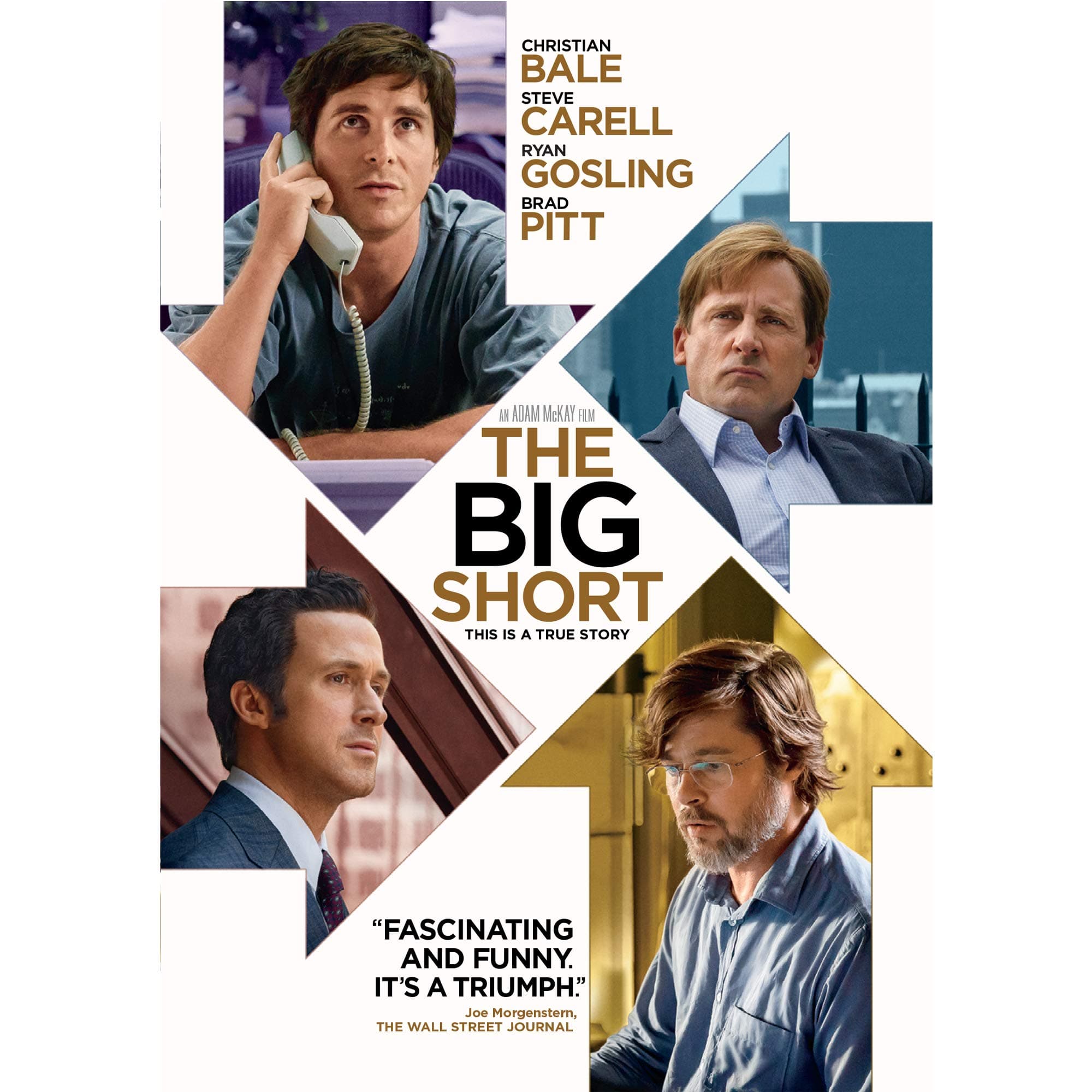


In the mid-2000s, hedge fund manager Michael Burry (Christian Bale) took a hard look at the subprime mortgage market...and saw the tidal wave of borrower defaults to come. As a handful of financial industry insiders watched him bet billions against the very stability of the banks, they felt themselves torn between knowing the consequence of collapse...and getting themselves a very lucrative piece of that action. Adam McKay’s trenchant take on the ‘08 economic crisis, inspired by the Michael Lewis bestseller, also stars Steve Carell, Ryan Gosling, Brad Pitt, Marisa Tomei, Hamish Linklater. 130 minutes Review: Informational yet entertaining - True entertainment as well as historical accuracies. I love how this movie blends keeping it real with numbers and breaking the fourth wall, with having celebrities and keeping me engaged. Review: Pretty Accurate Story - This is long (covers 2004-2009), but explains the movie and events related to the move. There were some things in the movie that were not accurate (maybe for dramatic effect), but overall events are fairly accurate regarding Credit Default Swaps ("CDS"). A CDS is like taking out an insurance policy that says, if someone owes you money, and they can't pay; the insurance company pays you. What if the insurance company can't pay you either? Welcome to the movie! Comparing this movie with related historical events: Many 2007-2009ish mortgage defaults occurred because: (1) FED Gov created the Community Reinvestment Act of 1977 (Carter); expanded in 1999 (Clinton), and further encouraged under GW Bush & Obama Admins. All Admins under CRA forced banks to provide loans to people who basically could not afford them. (2) Permitted "stated income" (no proof of income or proof of job for home loans). (3) The Federal Reserve Bank moved interest rates from 1% to 5.25% from 2004 to 2006 to "fight inflation." (Sound familiar 2022-2023?) Those cheap adjustable-rate mortgages got super expensive when interest rates reset. A 3% adjustable mortgage could have gone 3% + prime (5.25%) plus say 3+ points = 11.25% mortgage rate. If one was paying say $3000 year in interest on every $100,000 (mortgage loan) they would now be paying $11,250/ year in just interest (per $100,000 borrowed). If one could barely afford the $3000/ year, think they could afford paying more than 3x that? Higher interest rates also affected everything with adjustable rates (car loans, credit cards, personal, and business loans, etc.). In the movie and true to life, investment banks sought to manage mortgage risk by putting high quality (A+ mortgages with low quality (sub-prime mortgages) in an investment package. With 1,000's -10,000+ mortgages in these packages, some could default, but overall ppl would still pay their mortgage was the thinking. The mistaken belief was that most people thought interest rates would never go up significantly (increased 425% in 2 years per FED Reserve), and home prices could never go down. Both events happened. A few people effectively took the investment risk (as in the movie) and bet that the insurance companies and banks would default on paying interest on these Credit Default Swaps. Nearly 1 out of 4 mortgages were subprime in 2006 - about $600 Billion in 2006 dollars; and began massively defaulting from spring 2007 to 2009ish then collapsed. This bled into higher quality mortgages. These events led to the largest bank failures since the Great Depression (1929-39). As rates went up, home prices tanked, and borrowers were paying more for their homes than they were worth. Then the US / global economy tanked (related to mortgages, home, and credit issues). Then massive job layoffs occurred as companies could not afford to borrow, and consumers were cutting their spending massively, which led to a massive recession. Like in the movie, the banks/ insurance companies that sold the CDS's (insurance guarantees) defaulted. Banks, insurance, and mortgage companies we failing faster than dropping a rock off a building (don't advise). By Oct 2009, some $9.8 Trillion of wealth was lost just in the USA. These few people (in the movie and real life) who bet on the defaults of the mortgage/ credit markets made out like bandits. They took on huge risks and lost money for 1-2 years before they made a huge profit. Completely legal (like short selling). They didn't cause the crisis, just recognized the risks, and made money as the underlines mortgages (CDS's) tanked in value. Guess what is happening in 2022-2023? Movie part 2 in a few years? We had a booming stock-market (Pre-2022) and a booming real estate market (early 2023). Aggressive FED interest rate hikes to "fight inflation" which was caused by cutting U.S. domestic energy policies. Where are things going in 2022-2023? I think a lot like the movie, but it will be a little different. What the FED and Gov does will impact markets. Overall, best movie that captures this economic time period. It also proves that people who think they are so smart were found to be completely wrong.


| ASIN | B0177ZM3MI |
| Actors | Brad Pitt, Christian Bale, Marisa Tomei, Melissa Leo, Steve Carrell |
| Best Sellers Rank | #2,452 in Movies & TV ( See Top 100 in Movies & TV ) #237 in Comedy (Movies & TV) |
| Customer Reviews | 4.8 4.8 out of 5 stars (4,025) |
| Dubbed: | English, French, Spanish |
| Is Discontinued By Manufacturer | No |
| Item model number | 59176430000 |
| MPAA rating | R (Restricted) |
| Media Format | Subtitled |
| Number of discs | 1 |
| Product Dimensions | 0.7 x 7.5 x 5.4 inches; 1.92 ounces |
| Release date | March 15, 2016 |
| Run time | 2 hours and 10 minutes |
| Studio | Paramount |
| Subtitles: | English, French, Portuguese, Spanish |
M**E
Informational yet entertaining
True entertainment as well as historical accuracies. I love how this movie blends keeping it real with numbers and breaking the fourth wall, with having celebrities and keeping me engaged.
C**3
Pretty Accurate Story
This is long (covers 2004-2009), but explains the movie and events related to the move. There were some things in the movie that were not accurate (maybe for dramatic effect), but overall events are fairly accurate regarding Credit Default Swaps ("CDS"). A CDS is like taking out an insurance policy that says, if someone owes you money, and they can't pay; the insurance company pays you. What if the insurance company can't pay you either? Welcome to the movie! Comparing this movie with related historical events: Many 2007-2009ish mortgage defaults occurred because: (1) FED Gov created the Community Reinvestment Act of 1977 (Carter); expanded in 1999 (Clinton), and further encouraged under GW Bush & Obama Admins. All Admins under CRA forced banks to provide loans to people who basically could not afford them. (2) Permitted "stated income" (no proof of income or proof of job for home loans). (3) The Federal Reserve Bank moved interest rates from 1% to 5.25% from 2004 to 2006 to "fight inflation." (Sound familiar 2022-2023?) Those cheap adjustable-rate mortgages got super expensive when interest rates reset. A 3% adjustable mortgage could have gone 3% + prime (5.25%) plus say 3+ points = 11.25% mortgage rate. If one was paying say $3000 year in interest on every $100,000 (mortgage loan) they would now be paying $11,250/ year in just interest (per $100,000 borrowed). If one could barely afford the $3000/ year, think they could afford paying more than 3x that? Higher interest rates also affected everything with adjustable rates (car loans, credit cards, personal, and business loans, etc.). In the movie and true to life, investment banks sought to manage mortgage risk by putting high quality (A+ mortgages with low quality (sub-prime mortgages) in an investment package. With 1,000's -10,000+ mortgages in these packages, some could default, but overall ppl would still pay their mortgage was the thinking. The mistaken belief was that most people thought interest rates would never go up significantly (increased 425% in 2 years per FED Reserve), and home prices could never go down. Both events happened. A few people effectively took the investment risk (as in the movie) and bet that the insurance companies and banks would default on paying interest on these Credit Default Swaps. Nearly 1 out of 4 mortgages were subprime in 2006 - about $600 Billion in 2006 dollars; and began massively defaulting from spring 2007 to 2009ish then collapsed. This bled into higher quality mortgages. These events led to the largest bank failures since the Great Depression (1929-39). As rates went up, home prices tanked, and borrowers were paying more for their homes than they were worth. Then the US / global economy tanked (related to mortgages, home, and credit issues). Then massive job layoffs occurred as companies could not afford to borrow, and consumers were cutting their spending massively, which led to a massive recession. Like in the movie, the banks/ insurance companies that sold the CDS's (insurance guarantees) defaulted. Banks, insurance, and mortgage companies we failing faster than dropping a rock off a building (don't advise). By Oct 2009, some $9.8 Trillion of wealth was lost just in the USA. These few people (in the movie and real life) who bet on the defaults of the mortgage/ credit markets made out like bandits. They took on huge risks and lost money for 1-2 years before they made a huge profit. Completely legal (like short selling). They didn't cause the crisis, just recognized the risks, and made money as the underlines mortgages (CDS's) tanked in value. Guess what is happening in 2022-2023? Movie part 2 in a few years? We had a booming stock-market (Pre-2022) and a booming real estate market (early 2023). Aggressive FED interest rate hikes to "fight inflation" which was caused by cutting U.S. domestic energy policies. Where are things going in 2022-2023? I think a lot like the movie, but it will be a little different. What the FED and Gov does will impact markets. Overall, best movie that captures this economic time period. It also proves that people who think they are so smart were found to be completely wrong.
M**R
Quality and price
Great movie
R**N
Awesome movie!
Amazing movie - teaches you so much about the financial system! I would absolutely recommend this for anyone curious about how 2008 happened. Some of their explanations - like how a synthetic CDO work are oversimplified to the point of being theoretically incorrect, when they're not that complicated in the first place. But overall, a great movie, and most of the terminology you can easily look up on your own.
D**L
Great movie. No digital code.
I really enjoyed the movie. Strong performances by everyone and imaginative story-telling. This is the first movie I've received (of dozens) where a digital code was advertised but not supplied. It hadn't just expired, there was no paper inside. That was disappointing, and I wish they would change the packaging.
A**G
How they did it before -- Will they do it again? ~~
The perils of herd mentality in the mortgage markets, and the pitfalls of corruption that are still very much with us, are the serious messages that come out of this zippy, well-informed, surprisingly intelligent (and only slightly fictionalized) feature movie. Based on veteran financial journalist Michael Lewis' 2010 bestseller of the same name, which profiled the 2008 crash in residential mortgage "paper" and the tiny handful of people who had had the insight and integrity to see it coming despite the financial establishment's insistence that nothing could go wrong, what amazed me in this entertaining and enlightening movie is how well it does justice to Lewis' straightforward but rather complex text. Yes, one time two characters break the celluloid proscenium (so to speak) and tell the audience directly that they weren't REALLY thrown out of the lobby of an investment bank building, but close enough. Welcome comic relief comes in the form of guest "witnessing" by chef Anthony Bourdain, Selena Gomez and other celebrities to explain the intricacies of home mortgage "packages" and that creature from financial hell, the Credit Default Obligation swap, which essentially takes huge piles of mortgages heavily shot through with garbage (I almost used another word) and spins it enough to lose track of the essentials and appear attractive. Definitions and complex terms are actually a very small part of this movie, though. The enduring themes are that nobody wants to buck a herd mentality, no matter how ludicrous that mentality has come to be. Why would anybody seriously involved in Wall Street's take on mortgage liquidity want to listen to a couple of very small-time financiers who figured out in 2007 that the mortgage market was bound to collapse catastrophically -- well, they didn't, despite accurate predictions based on accurately observed data. At least, not until a couple of accidental encounters and the recruitment of a semi-survivalist burnout from the financial markets (delightfully underplayed by Brad Pitt in a smaller role than usual), set up the conditions to skin the big banks who can't bring themselves to accept, institutionally, what an unstable fraud they are perpetuating. The principal players -- Christian Bale, Steve Carell and Ryan Gosling -- are wonderful too, all of which makes THE BIG SHORT an excellent movie that holds some dire predictions. When the financial services industry is allowed to perpetuate derivatives upon derivatives -- as they are now doing again, eight years after the crash that caused the Great Recession -- what happens when the markets crash again? More taxpayer bailouts, and politicians who once again will blame "poor people and immigrants" is the prediction at the end of this insightful, memorable movie. I recommend THE BIG SHORT without qualification, whether in book or movie form, or both, but I will point out that since the dialog reflects the speech of young competitive men under stress, a great deal of swearing is involved -- something you might want to think about if small children are around.
P**S
Fantastic movie regarding the great recession and the housing crash in particular
The most amazing movie I’ve ever seen pertaining to the great recession of 2007 to 2009. Tremendous acting and cast with the most insightful and humorous insights into the awful and despicable tactics of an industry gone wrong without values and integrity and an inept government Response. A must watch for anyone who wants to know more about this time period.
L**.
Ottimo, da vedere assolutamente!
J**R
La película llegó a tiempo y en buen estado. Muy interesante película explicando una de las mayores crisis en USA.
W**E
How much the 2008 financial crash grips the viewer I suppose depends on their situation at the time. To the financial world it was a disaster. To others it probably varied from nothing to a semi-disaster that robbed people of interest earnings on their savings! But this film is partly educational. It makes a pretty good drama leading up to that crash while explaining what the various financial instruments and credit ratings meant; how they were thrown into chaos by agencies who should have known better. It illustrates well what a casino financial speculation really is; how people can get rich pretty quickly and then thrown to the wall just as fast. So if you're interested what a CDO is and what Standard and Poors does, Bale and his team bring it off brilliantly!
M**T
C'est vraiment un bon film.
E**O
Top
Trustpilot
Hace 1 mes
Hace 1 día