We remain fully operational. Our teams are working around the clock to ensure your deliveries continue safely.

Descargar la aplicación


Servicios al cliente
Sobre nosotros
Copyright © 2025 Desertcart Holdings Limited
Descargar la aplicación

Buy anything from 5,000+ international stores. One checkout price. No surprise fees. Join 2M+ shoppers on Desertcart.
Desertcart purchases this item on your behalf and handles shipping, customs, and support to Panama.
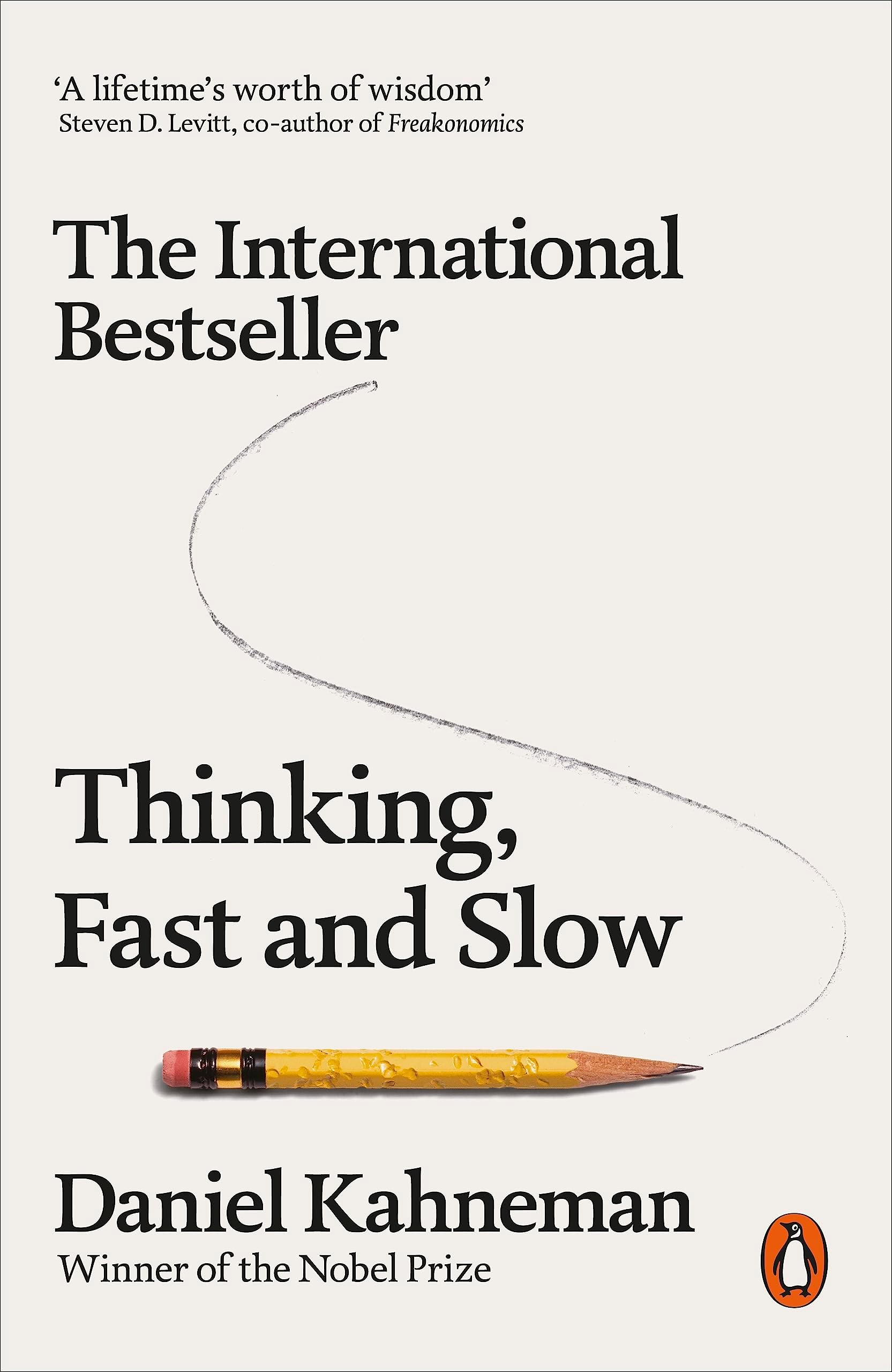
Buy Thinking, Fast and Slow: Daniel Kahneman 1 by Kahneman, Daniel (ISBN: 9780141033570) from desertcart's Book Store. Everyday low prices and free delivery on eligible orders. Review: When is an intuition a simplifying heuristic or an expert solution? That is the cue of recognition, nigh a formula Grasshopper! - Stemming from the author's Nobel prize winning scholarly research on the simplifying short-cuts of intuitive thinking (systematic errors) and then decision making under uncertainty both published in Science Journal, the book is a series of thought experiments that sets out to counter the prevailing rational-agent model of the world (Bernoulli's utility errors) that humans have consistent preferences and know how to maximise them. Instead, Prospect Theory shows that important choices are prone to the relativity of shifting reference points (context) and formulations of inconsequential features within a situation such that human preferences struggle to become reality-bound. In particular our decisions are susceptible to heuristic (short-cutting) or cognitive illusory biases - an inconsistency that is built in to the design of our minds, for example, the 'duration neglect' of time (less is more effect) in recounting a story by the Remembering Self, as opposed to sequentially by the Experiencing Self. Prospect Theory is based on the well known dominance of threat/escape (negativity) over opportunity/approach (positivity) as a natural tendency or hard wired response towards risk adversity that Kahneman's grandmother would have acknowledged. Today this bias is explored by behavioural economics (psychophysics) and the science of neuroeconomics - in trying to understand what a person's brain does while they make safe or risky decisions. It would appear that there are two species of homo sapiens: those who think like "Econs" - who can compare broad principles and processes 'across subjects', like spread betters (broad framing) in trades of exchange; and "Humans" who are swayed optimistically or pessimistically in terms of conviction and fairness by having attachments to material usage (narrow framing) and a whole host of cognitive illusions, e.g. to name but a very few: the endowment effect, sunk cost fallacy and entitlement. Kahnmann argues that these two different ways of relating to the world are heavily predicated by a fundamental split in the brain's wet-ware architecture delineated by two complementary but opposing perspectives: System 1 is described as the Inside View: it is "fast" HARE-like intuitive thought processes that jump to best-case scenario and plausible conclusions based on recent events and current context (priming) using automatic perceptual memory reactions or simple heuristic intuitions or substitutions. These are usually affect-based associations or prototypical intensity matches (trying to compare different categories, e.g. apples or stake?). System 1 is susceptible to emotional framing and prefers the sure choice over the gamble (risk adverse) when the outcomes are good but tends to accept the gamble (risk seeking) when all outcomes are negative. System 1 is 'frame-bound' to descriptions of reality rather than reality itself and can reverse preferences based on how information is presented, i.e. is open to persuasion. Therefore, instead of truly expert intuitions System 1 thrives on correlations of coherence (elegance), certainty (conviction) and causality (fact) rather than evidential truth. System 1 has a tendency to believe, confirm (well known bias), infer or induce the general from the particular (causal stereotype). System 1 does not compute base rates of probability, the influence of random luck or mere statistics as correlation (decorrelation error) or the regression to the mean (causality error). System 1's weakness is the brain's propensity to succumb to over-confidence and hindsight in the resemblance, coherence and plausibility of flimsy evidence of the moment acronymically termed WYSIATI (What You See Is All There Is) at the expense of System 2 probability. To succumb is human as so humbly shown throughout the book which has no bounds to profession, institution, MENSA level or social standing. Maybe Gurdjieff was right when he noticed that the majority of humans are sheep-like. System 2 on the other hand is the Outside View that attempts to factor in Rumsfeld's "unknown unknowns" by using realistic baselines of reference classes. It makes choices that are 'reality-bound' regardless of presentation of facts or emotional framing and can be regarded as "slow" RAT-like controlled focus and energy sapping intention, the kind used in effort-full integral, statistical and complex reasoning using distributional information based on probability, uncertainty and doubt. However System 2 is also prone to error especially in the service of System 1 and even though it has the capability with application not to confuse mere correlation with causation and deduce the particular from the general, it can be blocked when otherwise engaged, indolent or full of pride! As Kahneman puts it "...the ease at which we stop thinking is rather troubling" and what may appear to be compelling is not always right especially when the ego - the executive regulator of will power and concentration - is depleted of energy, or conversely when it is in a good mood of cognitive ease (not stress) deriving from situations of 'mere exposure' (repetition and familiarity). Experiments have repeatedly shown that cognitive aptitude and self-control are in direct correlation, and biases of intuition are in constant need of regulation which can be hard work such as uncovering one's outcome bias (part hindsight bias and halo effect) based on the cognitive ease with which one lays claim to causal 'narrative fallacies' (Taleb) rather than "adjusting" to statistical random events born out of luck! So.. Do not expect a fun and "simples" read if you want clarity in to how impulses become voluntary actions and impressions and feelings and inclinations so readily become beliefs, attitudes and intentions (when endorsed by System 2). The solution.. Kahneman makes the special plea that our higher-minded intuitive statistician of System 2 take over the art of decision-making and wise judgement in "accurate choice diagnosis" to minimise the "errors in the design of the machinery of cognition." We should learn to recognise situations in which significant mistakes are likely by making the time and putting in the analytical effort to avoid them especially when the stakes are high - usually when a situation is unfamiliar and there is no time to collect more information. 'Thinking Fast and Slow' practically equips the reader with sufficient understanding to approach reasoning situations applying a certain amount of logic in order to balance and counter our intuitive illusions. For example recognising the Texas sharp shooter fallacy (decorrelation error) or de-constructing a representative heuristic (stereotype) in one's day-to-day affairs should be regarded as a reasonable approach to life even by any non-scientific yard stick. In another example, the System 2 objectivity of a risk policy is one remedy against the System 1 biases inherent in the illusion of optimists who think they are prudent, and pessimists who become overly cautious missing out on positive opportunities - however marginal a proposition may appear at first. One chapter called "Taming Intuitive Predictions" is particularly inspiring when it comes to corrections of faulty thinking. A reasonable procedure for systematic bias in significant decision-making situations where there is only modest validity (validity illusion) especially in-between subjects is explored. For example, when one has to decide between two candidates, be they job interviewees or start up companies as so often happens the evidence is weak but the emotional impression left by System 1 is strong. Kahneman recommends that when WYSIATI to be very wary of System 1's neglect of base rates and insensitivity to the quality of information. The law of small numbers states that there is more chance of an extreme outcome with a small sample of information in that the candidate that performs well at first with least evidence have a tendency not to be able to keep up this up over the longer term (once employed) due to the vagaries of talent and luck, i.e. there is a regression towards the mean. The candidate with the greater referential proof but less persuasive power on the day is the surer bet in the long term. However, how often can it be said that such a scenario presents itself in life, when the short term effect is chosen over the long term bet? Possibly a cheeky pertinant example here is the choice of Moyes over Mourinho as the recently installed Man Utd manager! A good choice of bad choice? There are many examples shown in low validity environments of statistical algorithms (Meehl pattern) showing up failed real world assumptions revealing in the process the illusion of skill and hunches to make long-term predictions. Many of these are based on clinical predictions of trained professionals, some that serve important selection criteria of interviewing practices which have great significance. Flawed stories from the past that shape our views of the present world and expectations of the future are very seductive especially when combined with the halo effect and making global evaluations rather than specific ratings. For example one's belief in the latest block busting management tool adopted by a new CEO has been statistically shown to be only a 10% improvement at best over random guess work. Another example of a leadership group challenge to select Israeli army leaders from cadets in order to reveal their "true natures" produced forecasts that were inaccurate after observing only one hour of their behaviour in an artificial situation - this was put down to the illusion of validity via the representation heuristic and non regressive weak evidence. Slightly more worryingly, the same can be said for the illusory skills of selling and buying stock persistently over time. It has shown that there is a narrative being played within the minds of the traders: they think they are making sensible educated guesses when the exposed truth is that their success in long term predictability is based on luck - a fact that is deeply ingrained in the culture of the industry with false credit being "taken" in bonuses!! Kahneman pulls no punches about the masters of the universe and I am inclined to believe in the pedigree of his analysis!! According to Kahneman so-called experts - and he is slightly derisive in his use of the term - in trying to justify their ability to assess masses of complexity as a host of mini-skills can produce unreliable judgements, especially long term forecasts (e.g planning fallacy) due to the inconsistency of extreme context (low or zero-validity environments with non regular practice) - a System 1 type error. Any final decision should be left to an independent person with the assessment of a simple equally weighted formula which is shown to be more accurate than if the interviewer also makes a final decision who is susceptible to personal impression and "taste"..(see wine vintage predictions). The best an expert can do is anticipate the near future using cues of recognition and then know the limits of their validity rather than make random hits based on subjectively compelling intuitions that are false. "Practice makes perfect" is the well known saying though the heuristics of judgement (coherence, cognitive ease and overconfidence) are invoked in low validity environments by those who do not know what they are doing (the illusion of validity). Looking at other similar books on sale, "You are Not So Smart" for example by David McRaney is a more accessible introduction to the same subject but clearly rests on Kahneman's giant shoulders who with his erstwhile colleagues would appear to have informed the subject area in every conceivable direction. It is hard not to do justice to such a brilliant book with a rather longish review. This is certainly one of the top ten books I have ever read for the benefits of rational perseverance and real world knowledgeable insights and seems to be part of a trend or rash of human friendly Econ (System 2) research emanating out of the USA at the moment. For example, recently 2013 Nobel winning economics research by R Shiller demonstrates that there are predictable regularities in assets markets over longer time periods, while E Fama makes the observation that there is no predictability in the short run. In summary, "following our intuitions is more natural, and 'somehow' more pleasant than acting against them" and we usually end up with products of our extreme predictions, i.e. overly optimistic or pessimistic, since they are statistically non-regressive by not taking account of a base rate (probability) or regression towards the mean (self correcting fluctuations in scores over time). The slow steady pace of the TORTOISE might be considered the right pace to take our judgements but we are prone not to give the necessary time and perspective in a busy and obtuse world. The division of labour and conflict between the two Systems of the mind can lead to either cognitive illusion (i.e. prejudice/bias) or if we are lucky wise judgement in a synthesis of intuition and cognition (called TORTOISE thinking by Dobransky in his book Quitting the Rat Race). Close your eyes and imagine the future ONLY after a disciplined collection of objective information unless of course you happen to have expert recognition, which is referred to in Gladwell's book on subject called Blink, but then your eyes are still open and liable to be deceived. Kahneman's way seems so much wiser but harder nonetheless. The art and science of decision-making just got so much more interesting in the coming world of artificial intelligence! Review: What You See Is All That Is... - Excellent book. Has really left me stumped. This is by no means light reading. It is a wonderful and enlightening voyage through the human mind and consciousness, topics which never fail to intrigue me. Overall Kahneman seems to have developed the System 1 and System 2 thought processes. I call system 1, originating creations or Primaries. System 2 I refer to a Secondaries. Secondaries are re-examinations of originating creations. They often change the way we think and perceive and although most of us tend to operate through a System 2 consciousness, it is far from foolproof as you will fast discover when reading this book. At the time of writing this review I am still only half way through the book so I intend to return with a more thorough review in time. However the book invites the reader to assess your own thinking in clear and unambiguous language and is a superb introduction to self psychology or possibly spiritualistic examination. As Kahneman says WYSIATI - What You See Is All That Is. To appreciate the essence of WYSIATI you really need to read the book as it would take a book to explain it here. But once you grasp the essence that what we see tends to get reinterpreted by us with the assistance of outside forces (including System 2 thinking) such that we 'very often' ignore the reality with which we are faced and reinterpret a new reality which better suits our preferences. The book covers immense areas of daily life from assessments of news and people through to routine decision making and interactions. As an investor I originally bought this to help in assessing the financial markets. It is without doubt in my top 10 must reads for anyone interested in Investing, politics, human associations, theory, psychology, academia or indeed simply daily life routine. I can honestly say it will change the way you view your own thinking and it will shed light on how other people think. UPDATE: well I am now about 75% through this gem of a book and even more impressed than before. Kahneman has given me a lot to think about and it all fits in neatly with my own studies on spiritualism and dimensions. I think he comes close to being able to follow this book up with the next stage which is an analysis of the origins of System 1 and System 2 thinking. Although the book explores the two concepts of thought, it does not address 'where' these emanate from in sufficient detail. Is that because he does not want to preach or perhaps he is still working in that theory. Anyway - more on that later. But for now I came across a fabulous piece of advice on page 264 that I have to share - the PreMortem. This is advocated by Gary Klein and in a nutshell it goes as follows: When an organisation has come to an important decision but has not formally committed itself, Klein proposes gathering for as brief session a group of individuals who are knowledgeable about that decision. The premise of the session is a short speech "imagine that we are a year into the future, we implemented the plan as it now exists. The outcome was a disaster. Please take 5-10 minutes to write a brief history of the disaster" Now apply that to any decision you make in your own life, be it starting a new business venture, buying a house, getting married, or indeed divorced; the insights that this wee little exercise can produce should improve productivity and decision making manyfold in almost anyone. As I stated before, this book should help any reader (who can understand the concepts) to stop, and assess the thinker rather than the thought. I regret to say that I will be back again with another update soon....! sorry to bore you


| ASIN | 0141033576 |
| Best Sellers Rank | 721 in Books ( See Top 100 in Books ) 6 in Psychological Schools of Thought 9 in Scientific Psychology & Psychiatry 14 in Higher Education of Biological Sciences |
| Customer reviews | 4.5 4.5 out of 5 stars (47,100) |
| Dimensions | 12.7 x 2.6 x 19.7 cm |
| Edition | 1st |
| ISBN-10 | 0500022925 |
| ISBN-13 | 978-0141033570 |
| Item weight | 424 g |
| Language | English |
| Print length | 624 pages |
| Publication date | 10 May 2012 |
| Publisher | Penguin |
J**E
When is an intuition a simplifying heuristic or an expert solution? That is the cue of recognition, nigh a formula Grasshopper!
Stemming from the author's Nobel prize winning scholarly research on the simplifying short-cuts of intuitive thinking (systematic errors) and then decision making under uncertainty both published in Science Journal, the book is a series of thought experiments that sets out to counter the prevailing rational-agent model of the world (Bernoulli's utility errors) that humans have consistent preferences and know how to maximise them. Instead, Prospect Theory shows that important choices are prone to the relativity of shifting reference points (context) and formulations of inconsequential features within a situation such that human preferences struggle to become reality-bound. In particular our decisions are susceptible to heuristic (short-cutting) or cognitive illusory biases - an inconsistency that is built in to the design of our minds, for example, the 'duration neglect' of time (less is more effect) in recounting a story by the Remembering Self, as opposed to sequentially by the Experiencing Self. Prospect Theory is based on the well known dominance of threat/escape (negativity) over opportunity/approach (positivity) as a natural tendency or hard wired response towards risk adversity that Kahneman's grandmother would have acknowledged. Today this bias is explored by behavioural economics (psychophysics) and the science of neuroeconomics - in trying to understand what a person's brain does while they make safe or risky decisions. It would appear that there are two species of homo sapiens: those who think like "Econs" - who can compare broad principles and processes 'across subjects', like spread betters (broad framing) in trades of exchange; and "Humans" who are swayed optimistically or pessimistically in terms of conviction and fairness by having attachments to material usage (narrow framing) and a whole host of cognitive illusions, e.g. to name but a very few: the endowment effect, sunk cost fallacy and entitlement. Kahnmann argues that these two different ways of relating to the world are heavily predicated by a fundamental split in the brain's wet-ware architecture delineated by two complementary but opposing perspectives: System 1 is described as the Inside View: it is "fast" HARE-like intuitive thought processes that jump to best-case scenario and plausible conclusions based on recent events and current context (priming) using automatic perceptual memory reactions or simple heuristic intuitions or substitutions. These are usually affect-based associations or prototypical intensity matches (trying to compare different categories, e.g. apples or stake?). System 1 is susceptible to emotional framing and prefers the sure choice over the gamble (risk adverse) when the outcomes are good but tends to accept the gamble (risk seeking) when all outcomes are negative. System 1 is 'frame-bound' to descriptions of reality rather than reality itself and can reverse preferences based on how information is presented, i.e. is open to persuasion. Therefore, instead of truly expert intuitions System 1 thrives on correlations of coherence (elegance), certainty (conviction) and causality (fact) rather than evidential truth. System 1 has a tendency to believe, confirm (well known bias), infer or induce the general from the particular (causal stereotype). System 1 does not compute base rates of probability, the influence of random luck or mere statistics as correlation (decorrelation error) or the regression to the mean (causality error). System 1's weakness is the brain's propensity to succumb to over-confidence and hindsight in the resemblance, coherence and plausibility of flimsy evidence of the moment acronymically termed WYSIATI (What You See Is All There Is) at the expense of System 2 probability. To succumb is human as so humbly shown throughout the book which has no bounds to profession, institution, MENSA level or social standing. Maybe Gurdjieff was right when he noticed that the majority of humans are sheep-like. System 2 on the other hand is the Outside View that attempts to factor in Rumsfeld's "unknown unknowns" by using realistic baselines of reference classes. It makes choices that are 'reality-bound' regardless of presentation of facts or emotional framing and can be regarded as "slow" RAT-like controlled focus and energy sapping intention, the kind used in effort-full integral, statistical and complex reasoning using distributional information based on probability, uncertainty and doubt. However System 2 is also prone to error especially in the service of System 1 and even though it has the capability with application not to confuse mere correlation with causation and deduce the particular from the general, it can be blocked when otherwise engaged, indolent or full of pride! As Kahneman puts it "...the ease at which we stop thinking is rather troubling" and what may appear to be compelling is not always right especially when the ego - the executive regulator of will power and concentration - is depleted of energy, or conversely when it is in a good mood of cognitive ease (not stress) deriving from situations of 'mere exposure' (repetition and familiarity). Experiments have repeatedly shown that cognitive aptitude and self-control are in direct correlation, and biases of intuition are in constant need of regulation which can be hard work such as uncovering one's outcome bias (part hindsight bias and halo effect) based on the cognitive ease with which one lays claim to causal 'narrative fallacies' (Taleb) rather than "adjusting" to statistical random events born out of luck! So.. Do not expect a fun and "simples" read if you want clarity in to how impulses become voluntary actions and impressions and feelings and inclinations so readily become beliefs, attitudes and intentions (when endorsed by System 2). The solution.. Kahneman makes the special plea that our higher-minded intuitive statistician of System 2 take over the art of decision-making and wise judgement in "accurate choice diagnosis" to minimise the "errors in the design of the machinery of cognition." We should learn to recognise situations in which significant mistakes are likely by making the time and putting in the analytical effort to avoid them especially when the stakes are high - usually when a situation is unfamiliar and there is no time to collect more information. 'Thinking Fast and Slow' practically equips the reader with sufficient understanding to approach reasoning situations applying a certain amount of logic in order to balance and counter our intuitive illusions. For example recognising the Texas sharp shooter fallacy (decorrelation error) or de-constructing a representative heuristic (stereotype) in one's day-to-day affairs should be regarded as a reasonable approach to life even by any non-scientific yard stick. In another example, the System 2 objectivity of a risk policy is one remedy against the System 1 biases inherent in the illusion of optimists who think they are prudent, and pessimists who become overly cautious missing out on positive opportunities - however marginal a proposition may appear at first. One chapter called "Taming Intuitive Predictions" is particularly inspiring when it comes to corrections of faulty thinking. A reasonable procedure for systematic bias in significant decision-making situations where there is only modest validity (validity illusion) especially in-between subjects is explored. For example, when one has to decide between two candidates, be they job interviewees or start up companies as so often happens the evidence is weak but the emotional impression left by System 1 is strong. Kahneman recommends that when WYSIATI to be very wary of System 1's neglect of base rates and insensitivity to the quality of information. The law of small numbers states that there is more chance of an extreme outcome with a small sample of information in that the candidate that performs well at first with least evidence have a tendency not to be able to keep up this up over the longer term (once employed) due to the vagaries of talent and luck, i.e. there is a regression towards the mean. The candidate with the greater referential proof but less persuasive power on the day is the surer bet in the long term. However, how often can it be said that such a scenario presents itself in life, when the short term effect is chosen over the long term bet? Possibly a cheeky pertinant example here is the choice of Moyes over Mourinho as the recently installed Man Utd manager! A good choice of bad choice? There are many examples shown in low validity environments of statistical algorithms (Meehl pattern) showing up failed real world assumptions revealing in the process the illusion of skill and hunches to make long-term predictions. Many of these are based on clinical predictions of trained professionals, some that serve important selection criteria of interviewing practices which have great significance. Flawed stories from the past that shape our views of the present world and expectations of the future are very seductive especially when combined with the halo effect and making global evaluations rather than specific ratings. For example one's belief in the latest block busting management tool adopted by a new CEO has been statistically shown to be only a 10% improvement at best over random guess work. Another example of a leadership group challenge to select Israeli army leaders from cadets in order to reveal their "true natures" produced forecasts that were inaccurate after observing only one hour of their behaviour in an artificial situation - this was put down to the illusion of validity via the representation heuristic and non regressive weak evidence. Slightly more worryingly, the same can be said for the illusory skills of selling and buying stock persistently over time. It has shown that there is a narrative being played within the minds of the traders: they think they are making sensible educated guesses when the exposed truth is that their success in long term predictability is based on luck - a fact that is deeply ingrained in the culture of the industry with false credit being "taken" in bonuses!! Kahneman pulls no punches about the masters of the universe and I am inclined to believe in the pedigree of his analysis!! According to Kahneman so-called experts - and he is slightly derisive in his use of the term - in trying to justify their ability to assess masses of complexity as a host of mini-skills can produce unreliable judgements, especially long term forecasts (e.g planning fallacy) due to the inconsistency of extreme context (low or zero-validity environments with non regular practice) - a System 1 type error. Any final decision should be left to an independent person with the assessment of a simple equally weighted formula which is shown to be more accurate than if the interviewer also makes a final decision who is susceptible to personal impression and "taste"..(see wine vintage predictions). The best an expert can do is anticipate the near future using cues of recognition and then know the limits of their validity rather than make random hits based on subjectively compelling intuitions that are false. "Practice makes perfect" is the well known saying though the heuristics of judgement (coherence, cognitive ease and overconfidence) are invoked in low validity environments by those who do not know what they are doing (the illusion of validity). Looking at other similar books on sale, "You are Not So Smart" for example by David McRaney is a more accessible introduction to the same subject but clearly rests on Kahneman's giant shoulders who with his erstwhile colleagues would appear to have informed the subject area in every conceivable direction. It is hard not to do justice to such a brilliant book with a rather longish review. This is certainly one of the top ten books I have ever read for the benefits of rational perseverance and real world knowledgeable insights and seems to be part of a trend or rash of human friendly Econ (System 2) research emanating out of the USA at the moment. For example, recently 2013 Nobel winning economics research by R Shiller demonstrates that there are predictable regularities in assets markets over longer time periods, while E Fama makes the observation that there is no predictability in the short run. In summary, "following our intuitions is more natural, and 'somehow' more pleasant than acting against them" and we usually end up with products of our extreme predictions, i.e. overly optimistic or pessimistic, since they are statistically non-regressive by not taking account of a base rate (probability) or regression towards the mean (self correcting fluctuations in scores over time). The slow steady pace of the TORTOISE might be considered the right pace to take our judgements but we are prone not to give the necessary time and perspective in a busy and obtuse world. The division of labour and conflict between the two Systems of the mind can lead to either cognitive illusion (i.e. prejudice/bias) or if we are lucky wise judgement in a synthesis of intuition and cognition (called TORTOISE thinking by Dobransky in his book Quitting the Rat Race). Close your eyes and imagine the future ONLY after a disciplined collection of objective information unless of course you happen to have expert recognition, which is referred to in Gladwell's book on subject called Blink, but then your eyes are still open and liable to be deceived. Kahneman's way seems so much wiser but harder nonetheless. The art and science of decision-making just got so much more interesting in the coming world of artificial intelligence!
N**Y
What You See Is All That Is...
Excellent book. Has really left me stumped. This is by no means light reading. It is a wonderful and enlightening voyage through the human mind and consciousness, topics which never fail to intrigue me. Overall Kahneman seems to have developed the System 1 and System 2 thought processes. I call system 1, originating creations or Primaries. System 2 I refer to a Secondaries. Secondaries are re-examinations of originating creations. They often change the way we think and perceive and although most of us tend to operate through a System 2 consciousness, it is far from foolproof as you will fast discover when reading this book. At the time of writing this review I am still only half way through the book so I intend to return with a more thorough review in time. However the book invites the reader to assess your own thinking in clear and unambiguous language and is a superb introduction to self psychology or possibly spiritualistic examination. As Kahneman says WYSIATI - What You See Is All That Is. To appreciate the essence of WYSIATI you really need to read the book as it would take a book to explain it here. But once you grasp the essence that what we see tends to get reinterpreted by us with the assistance of outside forces (including System 2 thinking) such that we 'very often' ignore the reality with which we are faced and reinterpret a new reality which better suits our preferences. The book covers immense areas of daily life from assessments of news and people through to routine decision making and interactions. As an investor I originally bought this to help in assessing the financial markets. It is without doubt in my top 10 must reads for anyone interested in Investing, politics, human associations, theory, psychology, academia or indeed simply daily life routine. I can honestly say it will change the way you view your own thinking and it will shed light on how other people think. UPDATE: well I am now about 75% through this gem of a book and even more impressed than before. Kahneman has given me a lot to think about and it all fits in neatly with my own studies on spiritualism and dimensions. I think he comes close to being able to follow this book up with the next stage which is an analysis of the origins of System 1 and System 2 thinking. Although the book explores the two concepts of thought, it does not address 'where' these emanate from in sufficient detail. Is that because he does not want to preach or perhaps he is still working in that theory. Anyway - more on that later. But for now I came across a fabulous piece of advice on page 264 that I have to share - the PreMortem. This is advocated by Gary Klein and in a nutshell it goes as follows: When an organisation has come to an important decision but has not formally committed itself, Klein proposes gathering for as brief session a group of individuals who are knowledgeable about that decision. The premise of the session is a short speech "imagine that we are a year into the future, we implemented the plan as it now exists. The outcome was a disaster. Please take 5-10 minutes to write a brief history of the disaster" Now apply that to any decision you make in your own life, be it starting a new business venture, buying a house, getting married, or indeed divorced; the insights that this wee little exercise can produce should improve productivity and decision making manyfold in almost anyone. As I stated before, this book should help any reader (who can understand the concepts) to stop, and assess the thinker rather than the thought. I regret to say that I will be back again with another update soon....! sorry to bore you
V**H
Hard cover. Very good quality. Finished reading first two chapters. The book essentially talks about how the mind works. This is helpful in identifying our biases and actively countering them. So definitely a read for those who are interested in understanding how does our brain impact our actions.
J**A
great book, amazing insights
H**S
Thoughtful, applicable, insightful, entertaining. I enjoyed dissecting the numerous thought experiments and studies for merit that I could apply to my everyday thinking. System 1 and System 2 form the backbone of this book. System 1 is impulsive, and provides heuristic and intuitive guesses and reactions to stimuli without prompting. It can't be turned off. Why You See Is All There Is (WYSIATI). But it's also responsible for remarkably well-tuned intuitions, fast information-processing, "muscle memory," pattern-matching, intensity matching, face & situation recognition, and much of what makes human minds human. Author Daniel Kahneman points out situations in which System 1 is scientifically poor, including statistics (like the difference between 0.01% and 0.001%), random events, weighting time & duration in retrospect. System 2 is more calculated, requires devoted effort and concentration in rationalizing & making decisions. It assigns value to past events, keeps score, questions bias, and carries out more intensive, deliberate calculations involving more data. It's like fetching data from main memory, rather than relying on the cache. Kahneman's prose is rich with examples and experimental case studies, from visceral phenomena like pleasure vs. pain tolerance, and the tendency to derive general from specific, rather than the specific from the general (statistic).... to logic fallacies like optimism in planning, misjudging statistics, underestimating sampling, and sunk costs. He gives simple, easy-to-remember names to a lot of the phenomena he observed in studies, like the peak-end rule that describes how humans tend to judge pain or pleasure of a past event based on an average of how it ended and the peak of the experience, neglecting duration. He also provides solutions and checks & balances that can help us reduce bias, where possible. For example, to mitigate the planning fallacy, he writes: 1.) Identify an appropriate reference class. 2.) Obtain the statistics of the reference class. Use the statistics to generate a baseline prediction. 3.) Use specific information about the case to adjust the baseline prediction, if there are particular reasons to expect the optimistic bias to be more of less pronounced in this project than in others of the same type. The author's life experiences, from serving as an evaluator in the Israeli defense forces to publishing papers as a professor, inform many of the studies and give them a human element and interest to which I could easily relate. I also appreciate his emotion, adding exclamation points to the observations that surprised him, or proved him wrong. He writes in an unassuming, humble, curious way that made each anecdote or cited study a joy to read. Finally, I thought he -- and his editors -- divided the book brilliantly. Chapters are short, usually 8~16 pages, and they always concentrate on some nugget or fallacy that could be later referenced by a single term, like "anchoring," "regression to the mean," "the fourfold pattern," or "the halo effect." He builds up knowledge brick by brick, experiment by experiment, that after a few nights of reading, you begin to recognize fallacies and patterns in everyday life by the terms Kahneman has assigned to them. My favorite part of each chapter is the end: a short section of quotations that describe and use key terms from the chapter, in an everyday, relatable way. There are too many topics and quotes to list them all. Some of my favorites: "The best we can do is a compromise: learn to recognize situations in which mistakes are likely and try harder to avoid significant mistakes when the stakes are high. The premise of this book is that it is easier to recognize other people's mistakes than our own." "Self-control requires attention and effort." "His System 1 constructed a story, and his System 2 believed it. It happens to all of us." "They didn't want more information that might spoil their story. WYSIATI." "We often compute much more than we want or need. I call this excess computation the mental shotgun. It is impossible to aim at a single point with a shotgun because it shoots pellets that scatter, and it seems almost equally difficult for System 1 not to do more than System 2 charges it to do." "Money-primed people become more independent than they would be without the associative trigger." "He was asked whether he thought the company was financially sound, but he couldn't forget that he likes their product." "Our aim in the negotiation is to get them anchored on this number." "Let's make it clear that if that is their proposal, the negotiations are over. We do not want to start there." "When the evidence is weak, one should stick with the base rates." "They added a cheap gift to the expensive product, and made the whole deal less attractive. Less is more in this case." "System 1 can deal with stories in which the elements are causally linked, but it is weak in statistical reasoning." "The experiment shows that individuals feel relieved of responsibility when they know that others have heard the same request for help." "We can't assume that they will really learn anything from mere statistics. Let's show them one or two representative individual cases to influence their System 1." "But those with the most knowledge are often less reliable. The reason is that the person who acquires more knowledge develops an enhanced illusion of her skill and becomes unrealistically overconfident." "The question is not whether these experts are well trained. It is whether their world is predictable." "The research suggests a surprising conclusion: to maximize predictive accuracy, final decisions should be left to formulas, especially in low-validity environments." "In this view, people often (but not always) take on risky projects because they are overly optimistic about the odds they face." "A well-run organization will reward planners for precise execution and penalize them for failing to anticipate difficulties, and for failing to allow for difficulties that they could not have anticipated --the unknown unknowns." "She is the victim of a planning fallacy. She's assuming a best-case scenario, but there are too many different ways for the plan to fail, and she cannot foresee them all." "He weighs losses about twice as much as gains, which is normal." "Think like a trader! You win a few, you lose a few." "Decision makers tend to prefer the sure thing over the gamble (they are risk averse) when the outcomes are good. They tend to reject the sure thing and accept the gamble (they are risk seeking) when both outcomes are negative." "We are hanging on to that stock just to avoid closing our mental account at a loss. It's the disposition effect." "The salesperson showed me the most expensive car seat and said it was the safest, and I could not bring myself to buy the cheaper model. It felt like a taboo tradeoff." "Did he really have an opportunity to learn? How quick and how clear was the feedback he received on his judgments?" "We want pain to be brief and pleasure to last. But our memory, a function of System 1, has evolved to represent the most intense moment of an episode of pain or pleasure (the peak) and the feelings when the episode was at its end. A memory that neglects duration will not serve our preference for long pleasure and short pains." There are many, many more. Read the book for yourself and enjoy the wisdom!
M**S
Même si l'expression est un cliché, disons-le sans hésitation : ce livre est un must. D'abord, songez au prestige que vous vous attirerez en glissant, au hasard d'une conversation, que vous êtes en train de lire un ouvrage signé d'un prix Nobel d'économie ! Mais surtout, cet ouvrage constitue une plongée des plus passionnantes dans les arcanes de l'esprit humain, sous la conduite d'un guide qui, en plus de sa profonde érudition et de son expertise, n'oublie jamais d'être accessible, pratique, voire drôle ! Plus d'une fois, au détour d'une page, vous vous surprendrez à penser : « Bien sûr, c'est cela ! », tant les démonstrations de Daniel Kahneman font écho à notre expérience quotidienne, aux mécanismes psychiques avec lesquels nous nous débattons dans notre for intérieur. Au fil des chapitres, l'auteur passe en revue les merveilles et les nombreux travers de la pensée intuitive, cette « star masquée » qui, sans que nous le réalisions, prend bien souvent le dessus sur notre esprit rationnel : hyper-sensibilité à l'environnement extérieur et à une kyrielle de biais (effet de halo, excès de confiance, etc.), tendance à poser ses conclusions d'emblée et à chercher ensuite les raisons qui les justifient, oubli des principes statistiques les plus élémentaires... Sans être inaccessible, le chapitre sur la théorie des perspectives - le domaine qui a valu à l'auteur son prix Nobel - est plus pointu et s'adresse aux lecteurs soucieux d'entrer dans le détail d'une théorie à la pointe des réflexions actuelles sur la prise de décision. Fort de ses plus de 500 pages, ce livre est un ouvrage de référence, à lire et à méditer en prenant son temps, car un contenu d'une telle richesse ne se digère pas en quelques heures.
T**I
Although the behaviorial economics economics is right now thrown doubt on because of either faked or dubious experimental records by a couple of scholars, this book impresses me with its coherent, convincing argument which reconciles with what I have been feeling about irraationality of human beings. However, that might be exactly what " System 1" of me tells me, though. This book teaches us how to exercise our "System 2" to put things in perspective so that we can enjoy more well-being as well as life satisfaction.
Trustpilot
Hace 2 meses
Hace 1 mes