
Descargar la aplicación


Servicios al cliente
Sobre nosotros
Copyright © 2025 Desertcart Holdings Limited
Descargar la aplicación
Full description not available




T**E
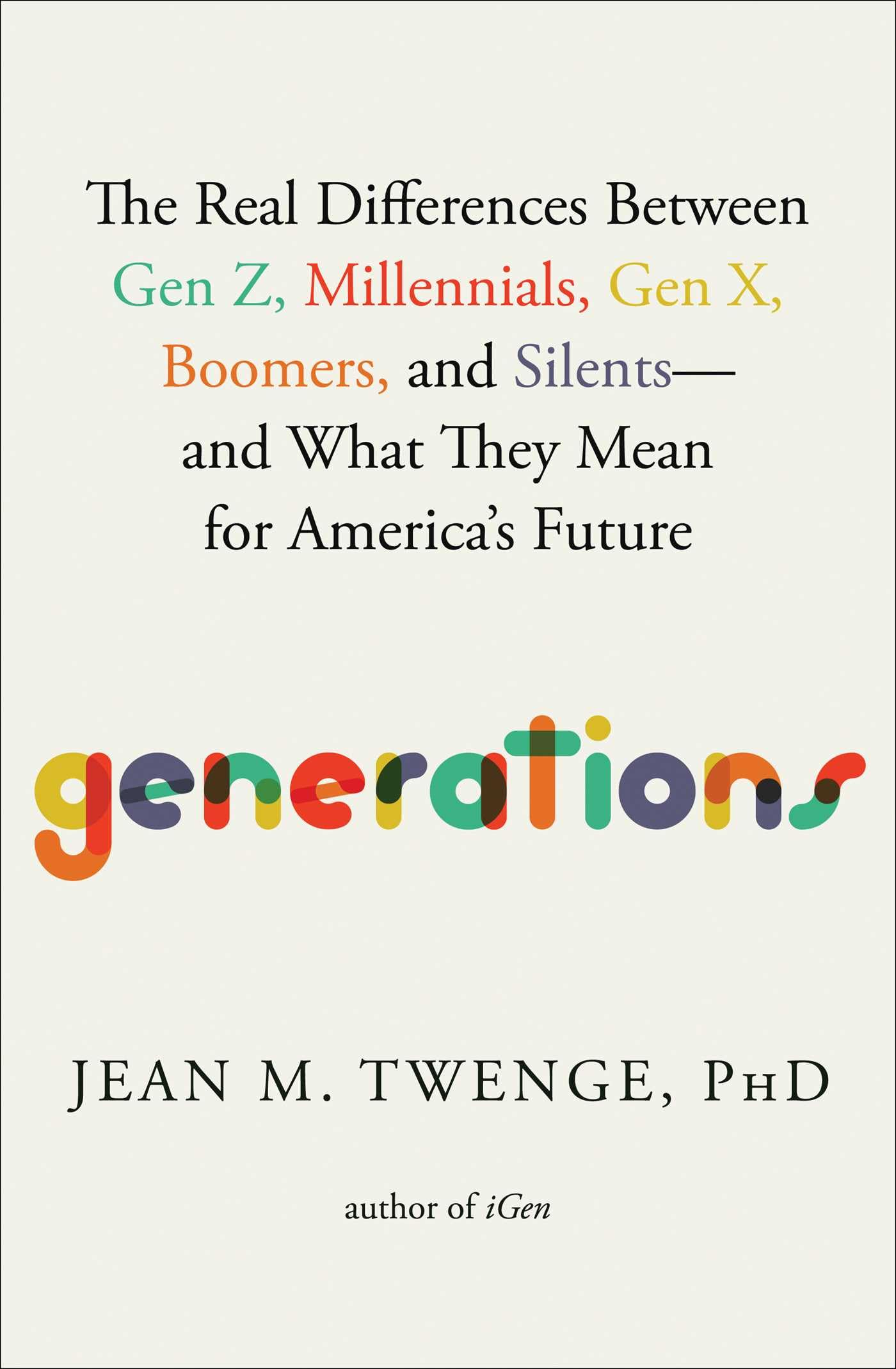
Generations: Eye-opening, Myth-busting, Bridge-Building & Prophetic
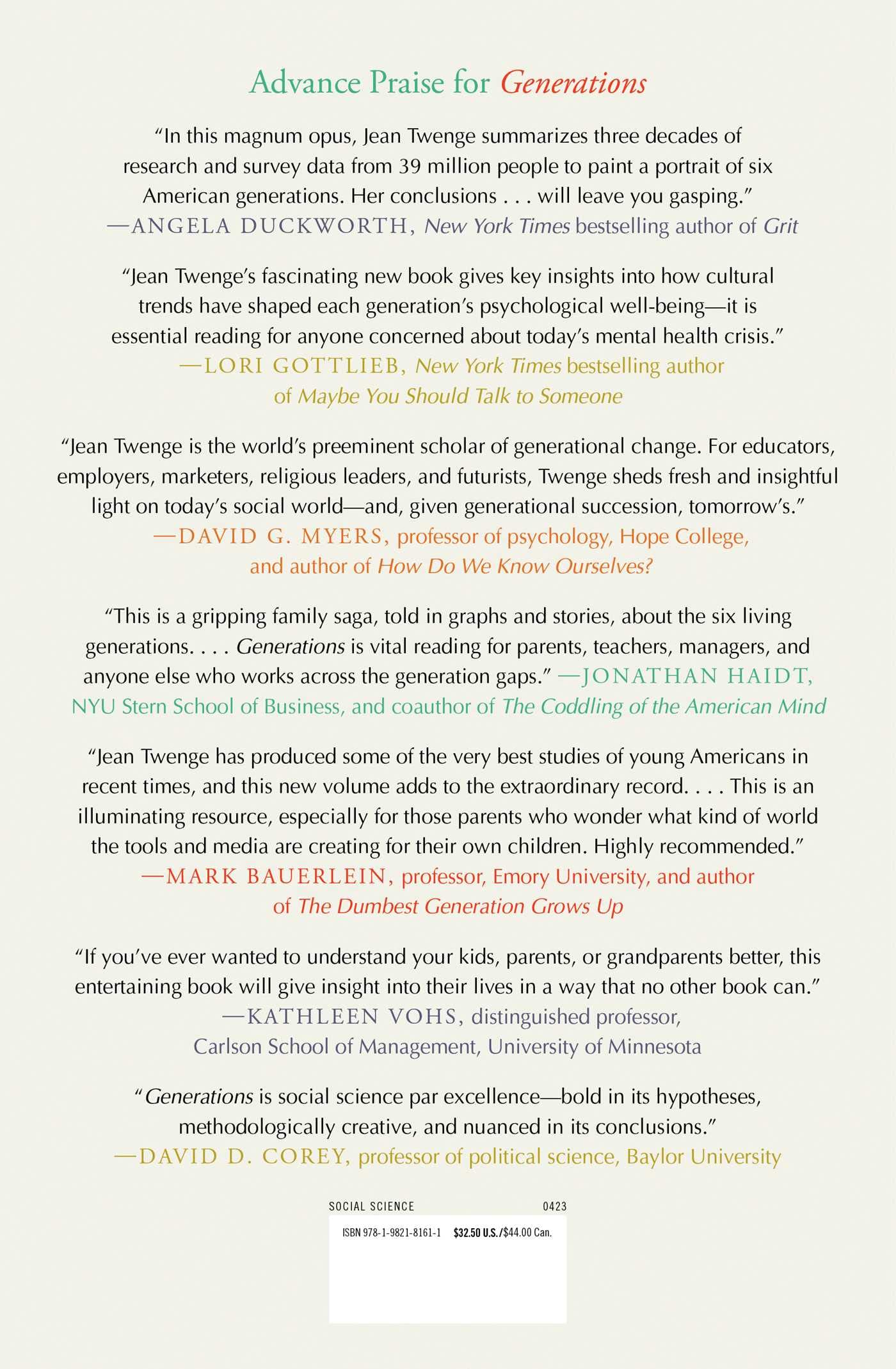
I've long been drawn to books that shed light on differences in human behavior, from personality types to personality disorders. But until recently, I'd never read much on generational differences, as I basically viewed age-group descriptions as stereotypical, divisive, and all too often derogatory. (You know, fodder for auto insurance commercials and the like.) Jean Twenge's Generations set me straight. With an almost dizzying amount generational data, Twenge's work makes it abundantly clear how we -- our attitudes and behaviors -- are profoundly shaped by the times in which we live, the generation with whom we come of age, and the technology on which we come to rely. Covering every generation alive today, she lays out all the differences. This book will benefit any reader of any age, in any field and walk of life. And that may well be an understatement.While Generations is well worth the time, brace yourself for data overload. There's a graph on virtually every page and a tremendous amount of analysis, too. It's what gives this work real weight. But rest assured, the book is no chore to read. To me, it read like a data-infused US history book covering the past 100 years, only better. And with unexpected gifts. The book endeared me to my parents' generation, removed the rose-tinted lens through which I've always viewed my own, and woke me up to the realities, challenges and potential consequences of my daughter's high-tech, social media-driven world. That's no small feat. In many ways, for me, the book wasn't so much a type-caster as a myth-buster and bridge-builder.That's not to say you won't always like what you read. Twenge isn't shy about conveying what she sees as the good, the bad and the ugly in every living generation today -- from the Silents and their Baby Boomer progeny to Gen X, the Millennials, Gen Z and the youngest generation whom she calls Polars (as in polarization and melting polar caps, not bears). If you're like me, you might find yourself peeved and even a little anxious when she describes your generation's issues and shortcomings and relieved when she gets around to its finer attributes. But the big picture she paints with her detailed generational descriptions makes clear that every generation plants the seeds of what sprouts in the next. It's cause and effect, so you'd better pay attention. Major technological advances just keep coming and, as Twenge asserts, they not only shape generations, they define them and perhaps at our peril. After all, technology is always at least one step ahead of its safeguards. (Think of all the lives lost before seat belts and headrests.)In its final section, Generations swings from descriptions to prophecies, offering a wide-angle view of the future, one that touches on everything from birth rates to work life to politics, the economy, technology, mental health and more. Twenge has all the data to back up her crystal ball, and her speculations and insights are not only logical but also riveting and concerning.I highly recommend this work to anyone who wants to better understand their children, parents, grandparents, and peers. But it's also a terrific resource for educators and academics, psychologists, social and political scientists, religious, political and corporate leaders, economists and virtually anyone in the fields of technology, e-commerce, and public policy. City planners and developers will benefit too. It's the rare book that offers something for everyone. And if you're lucky enough to be part of a multigenerational book group, choose it for your next discussion and please invite me. :)
A**N
Must read for understanding the cultural differences among co-living generations
I am reading this book later than I should have but it remains a must read despite being published over a year ago. We live in a time of rapid change in which it seems the rate of change is only increasing with geopolitical breaks as well as rapid advancement in technology improvements. Nonetheless this rapidly changing environment has been taking place for the last 100 years and the consequences can be seen in the vastly different life experiences of the cohabiting generations on the planet. Generations methodically documents both the cultural trends of the various living generations, the events which shaped those generations and their age overlapping differences in measured statistics. It both helps make sense of the divides of today as well as the precursors to the divisions. It is a remarkable book.The frustration with today is not to be disregarded as neo Luddite. The changes in technology for social patterns is both real as well as concerning for its impacts on mental health and community building. These are among the many facts presented in the book to show how age cohorts have been affected by different phenomenon in their upbringing. The author starts with the Silents, a generation who were born through the depression and through WII and ends with the polars, which are born where everyone has a smart phone. To frame things in that high level picture already gives a sense of how much the world has changed in the last 80 years. Nonetheless the book starts with this generation who still dominates much of politics, in particular the senate and presidency. This generation saw significant expansion in political rights and was the one which grew up with much less structure and entered the workforce much earlier. Times were leaner and challenges were more abundant and the Silents were a liberalizing generation but very far from the politics of the left today on many topics. The book moves on to the baby boomer generation, which was the product of the return of soldiers which led to the biggest demographic bulge in human history. This generation has been destabilizing for asset ownership where their lifecycle has witnessed the greatest accumulation of wealth in human history that is largely in their hands and part of the angst of younger generations who psychologically feel that they have less stake in ownership in a capital economy (this is despite their real wages growing and in middle age, higher than the boomer generation). This generation had a broader adoption of college education and growing women's rights as well as focus on more individual rights over collective rights. They were politically active and are also dominant in the senate. But their lives still mimicked the process of the previous generation which included getting married early with conservative values about the family unit. The generation that followed the boomers was Gen X, which included the likes of Elon Musk, Sergei Brin and other tech moguls, this generation had a longer adolescence with many families having both parents work leaving children more unattended. The author argues that this generation grew up slower than before in that more time was dedicated to education but they also had more freedoms than younger generations as parents had more responsibilities away from the family. This generation saw the adoption of the internet in their teens and 20s but grew up with a slower technology speed, largely prior to the home computer being in every home. The author has the next chapter on Millennials which is the longest chapter. Millennials and Gen X have many overlapping qualities but Millennials spend more of their lives saturated with technology with many being born around the launch of the web. This generation too had a longer adolescence, was a proponent of individualism over collective identity. The millennials are now often the CEOs of major tech companies and the prime example includes Mark Zuckerberg but also the likes of Sam Altman. Many of this generation are liberals and have higher education along with a higher earning more equal wage female cohort. The book then moves on to Gen Z which is a generation fully growing up with smartphones and changing social norms. For this generation behaviors are distinctly changing along with gender norms. For most older generations this is hard to understand but the proportion of the population which believes gender is fluid in Gen Z is significant and a source of much friction along with a host of other grievances, many directed towards boomers. Politics is more bifurcated in this generation and more extreme. The author highlights how smartphones and social media has been coincident with these trends and believes them to be causal along with the isolation that has seeped into its usage. What peoples aspirations are has been overly influenced by these platforms to the detriment of setting realistic goals for the individual. This is monitored through statistics on how generations rate themselves with more recent generations having strong and increasing bias to the illusion that they can all be above average. Furthermore objective competition is suppressed for greater inclusiveness giving a false sense of accomplishment in much of the upbringing conditions of this generation. This is also associated with the authors belief that in needing narrower expertise with greater technological change to be useful in the job market, growing up is getting extended and people are protected from the world for longer (with questionable results). Having safe spaces and cancel culture are outgrowths of this culture of believing disagreement doesn't need to be resolved it can be escaped from. The author spends a few pages on the polar generation but being so young this is largely irrelevant.Overall the book does two things of significant value, it describes the conditions under which generations grew up and how that effects their world view and beliefs on cultural norms and it tracks how statistics on well being and other goals have changed through time so that one can measure the effect of these changes on broad categories of livelihood measurement that brings things back to real data. It is really illuminating for these two reasons and gives much food for thought. It is a long book but it needs to be and it was enjoyable throughout. Definitely one of the most important perspectives to consider for framing why there are generation differences, what conditions led to them and is there something to learn about the consequences of technology that should be considered as we continue to roll out more and more products for which there are measurable spillovers into generation behavior.
S**E
Enjoyable read
My parents were Boomers, I'm an X, and my kids are Zs - this book was satisfying 👍.What I found most enjoyable was how much attention was put on Gen Z.I was introduced to this book by an interview the author gave on TV and Generations seemed like it would be a good read. I was glad i got it. No doubt Jean did alot of research and put a ton of energy into real facts instead of opinion. Perhaps a bit of an overkill on the graphs but still made the book unique. I would recommend this book for someone who is interested in knowing more about the different generations and what makes them tick.
Trustpilot
Hace 2 meses
Hace 2 semanas