⚡ Transform your tank, skip the wait, and join the thriving aquatic elite!
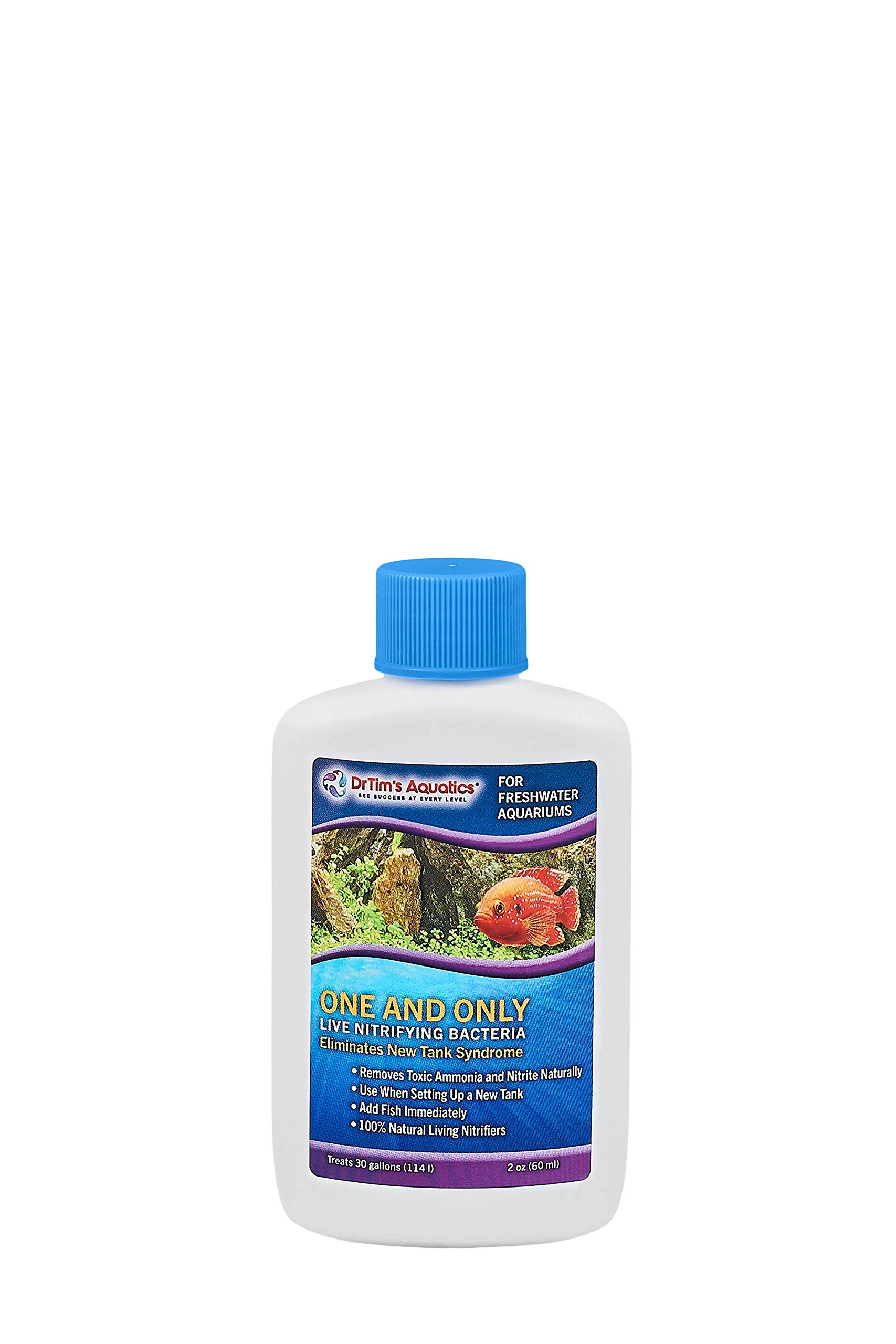
Dr. Tim’s Aquatics Freshwater One & Only is a premium nitrifying bacteria solution designed to rapidly cycle freshwater aquariums by converting harmful ammonia and nitrites into non-toxic nitrates. This eco-friendly, odorless formula treats up to 30 gallons per bottle and is scientifically developed to ensure a healthy, toxin-free environment for fish and aquatic life, reducing new tank syndrome and accelerating tank readiness.


| ASIN | B001LULBXI |
| ASIN | B001LULBXI |
| Best Sellers Rank | #80,772 in Pet Supplies ( See Top 100 in Pet Supplies ) #743 in Aquarium Water Treatments |
| Brand Name | DrTim's Aquatics |
| Color | Freshwater |
| Country of Origin | United States |
| Customer Reviews | 4.5 4.5 out of 5 stars (630) |
| Date First Available | November 21, 2008 |
| Date First Available | November 21, 2008 |
| Directions | Shake well before using. It is best to use the entire contents at one time. Cannot be overdosed. Add directly to the aquaria. Make sure any UV and ozone systems are off for 48 hours after adding. |
| Is Discontinued By Manufacturer | No |
| Item Dimensions LxWxH | 2 x 1 x 4.25 inches |
| Item Package Dimensions L x W x H | 3.74 x 1.34 x 1.26 inches |
| Item Weight | 2.4 ounces |
| Item model number | 0 |
| Item model number | 0 |
| Manufacturer | Dr Tim's Aquatics |
| Manufacturer | Dr Tim's Aquatics |
| Model Name | 000 |
| Number of Items | 1 |
| Product Dimensions | 2 x 1 x 4.25 inches; 2.4 ounces |
| Size | 2 oz - Treats 30 Gallons |
| Specific Uses for Product | Indoor |
| Style | One & Only |
| Target Audience Keyword | algae-eaters, betta-fish, bottom-feeder-fish, cichlid-fish, fish, goldfish, invertebrate-fish, mollusks, octopuses, rays, sharks, snails |
| Warranty Description | None. |
D**B
Awesome!
I cycled a 40 gallon breeder tank using Dr. Tims Nitrifying solution along with his ammonia product. The tank completely cycled in five days as verified with the API master test kit. This is a great product! The fish are thriving in their new home.
S**E
Absolutely Works
Started 3 29 gallon tanks for a research project in biology. Tank 1: Plain Water with ammonium chloride as ammonia source. Tank 2: APIs Quick Start with ammonium chloride as ammonia source. Tank 3: DrTim's One & Only with ammonium chloride as ammonia source. Ammonium Chloride was purchased from Amazon (DrTim's Ammonium Chloride Solution for Fish-less Cycling). Each tank was prepared with a standard dechlorinator (It is important not to use any product that binds or "locks" ammonia, as it is required for the cycle to progress). Water was allowed to rest for 24 hours, filters and heaters running, temps set to 80.5F, 30 LBS of standard gravel in each tank. Each tank received an initial dose of ammonium chloride of 29 drops (one drop per gallon), which raised ammonia to ~2.0 PPM. Caveats: If you use an API test kit, you will likely see about half the expected ammonia concentration. The test is not accurate at low levels, and does not measure the type of source used as well as other master kits. Be concise with the dosing and you are fine. You can use a Nutrifin NH3/NH4 test or other high grade ammonia detection kit that measures NH3 and NH4. Do not adjust water parameters or add water for several days. If you must adjust water parameters, do so slowly. Water should only be added if it has been allowed to rest after 24 hours once treated with dechlorinator. Results at 6 days: Tank 1: Barely detectable amount of ammonia reduction, zero nitrites, zero nitrates. Tank 2: Some reduction in ammonia, zero nitrites, ~20PPM nitrates. Tank 3: .50 PPM Ammonia, zero nitrites, 50 PPM nitrates Tank 3 has had one water change already, and is ready for the second due to rising nitrates. It is processing enough ammonia at this point to equal ~11 inches worth of fish. Ammonia has been added to this tank daily to sustain the cycle, as fish were never going to be introduced. I will be adding fish to this tank however, and reducing ammonium chloride dosing. Decided to keep this tank. Myth 1: There are many posts on the Internet about fish-less cycling. Many of which suggest the use of off-the-shelf ammonia that you find in your local grocery or hardware stores. While some of these sources might be safe, most are not. The ammonium chloride is cheap, and will cycle many, many tanks. Consumers are generally unaware of the fact that not all ingredients need to be listed on products not intended for human consumption. Therefore, they see water and ammonia listed on a label and assume there is no surfactant in the off-the-shelf product. This is simply not the case. Most of these products do in fact contain other ingredients that are not safe for fish, and will destroy the bacteria needed for the aquarium cycle. This can be seen in one of the other reviews. The result was, the tank did not cycle as anticipated. If you want good results and have gone to the expense of purchasing a bacterial additive, spend the extra couple of dollars and get a pure source of ammonia. Myth 2: Some postings on the Internet suggest that these products use terrestrial strains of bacteria. All nitrifying bacteria need soil or other surface. Therefore, all can be considered terrestrial. They are commonly found on the bottom of lakes and streams. Our filters and substrate mimic this environment. While evidence in my experiment suggests that not all products are created equal, some products do work -- and work exceptionally well. Myth 3: The cycle will crash because it isn't the right bacteria. Fact: If the bacteria were unable to sustain, we would not see the substantial growth noted in tank 3. In order for the ammonia to be processes and nitrite to nitrate, a large colony has to exist. Once these bacteria undergo binary fission (how they multiply), there is no logical argument that would support this cycle failing. If you have an environment where they will multiply, that will continue until there is no food source. Any crashing would be the result of that food source not being adequate for the colony. Another possible source of crashing, high nitrates (more than 50-75 PPM) as this will kill the bacteria. It is also possible that once the cycle begins to establish, that the consumer adds too many fish before the colony is large enough to sustain. If you opt for fish-less cycling, use a pure source of ammonia (ammonium chloride). If you opt for fish-in, make sure you do not use an ammonia binding product to dechlorinate the water. Let the water rest for a full 24 hours before you add fish and the product. You may test for ammonia/nitrite/nitrate -- but only adjust your parameters if the results show >2.0PPM Ammonia or >50PPM Nitrate. Other than that, leave it alone for at least a week. If you do need to reduce any of the parameters via a water change (25%), fill your bucket the day before and add your standard dechlorinator to the water and let it rest for a complete 24 hours before adding to the tank. Keep your filters wet at all times (bacteria will die). I consider this product a 5-star purchase. If you have any questions, please don't hesitate to ask.
J**E
A Lifesaver for New Aquariums
Dr. Tim’s Aquatics Freshwater One & Only Nitrifying Bacteria has been a game-changer for my new fish tank. This product has exceeded my expectations in various ways. Setting up a new aquarium can be challenging, especially when you’re trying to establish the right balance of beneficial bacteria. Dr. Tim’s Aquatics One & Only made this process a breeze. It quickly kick-started the nitrogen cycle, allowing me to introduce my fish sooner than I expected. Not only did it facilitate the establishment of a healthy biological filter, but it also acted as a disease treatment. It provides added protection for my fish by removing toxins and promoting water clarity. I particularly appreciate that this product is eco-friendly, which aligns with my commitment to responsible aquarium maintenance. In conclusion, Dr. Tim’s Aquatics Freshwater One & Only Nitrifying Bacteria is an exceptional product for anyone with a new fish tank. It’s efficient, eco-friendly, and a true lifesaver for both your fish and your peace of mind. I highly recommend it for any aquarium enthusiast.
E**L
W Bacteria
Some people are iffy about this because they did it either incorrectly or there was a high chance that the bacteria died during shipping (it can get really hot out there). I left it at room temperature before adding all of it and in a few days I started seeing ammonia go down and nitrite steadily going up over the week. Keep in mind there are factors to play like temperature, decorations and substrate (which help it find a place to colonize) and I didn’t have much so it probably would’ve went faster if I did have more, but this still helped me finally get the cycle start moving so I’m really grateful. My cycle will probably finish sometime this month.
M**D
It didn't start working on few first days until after doing a little bit of research that I realized I needed some nutrients in my tank to provide enough energy for the bacteria to reproduce. The problem is my case was lack of enough phosphorus and magnesium in water. So, check your local water for traces of these elements if your fishless cycle has stuck and then add pinch of ground fish food into your tank in case of lacking of them in your fish tank water. Check your fish food to make sure it has these two before doing so. If you need more information, search for fishless cycle phosphate block and you'll find more information on this.
C**L
Did the job for me 👍
K**R
Arrived safely and quickly
L**.
I tried bac bombs , biological enhancers and all sorts if other stuff whilst emergency cycling with a sick fish .. no2 n 3 n amonia just would not level fast enough . 1 bottle of dr Tims all at once levelled amonia a d no2 to 0 so fast i was amazed they didnt go back up either(make sure you watch the how to use video by dr tim on Youtube). Best stuff ever, will always have a bottle ready to in case of an emergency
M**A
Was told about this ineint use nothing else
Trustpilot
Hace 3 semanas
Hace 2 semanas