Some deliveries may take a little longer than usual due to regional shipping conditions.

Descargar la aplicación


Servicios al cliente
Sobre nosotros
Copyright © 2025 Desertcart Holdings Limited
Descargar la aplicación
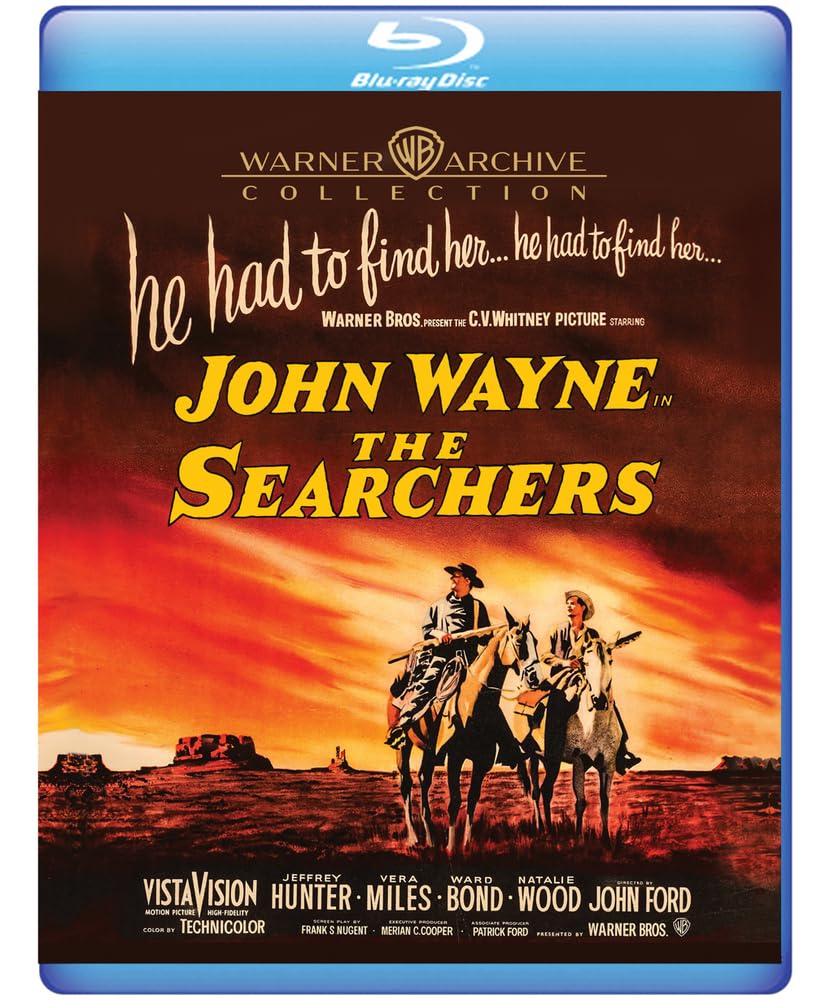
Working together for the 12th time, John Wayne and director John Ford forged The Searchers into a landmark Western offering an indelible image of the frontier and the men and women who challenged it. Wayne plays an ex-Confederate soldier seeking his niece, captured by Comanches who massacred his family. He won't surrender to hunger, thirst, the elements or loneliness. And in his five-year search, he encounters something unexpected: his own humanity. Beautifully photographed by Winston C. Hoch, thrillingly scored by Max Steiner, and memorably acted by a superb ensemble including Jeffrey Hunter, Vera Miles, Natalie Wood and Ward Bond, The Searchers endures as a great film of enormous scope and breathtaking physical beauty (Danny Peary, Guide for the Film Fanatic). Named the greatest American Western by the American Film Institute in 2008, The Searchers was among the first 25 films deemed culturally or aesthetically significant by the U.S. Library of Congress in 1989, when it was inducted in its National Film Registry. Now meticulously restored from its original negative, this new presentation of The Searchers presents this masterpiece with unparalleled image quality, accompanied by an impressive array of special features. Review: A Great Western!!! - One of the best westerns ever made. One of John Wayne's best movies. He should have one an academy award for best actor for his acting here. Review: Somehow This Movie Gets Better Every Year - This is one of those unique films that gets better every year because so many of the most compelling elements of it are contained within the mannerisms of the classic western which have long ago fallen out of both use and popularity. Just as we can no longer grasp the messages contained within the imagery of a medieval cathedral, contemporary audiences have trouble with John Ford's manner of visual story telling which references even older stories. It's even harder for them with his black and white films. Apart from Jeffrey Hunter - the original Captain Kirk - this is Ford's A List troupe of players. Each gives the best performance of their careers. Hank Worden, an actual cowboy and rodeo rider, is wonderful as Mos, the wise man playing the Shakespearean fool. Ward Bond was never better as the preacher and leader of the Texas Rangers: a seamless mixture of piety, bluster, caring and infinite courage. As many have noted, John Wayne delivers a riveting performance as Ethan Edwards, a war veteran who returns a tortured soul with no discernible moral core. Wayne was always underrated as an actor, in large part because most of his roles were so similar. And, on the surface, this at first may seem little different from his role as Thomas Dunson in Howard Hawks' Red River. Oh, but it is, in myriad ways which anticipate an entire generation of western heroes originally made famous by Sergio Leone and the then unknown Clint Eastwood. Yes, the depiction of aboriginal Americans is unusually harsh, especially for a John Ford film. Plus, the notion that captivity by "savages" drove white people insane is pure plot device at odds with the historical record. But this is mythology, in the most powerful sense of the word, not history. This is why the vanishing of the western is particularly sad; it is such a powerful mythological story telling device. Much has been made about the meaning of the final scene. The most moving part is John Wayne holding his left elbow with his right hand. This was the classic gesture of John Wayne's mentor in westerns, Harry Carey Sr., a star of silent movies, and was done in tribute to him. It is said that when his wife, Olive - who plays Mrs. Jorgensen in the movie - saw this, she wept.
| Customer Reviews | 4.7 out of 5 stars 6,825 Reviews |
M**T
A Great Western!!!
One of the best westerns ever made. One of John Wayne's best movies. He should have one an academy award for best actor for his acting here.
J**N
Somehow This Movie Gets Better Every Year
This is one of those unique films that gets better every year because so many of the most compelling elements of it are contained within the mannerisms of the classic western which have long ago fallen out of both use and popularity. Just as we can no longer grasp the messages contained within the imagery of a medieval cathedral, contemporary audiences have trouble with John Ford's manner of visual story telling which references even older stories. It's even harder for them with his black and white films. Apart from Jeffrey Hunter - the original Captain Kirk - this is Ford's A List troupe of players. Each gives the best performance of their careers. Hank Worden, an actual cowboy and rodeo rider, is wonderful as Mos, the wise man playing the Shakespearean fool. Ward Bond was never better as the preacher and leader of the Texas Rangers: a seamless mixture of piety, bluster, caring and infinite courage. As many have noted, John Wayne delivers a riveting performance as Ethan Edwards, a war veteran who returns a tortured soul with no discernible moral core. Wayne was always underrated as an actor, in large part because most of his roles were so similar. And, on the surface, this at first may seem little different from his role as Thomas Dunson in Howard Hawks' Red River. Oh, but it is, in myriad ways which anticipate an entire generation of western heroes originally made famous by Sergio Leone and the then unknown Clint Eastwood. Yes, the depiction of aboriginal Americans is unusually harsh, especially for a John Ford film. Plus, the notion that captivity by "savages" drove white people insane is pure plot device at odds with the historical record. But this is mythology, in the most powerful sense of the word, not history. This is why the vanishing of the western is particularly sad; it is such a powerful mythological story telling device. Much has been made about the meaning of the final scene. The most moving part is John Wayne holding his left elbow with his right hand. This was the classic gesture of John Wayne's mentor in westerns, Harry Carey Sr., a star of silent movies, and was done in tribute to him. It is said that when his wife, Olive - who plays Mrs. Jorgensen in the movie - saw this, she wept.
M**E
The searchers is worth a watch
I am NOT a huge John Wayne lover, but he is perfect for the part he plays in the sagebrush John Ford adventure. Interesting story and well acted and for 1956 taking on a very dicey subject. You can't not love John Fords vista of monument valley and the authentic inter family squabbles.. I have to say almost any John Ford movie is a step above what was been filmed at that time and this one is wonderful.. Great transfer and 4K color correction.
P**R
"As Sure as the Turnin' of the Earth..."
John Wayne, the duke. That really should say it all, but since that probably wont fly, I'll pontificate further. From the opening shot, a door being open and through it seeing the wide, open red desert, you know you're in for an old school western treat. I first saw this film not that long ago, probably around Christmas, 2010. It was AMC, and I decided to sit down with a pizza in the freezing cold and watch it. I was, to say the least, AMAZED. At sixteen, I'd never really seen a John Wayne film, as sad as that is, its true. My dad's always been a huge fan, but I was never able to get into the old westerns, that is, until I saw this one. Wayne's performance as the bigoted Ethan reminded me so much of the people I'd see and meet, hard shelled, soft centered. A real anti-hero, and a fabulous performance. I live in California by the way, Central Valley, Nor Cal, and what I mean by him reminding me of people I know if, is well, some of my fellow Caucasians are well-meaning morons, I've been around many that just constantly insult the Hispanic population around here, which just makes them dislike us in general even more, a vicious cycle if there ever was one. Anyway, I could relate to the young character of Martin, perhaps the moral character of the story, trying to hold back the old ways, trying to keep justice from becoming in-justice, just faced in the opposite direction. The characters all seem so real, even after fifty years, and many changes in the styles of film acting, John Wayne still holds his ground for me. And I have, yes, grown to love many a John Wayne film, from Rio Bravo to The Sons of Katie Elder, is, most definitely, in my top twenty favorite actors. The story itself revolves around Ethan and Martin trying for over ten years to find a girl who was kidnapped by a group of Comanche, who also slaughtered and raped the girls parents and siblings. The real greatness of this film is the interactions between Wayne and Jeffery Hunter(Martin), and how, at the end of the film, Wayne's character, Ethan, does change into a better, less bigoted and prejudiced man. The only thing that I could see from the film that could have been better, or perhaps just enhanced the film, would be the final act, I felt like it ended too quickly and happily, though I think it DOES work, I almost do wish that it ended more grimly, and that the film had more of the somber elements that are found through out, but, as it lies, it is a grand and wonderful film.
C**S
Love vs. Hate, Hope vs. Despair
The word masterpiece gets thrown around a lot. However, one measure of artistic greatness is the ability for a work of art to communicate different things to different people at different times. When viewed in this way, it is hard to imagine The Searchers as anything but a masterpiece. I first saw this movie when I was about 13 or 14 years old on cable television. At that time, it seemed like a good western yarn set in Texas with John Wayne as the stereotypical protagonist riding off in the sunset, presumably, to kiss his horse. Indeed, Wayne has some awesome one-liners in this move. Phrases like "Not hardly" and "That'll be the day" are the ideological grandfathers of todays "Make my day, punk" or "I'll be back". As you may know (and other reviewers have pointed out), "That'll be the day" inspired the Buddy Holly song of the same name. Years later, this viewer was able to see deeper meanings in this morality tale. Ultimately, this tale is not about Ethan Edwards versus the Comanche. Rather, the true conflict is between Martin Pauley (Jeffrey Hunter) and Ethan Edwards (John Wayne). While there are whole levels of analysis about the Indians and their role in society as portrayed in the movie, they are, on some level, merely the prop (the gizmo in the box) that create the reason for the conflict of wills between Ethan and Marty. Who is Ethan Edwards? He is a character shrouded in mystery. Speaking fluent Comanche and possessing a deep understanding of their religion, culture, and lifestyle, he is for some unexplained reason filled with bitter, psychotic all-consuming hatred for all Indians, but especially Comanche. This is true even before they kill his brother's family and kidnap his two nieces. We learn this when Moses Harper talks about the Indians not missing Ethan while he was away during the Civil War. There is a strong emotional tension between Ethan and his brother's wife. One can clearly see the emotion in her eyes when Ethan returns from the Civil War and when she sends him off to take part in the hunt for rustlers/Indians who have stolen Jorgensen's cattle. Ethan seems to have an estranged relationship with his brother, offering to pay him for staying at his farm. One can only assume that Ethan had a relationship at some point with his brother's wife. Was Ethan at some point a captive of the Comanche? In that absence did the woman he loves marry his brother? Also, why did Ethan wait three years after the end of the Civil War to return home? Where did he get the large stockpile gold, unmarked and uncirculated "Yankee" gold coins? It is clear from his comments to the Reverend/Captain Clayton that Ethan considers the Civil War still ongoing and, indeed, when we first see Ethan, he is still wearing his uniform. Ethan further states that he doesn't believe in surrenders and he still feels his oath to the Confederacy still binding. Has he been fighting some sort of one man guerrilla war against the Union Army, attacking the wagon trains that supply the distant Forts in the West - they often had newly minted gold to pay soldiers? Did he return home because he was tired of fighting or does he intend to renew his relationship with his brother's wife? We will never know because within a day of his return home, his brother, his brother's wife, and nephew are killed by a Comanche raiding party. His two nieces are kidnapped, one dying shortly thereafter when she is presumably raped by the raiding party. Ethan becomes, if he wasn't already, obsessed with revenge. He sets out on a never ending quest to kill all Comanche to include, and especially, his niece who he believes will become more Indian then white and must be destroyed. Marty (Jeffrey Hunter) is motivated by love. Love for his adopted family. Love for life. His only desire is to find his adopted sister and free her from the Indians. One reviewer described Marty as being reasonable, but in his own way he is as obsessed as Ethan. He turns down personal wealth, not once but twice, to stay with Ethan as they hunt for the girl. The first time is when Ethan offers to let him oversee his cattle and work with Jorgensen. The second is when Ethan offers to make him a beneficiary in his will tacitly recognizing that his niece, Marty's adopted sister, is dead. Additionally, Marty risks losing the love of his life by staying on this seemingly never ending quest. Jeffery Hunter looks like a little boy, perhaps baggy wardrobe helped a bit here, next to the swaggering Wayne. His inexperience and relative physical weakness cause one to wonder how he can hope to prevail in this unrelenting battle of wills. This story ends in a way which is guaranteed to touch your heart. On a side note, while many reviewers have commented on image quality issues with this movie, this is the first time that Monument Valley was filmed in color. It is simply breath taking. This alone is worth the price of the DVD. In conclusion, there are layer after layer of stories wrapped into this excellent film. Not only is this movie appropriate for the whole family, it has themes and sub-plots that mean almost anyone can find something to like.
R**A
A Classic for All Time
The Searchers cast John Wayne in a role that was a bit different from many of his other roles on film, but it resulted in a superb film that has become the all time great Western movie. This film was made in the era when political correctness was not recasting history into something that never existed. A lone rider approaches a remote homestead in the American Southwest in 1868 where the only true love of Ethan still lived with his brother and his family scratching a living from the cruel desert raising cattle. Ethan quickly reveals himself to be a bitter, hard man from his Civil War service as a Confederate soldier. He also reveals himself to be highly prejudiced against Indians, but his prejudice is borne from sad experience as he reveals his knowledge of Indian culture and especially murder raids. When his brother and his family are massacered by raiding Indians, it was discovered his two neices were kidnapped by the Indians. An enraged Ethan sets out to trail the Indians and make sure his nieces were not allowed to become part of the tribe life. Ethan grudgingly lets a young man played by Jeffrey Hunter who raised by his brother's family and was with Ethan investigating an Indian raid to accompany him on his quest for vengeance. Thus began a tale of trailing the Indians who had his niece over a period of several years with Ethan being obsessed with finding and killing his niece rather than letting her be raised as an indian. The Searchers was most appropriate as a title for the move. There are many tense moments as well as humorous times as the tale unfolds and the wanderings of the two men is narrated by Jeffrey Hunter. Ultimately, the two men catch up with the tribe and the planned retribution is at hand. Can Ethan really kill his niece? The end scene to this movie has been called one of the very best in all of movie making. I have watched this film so many times I can't count them. Anyone who has not seen this movie yet will have missed an incredibly exciting and well made story. This is film making like it should be. The best part is that there is no foul language of any kind during the entire film.
M**G
What is Ethan Really Searching For and What Does he Find?
One of the reasons that The Searchers stands out so prominently in my mind and heart, like those soaring and almost achingly beautiful monoliths in Monument Valley, is because of what it has taught me about understanding and cherishing my own humanity, and how denying the humanity of other human beings really just degrades the degrader. Upon seeing the movie again several years ago, I realized the importance for the first time of the fact that John Wayne's character, Ethan, came to the West after having fought as a rebel officer in the Civil War. That his commitment to fighting for the South had more to do with racism than state's rights becomes evident as soon as Native Americans enter the picture, especially as murderers of his kin and kidnappers of his young relative, Debby (played later in the movie by Natalie Wood). This terrible event, and others in the movie, seems to justify and fuel his racism and propel and maintain him on his five-year search to find and destroy both Scar, the Comanche leader who led the raid, and Debby -- whom he now considers on a par with the Native Americans, as being less than human and not worthy of life itself. But then there's Marty, Debby's mixed-blood brother and Ethan's companion and conscience on The Search, a figure about whom Ethan has great ambivalence, simultaneously tolerating and reviling him. I think Marty represents both a wall and a bridge between Ethan and his lost humanity, symbolized by Debby. A wall, because he physically stands between Ethan and Debby when Ethan pulls out his gun to kill her when they finally meet. A bridge, because Marty's stubborn love for his sister, his willingness to put his life on the line for her, and NOT a burning hatred for the Comanche, finally forces Ethan to fully acknowledge Marty's humanity despite his mixed blood (a change of heart that Ethan demonstrates by willing his possessions to Marty). And in granting Marty's humanity, he ultimately crosses the bridge and acknowledges Debby's humanity; when Ethan finally has the chance to kill her, he embraces her instead and takes her home. What Ethan has found, what he has recovered, is not just a young relative who has been through great separation and pain, but his own humanity. The brilliant and iconographic final scene of the movie, with Ethan standing in the doorway of the homestead and then walking away, alone, always left me moved, but unsatisfied. I didn't want Ethan to be alone now that he was whole again. But, then again, his being whole is the central point, not his being alone. Rather than feeling frustrated by his apparent return to solitude, I finally realized that it was fitting: as Ethan now addresses himself to the world as a complete human being, he may fight again, but never on the side of the dehumanizers. He has finally left his racism behind, just as he left his rebel uniform behind. In closing, I was reminded of The Searchers when I read an article recently about military chaplains. I had always assumed that they were there to somehow bless the violent proceedings, to symbolize that "God is on our side." But that's not how they saw it. As a group, they saw their mission as being to preserve the humanity of the men and women in their charge -- a key part of which was asserting the humanity of the enemy. One told of walking by two pilots talking about taking out "targets." He stopped and asked if the "targets" were people. When the pilots nodded "Yes," he said "And don't you forget it." I bet that chaplain just might be a fan of The Searchers...
R**N
Watching The Searchers During The Pandemic
I have been using the stay at home time resulting from the pandemic to watch several classic American westerns. The genre was highly popular through the 1950s, fell out of favor in the 1960s, and have experienced a renewal of interest of late. The best of these films, together with novels in the western genre, may help Americans think about and learn something of their country during these difficult times. "The Searchers" is a 1956 film directed by John Ford and starring John Wayne as Ethan Edwards, a Confederate veteran, a loner, and a wanderer who returns to the west Texas home of his brother and family in 1868. The film was successful upon its release and in the following years it achieved near-iconic stature. It is routinely included on lists of best westerns and best films. I don't remember seeing the film before watching it during the pandemic. The film immediately makes clear the abrasive, harsh character of Ethan Edwards. The Confederate veteran is unrepentant, ornery, quick with his fists and with insults, and most apparently, a racist in his attitude towards Indians. Immediately upon his return home, a group of Comanche Indians burn his brother's home to the ground killing the family with the exception of the two daughters, Lucie and Debbie (played by Natalie Wood) who are abducted. Edwards and a young man, Martin Pawley, (Jeffrey Hunter) are away at the time as the Indians have attempted to divert attention from their planned homestead burning by stealing a neighbor's cattle. Pawley has been raised by Edwards' family and has Indian blood. He becomes subject to Ethan's prejudice and ridicule. When Ethan and Pawley return, they and others in the community organize a search party to punish the Indians and to recover the young girls, if possible. The rest of the film focuses on the search, which becomes a five-year quest throughout the southwest by Edwards and Pawley. Edwards is more than willing to go on the search alone but reluctantly accepts Pawley's company. Pawley feels responsible for his adopted sisters and, more importantly, fears that Edwards will harm the girls when he finds them. Strong feelings of rape and of white women keeping company with Indian men pervade the film. The cinematography of the film is extraordinary in showing the expanse and beauty of the American West and in encouraging a love for the land. The story of the search has an immediacy to it over the long years and is easy to follow. The film is highly problematic in the questions it raises about racism and in the relationship between the settlers and the Indians. Ethan Edwards is in many respects shown throughout much of the movie as a highly flawed, biased individual. I was first puzzled and intrigued and then moved by this film. With the stature "The Searchers" has come to enjoy, the film has provoked a great deal of commentary. I took the opportunity to read some of the accessible comments to supplement watching the film. Many viewers still critique the film for what they see as its overt racism towards the Comanche. Other acknowledge the racism but find that the film itself critiques it and that Ethan Edwards gradually changes during the five year search shown in the film. The high regard in which the film is held should not blind the viewer to its ambiguities. Especially at the outset, the film may be disturbing in the attitudes of Ethan Edwards and, to a degree, of most of the other settlers. I found the movie worked for me in part because it is ethically problematic and encourages reflection by its viewers. In addition to the relationship between the settlers and the Indians, the film explores the life of a loner and probably an outlaw in the settlement of the west, as exemplified by John Wayne's character, and juxtaposes it with the path towards settlement and community. The story of the development of a common life, as compared to the life of a wandering loner, is a strong theme of the film. The cinematography and the ever-present music add to the passion this film encourages for the country. Lists of the best films, or the best of anything, have little significance. "The Searchers" both moved and troubled me. For those at home during the pandemic, watching "The Searchers" is an excellent use of time. Robin Friedman
Trustpilot
Hace 3 semanas
Hace 1 mes