We remain fully operational. Our teams are working around the clock to ensure your deliveries continue safely.

Descargar la aplicación


Servicios al cliente
Sobre nosotros
Copyright © 2025 Desertcart Holdings Limited
Descargar la aplicación
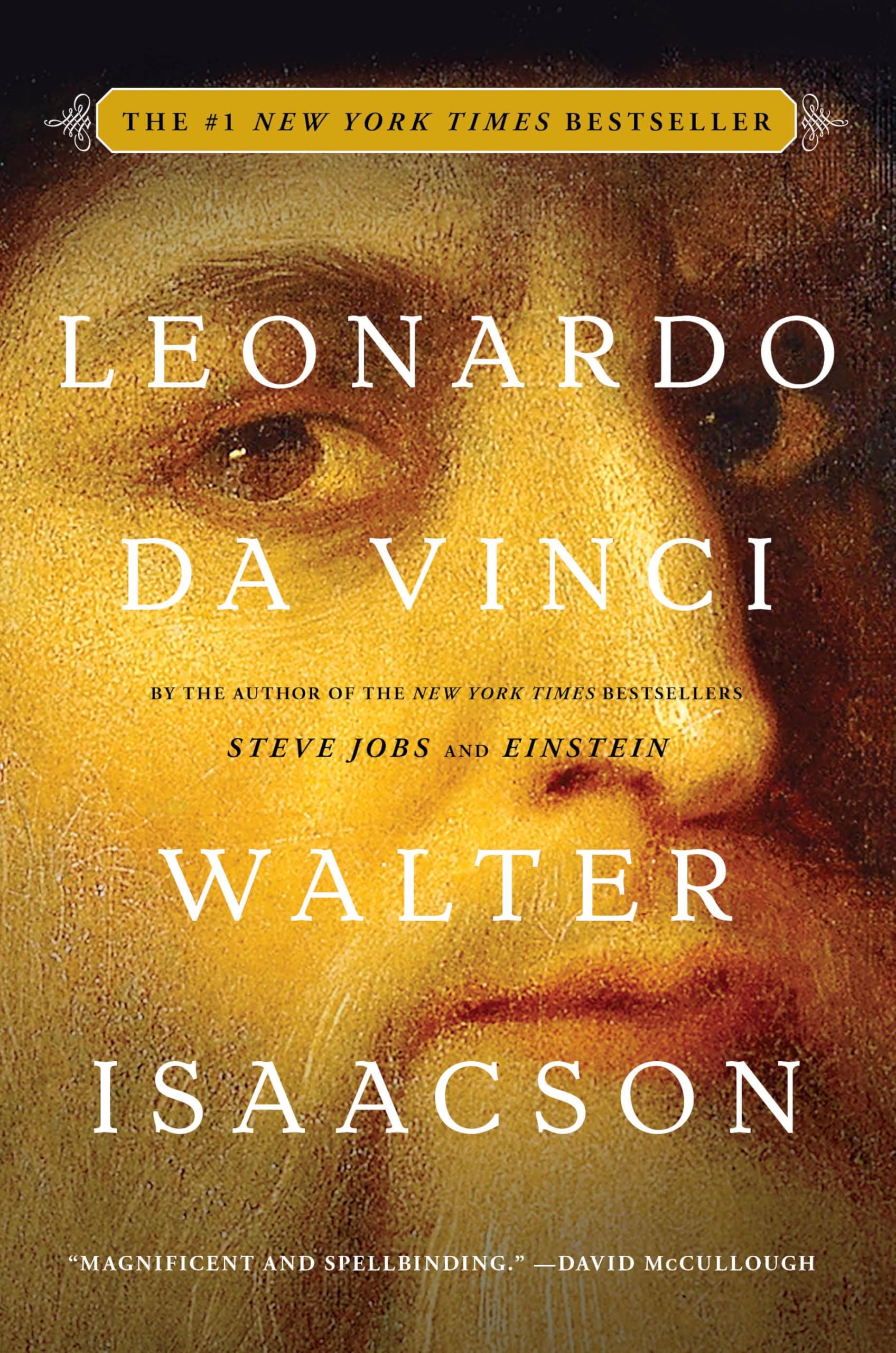
desertcart.com: Leonardo da Vinci: 0001501139169: Isaacson, Walter: Books Review: An excellent biography that will also help you think more like Leonardo - I didn’t buy this book because I was fascinated by Leonardo. I bought it because several people whose opinions I value said it was a great book and because the other books I’ve read by Walter Isaacson were excellent. I’m glad I bought it and read it. Before I started reading, I thought I knew the basics. Leonardo was the painter of perhaps the two most famous paintings in history: The Last Supper and the Mona Lisa. I had that right. But most of the rest of what I thought I knew turned out to be either wrong or incomplete. The man certainly was a creative genius, but a lot of the things that I’d read about him, like that bit about the “first helicopter,” turned out to be wrong. I didn’t know how much he did beyond painting and how deep he went on so many topics. Leonardo was certainly the prototype of the Renaissance Man, and looking back, we can see that he was born at the right time for someone with broad interests and many talents. Leonardo was born in 1452 and died in 1519. That gave him a long, productive life of 67 years. He was a bastard, which wasn’t a problem in Florence when he was born and may even have given him some advantages. He didn’t get a lot of formal schooling, which meant that he started to learn on his own and developed methods that worked for him. He started out in Florence, where he was apprenticed to an excellent master, and learned the craft of painting. But early in his life, he moved to Milan. That turned out to be a good thing, too. Florence was more artistic, but Milan had a much more diverse culture of people interested in the sciences. And it was in the sciences and engineering that Leonardo would do a lot of work I knew nothing about and now shake my head at, in wonder. Leonardo’s work in science included the development of thinking on perspective. I always thought perspective was a kind of geometric thing about painting. But it turns out that he developed three views of perspective. One was the standard vanishing point thing, but the others were the way color changes as distance increases, and the way that we lose detail on things the further they are away. He made contributions to anatomy by doing dissections of cadavers of both humans and animals. He certainly learned from his dissections, and he also captured what he observed in drawings and notes. He may have made even more contributions to engineering. He did a lot of military engineering, and a lot that revolves around water flows, including water systems for cities and diverting rivers. By the time I got to the end of the book, it seemed like Leonardo had done some work in almost any area of human knowledge. Not all of that work was great, or groundbreaking, but an awful lot of it was. So, the question is, how did he do it? That’s where I got my biggest takeaways from the book. Leonardo was very smart. Okay, we got that out of the way. Most of the people we call geniuses are very smart. But there are an awful lot of very smart people who aren’t geniuses. What really separates geniuses from the rest of the pack is what they do, not raw brainpower. The good news is that we have a pretty good idea of what Leonardo did. Isaacson developed his book primarily from the 7,000+ pages we have from Leonardo’s notebooks. That’s a lot, but it’s probably only about a quarter of the total he created. Here’s what Leonardo did to produce the quantity of quality insight and production that characterized his life. Leonardo captured his ideas. Early in his life, he developed a habit of walking around with a notebook that he used to jot down observations and make quick sketches. He even developed a shorthand that would help him recreate things he’d seen when he got back to his studio and wanted to draw them in detail. Leonardo was an acute observer who trained himself to be better. It helped that he was also a facile drawer. But the main driver of his close observations was curiosity. He developed his own process for observing things. It began with what Isaacson calls “marching orders.” Leonardo described what he needed to do to learn or properly observe something. Then he would go and observe. Leonardo learned by experimenting. Besides observing, Leonardo was an avid experimenter and he recorded both the experiments and what he learned from them. Leonardo got ideas and sharpened ideas through his reading. The printing press was invented the year Leonardo was born. By the time he was 40, books were increasingly common, and an autodidact like Leonardo could learn and get ideas from books. Leonardo had many friendships and collaborators over the years. This was not the lone genius retiring to his studio and producing bursts of insight. This is a man who went out into the world to observe, made careful observations, and then hone his understanding with reading, discussion, and experiment. Isaacson includes a final chapter in the book about things you can learn from Leonardo, and it’s a chapter worth reading. But there’s a statement of Isaacson’s near the beginning of the book that sums up the takeaway for me. “His genius was of the type we can understand, even take lessons from. It was based on skills we can aspire to improve in ourselves, such as curiosity and intense observation.” And, I would add, experiment and collaboration. Before you read the book straight through, read that final chapter about what you can learn from Leonardo. It will give you a frame for learning as you go. In A Nutshell This is a thorough and well-written biography of one of history’s most fascinating individuals. You’ll enjoy the read. You’ll learn a lot. With a little effort, you can improve the way you see the world and develop some discipline so that you can be more like Leonardo than you are today. Review: ‘Despite his immersion into science, Leonardo developed a deepening appreciation for the mystery of our place in the cosmos’ - “Despite his immersion into science, or perhaps because of it, Leonardo had developed an ever-deepening appreciation for the profound spiritual mystery of our place in the cosmos. And as Kenneth Clark noted, “Mystery to Leonardo was a shadow, a smile and a finger pointing into darkness.” (6917) This tension between science and religion was developing, adapting and producing the Renaissance. This work seems closer to a biography of this new world. Leonardo is the perfect one to highlight, even lead the way out of the medieval world. Issacson connects Columbus and Amerigo Vespucci and the drama of this epoch. For example, this list at the beginning . . . Cesare Borgia (c. 1475–1507). Italian warrior, illegitimate son of Pope Alexander VI, subject of Machiavelli’s The Prince, Leonardo employer. Donato Bramante (1444–1514). Architect, friend of Leonardo in Milan, worked on Milan Cathedral, Pavia Cathedral, and St. Peter’s in the Vatican. Caterina Lippi (c. 1436–1493). Orphaned peasant girl from near Vinci, mother of Leonardo; later married Antonio di Piero del Vaccha, known as Accattabriga. Francis I (1494–1547). King of France from 1515, last patron of Leonardo. Pope Leo X, Giovanni de’ Medici (1475–1521). Son of Lorenzo de’ Medici, elected pope in 1513. Louis XII (1462–1515). King of France from 1498, conquered Milan in 1499. Niccolò Machiavelli (1469–1527). Florentine diplomat and writer, became envoy to Cesare Borgia and friend of Leonardo in 1502. Lorenzo “the Magnificent” de’ Medici (1449–1492). Banker, art patron, and de facto ruler of Florence from 1469 until his death. Francesco Melzi (c. 1493–c. 1568). From a noble Milan family, joined Leonardo’s household in 1507 and became a surrogate son and heir. Michelangelo Buonarroti (1475–1564). Florentine sculptor and rival of Leonardo. Salai, born Gian Giacomo Caprotti da Oreno (1480–1524). Entered Leonardo’s household at age ten and was dubbed Salai, meaning “Little Devil.” Ludovico Sforza (1452–1508). De facto ruler of Milan from 1481, Duke of Milan from 1494 until his ouster by the French in 1499, patron of Leonardo. Nevertheless, the psychological/philosophical analysis is abundant. For example . . . “This echoed what Plato had written in the Timaeus, where he argued that just as the body is nourished by blood, so the earth draws water to replenish itself. Leonardo also drew on theorists of the Middle Ages, in particular a compendium by the thirteenth-century Italian monk and geologist Restoro d’Arezzo. As a painter who marveled at nature’s patterns, Leonardo embraced the microcosm-macrocosm connection as more than merely an analogy. He viewed it as having a spiritual component, which he expressed in his drawing of Vitruvian Man.’’ This profound spiritual/philosophical connection to ancient and medieval thinkers explains much of Leonardo’s decisions . . . “As we have seen, this mystical connection between humans and the earth is reflected in many of his masterpieces, from Ginevra de’ Benci to Saint Anne to Madonna of the Yarnwinder and eventually the Mona Lisa. It also became an organizing principle for his scientific inquiries. When he was immersed in his anatomical research on the human digestive system, he instructed himself, “First give the comparison with the water of the rivers; then with that of the bile which goes to the stomach against the course of the food.” Not a modern connection. Kindle includes four page time line with many color reproductions of his paintings with notes showing other events at that time. Excellent! This work closer to a scholar’s essay than a biographical novel. Focuses on analysis of Leonardo’s work and activity, almost overshadowing the man, but, nevertheless, he does come across. Issacson regularly cites other biographies, some centuries old, and other modern. The sometime contrasting opinions add depth and color. Upon finishing, I felt I had a good understanding of Leonardo, the man - world class procrastinator, openly gay, insatiably curious, driven to perfection, with a marvelous synthesis of the artistic and scientific. Along with this, more insight into the Italian Renaissance - controlling power of the elite, waning influence of the church, increasing influence of Greek philosophy, etc.. Reader needs serious interest and determination to tackle the detailed, extensive presentation. However, the writing and tone is easy to follow and clearly done.


| Best Sellers Rank | #4,942 in Books ( See Top 100 in Books ) #1 in Biographies of Artists, Architects & Photographers (Books) #1 in Historical Italy Biographies #10 in Scientist Biographies |
| Customer Reviews | 4.5 out of 5 stars 11,160 Reviews |
W**K
An excellent biography that will also help you think more like Leonardo
I didn’t buy this book because I was fascinated by Leonardo. I bought it because several people whose opinions I value said it was a great book and because the other books I’ve read by Walter Isaacson were excellent. I’m glad I bought it and read it. Before I started reading, I thought I knew the basics. Leonardo was the painter of perhaps the two most famous paintings in history: The Last Supper and the Mona Lisa. I had that right. But most of the rest of what I thought I knew turned out to be either wrong or incomplete. The man certainly was a creative genius, but a lot of the things that I’d read about him, like that bit about the “first helicopter,” turned out to be wrong. I didn’t know how much he did beyond painting and how deep he went on so many topics. Leonardo was certainly the prototype of the Renaissance Man, and looking back, we can see that he was born at the right time for someone with broad interests and many talents. Leonardo was born in 1452 and died in 1519. That gave him a long, productive life of 67 years. He was a bastard, which wasn’t a problem in Florence when he was born and may even have given him some advantages. He didn’t get a lot of formal schooling, which meant that he started to learn on his own and developed methods that worked for him. He started out in Florence, where he was apprenticed to an excellent master, and learned the craft of painting. But early in his life, he moved to Milan. That turned out to be a good thing, too. Florence was more artistic, but Milan had a much more diverse culture of people interested in the sciences. And it was in the sciences and engineering that Leonardo would do a lot of work I knew nothing about and now shake my head at, in wonder. Leonardo’s work in science included the development of thinking on perspective. I always thought perspective was a kind of geometric thing about painting. But it turns out that he developed three views of perspective. One was the standard vanishing point thing, but the others were the way color changes as distance increases, and the way that we lose detail on things the further they are away. He made contributions to anatomy by doing dissections of cadavers of both humans and animals. He certainly learned from his dissections, and he also captured what he observed in drawings and notes. He may have made even more contributions to engineering. He did a lot of military engineering, and a lot that revolves around water flows, including water systems for cities and diverting rivers. By the time I got to the end of the book, it seemed like Leonardo had done some work in almost any area of human knowledge. Not all of that work was great, or groundbreaking, but an awful lot of it was. So, the question is, how did he do it? That’s where I got my biggest takeaways from the book. Leonardo was very smart. Okay, we got that out of the way. Most of the people we call geniuses are very smart. But there are an awful lot of very smart people who aren’t geniuses. What really separates geniuses from the rest of the pack is what they do, not raw brainpower. The good news is that we have a pretty good idea of what Leonardo did. Isaacson developed his book primarily from the 7,000+ pages we have from Leonardo’s notebooks. That’s a lot, but it’s probably only about a quarter of the total he created. Here’s what Leonardo did to produce the quantity of quality insight and production that characterized his life. Leonardo captured his ideas. Early in his life, he developed a habit of walking around with a notebook that he used to jot down observations and make quick sketches. He even developed a shorthand that would help him recreate things he’d seen when he got back to his studio and wanted to draw them in detail. Leonardo was an acute observer who trained himself to be better. It helped that he was also a facile drawer. But the main driver of his close observations was curiosity. He developed his own process for observing things. It began with what Isaacson calls “marching orders.” Leonardo described what he needed to do to learn or properly observe something. Then he would go and observe. Leonardo learned by experimenting. Besides observing, Leonardo was an avid experimenter and he recorded both the experiments and what he learned from them. Leonardo got ideas and sharpened ideas through his reading. The printing press was invented the year Leonardo was born. By the time he was 40, books were increasingly common, and an autodidact like Leonardo could learn and get ideas from books. Leonardo had many friendships and collaborators over the years. This was not the lone genius retiring to his studio and producing bursts of insight. This is a man who went out into the world to observe, made careful observations, and then hone his understanding with reading, discussion, and experiment. Isaacson includes a final chapter in the book about things you can learn from Leonardo, and it’s a chapter worth reading. But there’s a statement of Isaacson’s near the beginning of the book that sums up the takeaway for me. “His genius was of the type we can understand, even take lessons from. It was based on skills we can aspire to improve in ourselves, such as curiosity and intense observation.” And, I would add, experiment and collaboration. Before you read the book straight through, read that final chapter about what you can learn from Leonardo. It will give you a frame for learning as you go. In A Nutshell This is a thorough and well-written biography of one of history’s most fascinating individuals. You’ll enjoy the read. You’ll learn a lot. With a little effort, you can improve the way you see the world and develop some discipline so that you can be more like Leonardo than you are today.
C**R
‘Despite his immersion into science, Leonardo developed a deepening appreciation for the mystery of our place in the cosmos’
“Despite his immersion into science, or perhaps because of it, Leonardo had developed an ever-deepening appreciation for the profound spiritual mystery of our place in the cosmos. And as Kenneth Clark noted, “Mystery to Leonardo was a shadow, a smile and a finger pointing into darkness.” (6917) This tension between science and religion was developing, adapting and producing the Renaissance. This work seems closer to a biography of this new world. Leonardo is the perfect one to highlight, even lead the way out of the medieval world. Issacson connects Columbus and Amerigo Vespucci and the drama of this epoch. For example, this list at the beginning . . . Cesare Borgia (c. 1475–1507). Italian warrior, illegitimate son of Pope Alexander VI, subject of Machiavelli’s The Prince, Leonardo employer. Donato Bramante (1444–1514). Architect, friend of Leonardo in Milan, worked on Milan Cathedral, Pavia Cathedral, and St. Peter’s in the Vatican. Caterina Lippi (c. 1436–1493). Orphaned peasant girl from near Vinci, mother of Leonardo; later married Antonio di Piero del Vaccha, known as Accattabriga. Francis I (1494–1547). King of France from 1515, last patron of Leonardo. Pope Leo X, Giovanni de’ Medici (1475–1521). Son of Lorenzo de’ Medici, elected pope in 1513. Louis XII (1462–1515). King of France from 1498, conquered Milan in 1499. Niccolò Machiavelli (1469–1527). Florentine diplomat and writer, became envoy to Cesare Borgia and friend of Leonardo in 1502. Lorenzo “the Magnificent” de’ Medici (1449–1492). Banker, art patron, and de facto ruler of Florence from 1469 until his death. Francesco Melzi (c. 1493–c. 1568). From a noble Milan family, joined Leonardo’s household in 1507 and became a surrogate son and heir. Michelangelo Buonarroti (1475–1564). Florentine sculptor and rival of Leonardo. Salai, born Gian Giacomo Caprotti da Oreno (1480–1524). Entered Leonardo’s household at age ten and was dubbed Salai, meaning “Little Devil.” Ludovico Sforza (1452–1508). De facto ruler of Milan from 1481, Duke of Milan from 1494 until his ouster by the French in 1499, patron of Leonardo. Nevertheless, the psychological/philosophical analysis is abundant. For example . . . “This echoed what Plato had written in the Timaeus, where he argued that just as the body is nourished by blood, so the earth draws water to replenish itself. Leonardo also drew on theorists of the Middle Ages, in particular a compendium by the thirteenth-century Italian monk and geologist Restoro d’Arezzo. As a painter who marveled at nature’s patterns, Leonardo embraced the microcosm-macrocosm connection as more than merely an analogy. He viewed it as having a spiritual component, which he expressed in his drawing of Vitruvian Man.’’ This profound spiritual/philosophical connection to ancient and medieval thinkers explains much of Leonardo’s decisions . . . “As we have seen, this mystical connection between humans and the earth is reflected in many of his masterpieces, from Ginevra de’ Benci to Saint Anne to Madonna of the Yarnwinder and eventually the Mona Lisa. It also became an organizing principle for his scientific inquiries. When he was immersed in his anatomical research on the human digestive system, he instructed himself, “First give the comparison with the water of the rivers; then with that of the bile which goes to the stomach against the course of the food.” Not a modern connection. Kindle includes four page time line with many color reproductions of his paintings with notes showing other events at that time. Excellent! This work closer to a scholar’s essay than a biographical novel. Focuses on analysis of Leonardo’s work and activity, almost overshadowing the man, but, nevertheless, he does come across. Issacson regularly cites other biographies, some centuries old, and other modern. The sometime contrasting opinions add depth and color. Upon finishing, I felt I had a good understanding of Leonardo, the man - world class procrastinator, openly gay, insatiably curious, driven to perfection, with a marvelous synthesis of the artistic and scientific. Along with this, more insight into the Italian Renaissance - controlling power of the elite, waning influence of the church, increasing influence of Greek philosophy, etc.. Reader needs serious interest and determination to tackle the detailed, extensive presentation. However, the writing and tone is easy to follow and clearly done.
D**R
informative but not captivating
Good overview of Leonardo’s life, but somehow this biography didn’t captivate me. Will read some other books on Z Leonardo to see if other approaches are better.
R**S
da Vinci He Be Duh Man
The Smartest Person Who Ever Lived By Bob Gelms In my “it does not count” opinion, the smartest person who ever lived was, unquestionably, Sir Isaac Newton. An awful lot of people disagree with me. The preponderance of their opinions puts Leonardo da Vinci in the number one spot. For the purposes of this issue we will confine our investigation to da Vinci as number one. Mostly because America’s number one biographer, Walter Isaacson, has just published Leonardo, the best biography I have ever read on Leonardo da Vinci. When I was in 4th grade in St. Thomas Moore grade school on the south side of Chicago, we had a series of biographies written for grade school kids. Most of the series was taken up with the saints. They had, however, a few biographies of famous people in history. The bookcase that housed this series was right next to my desk. One day, as was usual, I was bored so I reached over and pulled out the book on da Vinci. It didn't take long before I was hooked. The term “Renaissance Man” was new so I asked the kindly, ever so patient, Dominican nun who was only interested in the welfare and intellectual growth of her students. (sarcasm) She pronounced it for me and told me what it meant. Up to that point in my life it, for sure, was the coolest thing I had ever heard. From that point on I was fixated on Leonardo da Vinci. There were a lot of surprises in store for me because the biography I read in that Catholic grammar school of course didn’t mention that da Vinci was vegetarian, gay, illegitimate, left-handed, a heretic who produced some of the finest religious paintings in history and the world’s leading procrastinator. When I heard that Walter Isaccson was publishing a new biography, Leonardo, my first thought was, “Does the world really need ANOTHER biography of Leonardo da Vinci? After all there are only about 32,000 of them!” My second thought was that if there was any writer who could bring something fresh, exciting, and surprising to the subject of da Vinci's life, it was, without a doubt, Walter Isaccson. Mr. Isaccson does not shy away from difficult subjects. He has written about Steve Jobs, Albert Einstein, and Benjamin Franklin. His biography of Leonardo da Vinci is dazzling. In Leonardo, Mr. Isaccson gives us a superb scrutiny of of the master's paintings. It is to our everlasting benefit that the author seems to possess an extraordinarily discerning eye for these works in addition to an erudite mind capable of critical analysis. This brings a whole new aspect to the career of Leonardo da Vinci. According to Mr. Isaccson, da Vinci looked at the world around him and saw that everything was related to everything else, something of a theme during the High Renaissance. Da Vinci, however, took it to regions unknown. For example, he didn’t see that there was much of a difference between science and art or between art and the study of nature. All you need to get an idea of the relationship between art and science is to take a look at his breathtaking rendition of Vitruvian Man. The sensitive viewer will see a spectacular work of art but also the ideal of human proportions and geometry. Sfumato is a painting technique invented by da Vinci to give depth to the edges of his subjects. It gives a sense of three dimensions. Coupled with the glazes he used, he got that smoky hazy feeling that seems to pervade his paintings. Mr. Isaccson points out that da Vinci got this effect by carefully smearing the paint. It has been thoroughly documented that on a few of his works, Leonardo da Vinci inadvertently left his fingerprints, which have been used to confirm that he painted a few that weren’t, at first, attributed to him. This book is filled with little gems like that. The amount of detail Mr. Isaccson provides is prodigious. Buy Leonardo, if for no other reason than to read the chapters on the Mona Lisa and The Last Supper. They are just riveting and well worth the price of admission. I can’t fit all of da Vinci's interests in this review but the eminent art historian Kenneth Clark’s comment on Leonardo da Vinci seems to encapsulate his whole personality. Clark called him, “the most relentlessly curious man in history.”
S**E
A REMARKABLE BIOGRAPHER CHRONICLES A GENIUS
Walter Isaacson, a scholar and well-regarded biographer, has written a definitive study of the world’s most iconic figure, “Leonardo da Vinci.” It has been widely hailed as “a study in creativity,” “vigorous, insightful,” “a masterpiece,” and “luminous.” Great complements but, of course, they’re about the writer and his product, not Leonardo. I believe that Isaacson has tackled a huge topic and assert he has nailed it, considering the information, scant and effusive, available to him. Leonardo did not leave behind much about his personal life although he wasn’t a mysterious man. His life was fairly open, he was gregarious and generated many friends, and he wasn’t secretive about personal details of his romantic inclinations. But the notebooks, maps, paintings, drawings, and never-ending doodles, and everything else that remains, present a maddening array of stuff to delve through to quantify and catalog his being. I doubt that any other human has been so expansive with the products of his mind. He was quite simply a fountain of knowledge, ideas, thoughts, and interests. He was only intent on having his work involving machines, weapons, city designs, anatomy, geometric patterns, eddies, swirls, curls, scientific notions, botany, painting and art, music, and other esoteric musings be noted and, where possible, produced. The fact is, however, that because his mind was divided into so many deep and heavily absorbing sectors, much was delineated but very little was actually produced. Giorgio Vasari, a contemporary painter, made this early tribute to Leonardo. ”Occasionally…a single person is marvelously … endowed with beauty, grace and talent in such abundance that he leaves other men far behind… Everyone acknowledged that this was true of Leonardo da Vinci…who cultivated his genius so brilliantly that all problems he studied he solved with ease.” And so we are left with a tremendous amount of material from the mind of a genius but few physical manifestations of an end product. Even his paintings, magnificent and highly valued, are very few in number. He seldom finished anything he started. So it is not surprising that personal revelations stay mostly uncovered because they were simply not important enough for him to consider bringing them to light. Isaacson does his best to give us some personal insight and what he does reveal is interesting. But the real story of the remarkable man is the depth of his mind and talent, elements caught in extraordinary intricacy by the author. Read everything you can find from Isaacson. His biographies of important people are illuminating. You won’t become a Leonardo with the insight you gain, but you probably will be a more intelligent person. Schuyler Wallace Author of TIN LIZARD TALES
A**R
A Rich detail of Da Vinci, Deepening the Mystery.
Issacson managed to journey into a feverish domain of curiosity bringing perspective to the man behind the veil. It turns out he gets bigger, when you fall back, more complex as you dial in, more brilliant, more varied, more troubled, more sensitive and extraordinary than anyone could have imagined. The story congeals in the perfectly curated quotes selected by the author , peeled from the obscure margins of Da Vinci's notebooks to highlight greater truths. For instance, a comment presenting a theory on the craft of painting, becomes a way to perceive the workd. I've devoured everything I could find on Leonardo since I was a child, and it gets more intriguing. There are people who spend their lives studying the man, and I'll wager the best of Da Vinci historians we're knocked sideways by his scope when Issacson offered this take. Vasari's accounts somehow still need to be used as a disclaimer for poor academic practice, but further examination comfirms that his hyperbole may be understated. Issacson just made it clear that he's as deep as the deepest ocean, and as lovely too. Issacson is such a gifted biographer and storyteller, yet this brings him into new territory as an author. It's by a long mile his finest writing, and such a fitting portrait for Leonardo in the 21st century. To do this subject justice, and inspire us with Da Vinci's story was a Herculean effort. He managed to do it! It's not as if there's was a new trove of material unearthed to cast more light on the world's most beloved genius. Issacson found a way. He clearly worked his ass off. He tells this story with tenderness and deft clarity. The writing is elegant and suspenseful. He draws you in with a brief quaint scene in Italy. A young precocious Leonardo enjoying the company of his lazy uncle in their modest country home; WHAM... he's growing up, absorbing everything around him, faster and faster, he's muddling but growing, and ravenous for knowledge, accelerating in skills and synthesizing them into new one's, seeing into worlds beyond his time, and further still, into our present, and again beyond in insights. You think there's relief but Da Vinci is still going, his ideas still skating and sketching the fabric of the unknown. Leonardo has a spark that never went out. Hundrerds of years later he is inspiring innovations in art and science and all the while breaking down the illusion that they are separate. Thank you Walter Issacson for breathing life into the man. Thank you Leonardo Da Vinci for still filling me with such wonder.
M**E
Repetitive and overly detailed book that detracts from rather than adding to an appreciation of one of history's great geniuses
Although Isaacson's writing style is clear, and the book is exhaustively researched, giving great insight into Da Vinci's life, I cannot give it more than three stars because it is also tediously repetitive. Many of the topics he covers - such as Da Vinci's painting style, his personality (including his inability to finish commissioned works), the way he delved into human anatomy, his insights into the portrayal of movement - all of these and more were described, described again, and then redescribed several times over throughout the book. This is a 500+ page book that, with good editing, could have been cut down to 300 pages without any loss of important material. Yet at the same time, while dwelling on Da Vinci's clear genius as an individual, the book fails to provide any real depth about how Da Vinci's work fit into the society and culture of his era. Isaacson presented some basic material but not nearly enough to clearly connect Da Vinci to the times he lived in. At the end I was left thinking that rather than being a general interest book, this volume would work better as a text for a university-level art history class. The brush-stroke by brush-stroke analysis Isaacson presents in his discussions of Da Vinci's major paintings might be of great interest to students of his art, but as an enthusiastic reader of history and biography, I found such technical deconstruction to be distracting at best and boring at worst.
J**E
Helpful Info on Isaacson's "Leonardo"
STRENGTHS: ~Physically, this is a beautiful book. The high quality paper make the book impressively heavy, but the printed images do great justice to Leonardo's art--as just as you can get in a book. ~Biographically, this book is well-researched and well-written. This is the goal of the book, to give you, the reader, an insight into Leonardo's life and genius. WEAKNESSES: ~For as big as a book as this is, I thought there would be more about the politics of the Italian city-states. The Medici, Sforza and Borgia are all included in this story, but they're peripheral rather than contextual. The historical background of 15C Europe I felt could have been enhanced. But maybe that's been done enough and Isaacson simply wanted to give his treatment of Leonardo a different focus. WEAKNESS AND/OR STRENGTH?! ~Lots of art history! Why is this book so gosh darned long? Well, every work of art that Leonardo made is given a comprehensive evaluation. Quite simply, you may love that, or hate it. Personally, I enjoyed it. But, it's a bit like being in the Louvre: when you have all this incredible art, how can you possibly appreciate it all? However, this quality can make the book a good research tool if you just want to read about one of Leonardo's works. THE AUDIOBOOK: ~A PDF of all the images in the physical book are likewise included with the Audible book. So, don't worry those of you who prefer to listen to the book! I both listened and read, and it was fun for me to listen to the book, as the narrator read Isaacson's descriptions of Leonardo's works, while I could look and study each in real-time with the book. That was quite an enjoyable experience!
Trustpilot
Hace 1 mes
Hace 1 mes