We remain fully operational. Our teams are working around the clock to ensure your deliveries continue safely.

Descargar la aplicación


Servicios al cliente
Sobre nosotros
Copyright © 2025 Desertcart Holdings Limited
Descargar la aplicación
Buy anything from 5,000+ international stores. One checkout price. No surprise fees. Join 2M+ shoppers on Desertcart.
Desertcart purchases this item on your behalf and handles shipping, customs, and support to Panama.
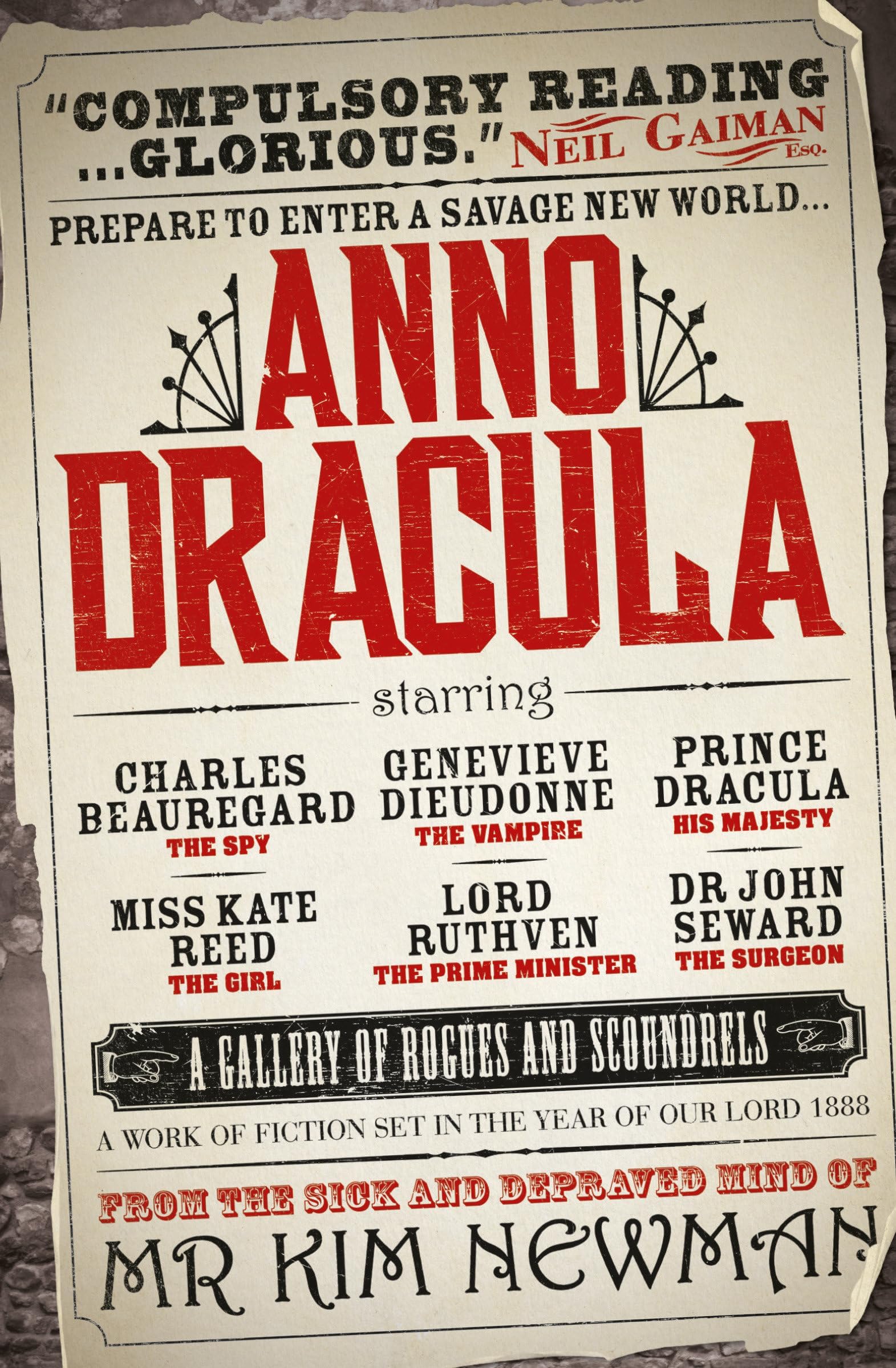
desertcart.com: Anno Dracula: 9780857680839: Newman, Kim: Books Review: Anno Dracula (Titan Books edition) - There are books one simply shouldn't attempt to describe to the casual reader; regardless of merit, they sound not just uninteresting, but deeply silly. In eighth grade I was reading Harry Turtledove's Worldwar tetralogy, and a well-meaning classmate mentioned to our history teacher that I was reading a book about World War II. I was left to explain, "Yes, it's an alternate history where World War II is underway... and then aliens invade." Mercifully, I've forgotten what Mr. Dennett's reaction was. The other day I was in the car, reading the new edition of Kim Newman's landmark vampire alternate history Anno Dracula, and I happened to read a passage out to my mother. (For readers familiar with the book, it was the exchange of insults in the pub.) She asked what the book's premise was, and I dutifully replied: "Well, it's like Dracula, except Dracula wins and he marries Queen Victoria." Mother was not amused. I suppose it does sound ridiculous, but it isn't really. Dracula was a prince, and his ambitions were not small; had he not been defeated by Van Helsing's merry band, he might well have ingratiated himself with the British royal family, and the consequence would have been the world Newman portrays: a country where vampires have emerged into everyday life, where the best way to advance in high society is to "turn" and vampire-resisters are dragged off to concentration camps, where the prostitutes of the East End are as likely to offer blood as sex. Unless they're vampires themselves. The story around which Newman's evocation of this alternate England is woven is the author's second quirky stroke of genius: Jack the Ripper is active in this world as well, but all his victims are vampires. The police, urged on by the government, are desperate to find this madman and potential folk hero, and so is the Diogenes Club, a secretive organization devoted to the national interest. The Club's agent, Charles Beauregard, finds himself working alongside the centuries old vampire Geneviève to find the Ripper. But their investigation is complicated by the sheer range of suspects, not to mention a vendetta against Geneviève and an increasingly repressive palace regime. As one might expect, the characters of the novel include several from Dracula-- those, at least, who have survived, including Dr. Seward and Arthur Holmwood. But other Victorian and Edwardian literature is amply represented. One of the police detectives is Inspector Lestrade, while two doctors consulted about the murderer's knowledge and motivations are named Jekyll and Moreau. Vampires from other fiction have flocked to England for safety and freedom. Readers who don't like this sort of cameo appearance are advised not to read Anno Dracula, which is littered with them. For those who enjoy the game of tracking down references, there are plenty of semi-obscure names to identify. Historical figures, from Oscar Wilde to Sir Charles Warren, also appear. But the novel is much more than a complicated game of Where's Waldo. Its world-building, in which real-world issues like sodomy raids and child prostitution are given a vampire twist, is ingenious enough, but it also includes vivid action sequences, intricate political intrigue, and a well-thought-out investigation. The Ripper's identity (itself a brilliant notion) is revealed to the reader early on, turning the book into a howcatchem rather than a whodunit, but allowing a powerful, disturbing insight into the killer's motivations. Anno Dracula is a fast-paced, delightful entertainment, a marvel of storytelling for those who like this sort of thing. The book, first published in the 1990s, has long been out of print, but was recently released in a new edition by Titan Books. In addition to the original text, the new edition includes a number of bonus features: annotations by the author, identifying some of the more obscure references; an afterword on the novel's genesis; an excerpt from the novella "Red Reign," which preceded the novel and has a slightly different ending; extracts from Newman's unproduced screenplay for a film version, which includes a few new sequences and some altered characters; "Drac the Ripper," an essay on other Ripper/Dracula stories; and "Dead Travel Fast," a short story featuring Dracula that, while not formally part of the Anno Dracula universe, could fit into it, and is in any case a sharp, nasty piece dealing with a less-appreciated trait of the vampire. I mention the Anno Dracula universe. Newman followed the original novel with two sequels: The Bloody Red Baron, set during World War I, and Dracula Cha Cha Cha (released in the US under the dull title Judgment of Tears), set in the 1950s. A fourth novel, Johnny Alucard, bringing the series into the present day, has long been in the works. Titan Books now plans to publish the entire series. Anno Dracula came out this month; The Bloody Red Baron (containing a never-before-published novella) will follow in October 2011, while Dracula Cha Cha Cha (with another new novella) will appear in April 2012 and Johnny Alucard in October 2012. Fans of Wold Newton-esque vampire fiction have much to look forward to. Review: What if Dracula took over the English throne? - This is the first book in a series, and it was so much fun. Imagine if Van Helsing and his cadre hadn't won over Dracula, and then the count goes on to marry queen Victoria and thereby taking over England. In this world, vampire Genevieve and her human companion Charles Bauregard team up to solve the Jack the Ripper murders. Sounds insane, but it works. This is a great book filled with references to history and literature.
| Best Sellers Rank | #357,514 in Books ( See Top 100 in Books ) #104 in Vampire Horror #5,381 in Paranormal Fantasy Books #15,577 in Suspense Thrillers |
| Customer Reviews | 4.2 out of 5 stars 1,417 Reviews |
B**Y
Anno Dracula (Titan Books edition)
There are books one simply shouldn't attempt to describe to the casual reader; regardless of merit, they sound not just uninteresting, but deeply silly. In eighth grade I was reading Harry Turtledove's Worldwar tetralogy, and a well-meaning classmate mentioned to our history teacher that I was reading a book about World War II. I was left to explain, "Yes, it's an alternate history where World War II is underway... and then aliens invade." Mercifully, I've forgotten what Mr. Dennett's reaction was. The other day I was in the car, reading the new edition of Kim Newman's landmark vampire alternate history Anno Dracula, and I happened to read a passage out to my mother. (For readers familiar with the book, it was the exchange of insults in the pub.) She asked what the book's premise was, and I dutifully replied: "Well, it's like Dracula, except Dracula wins and he marries Queen Victoria." Mother was not amused. I suppose it does sound ridiculous, but it isn't really. Dracula was a prince, and his ambitions were not small; had he not been defeated by Van Helsing's merry band, he might well have ingratiated himself with the British royal family, and the consequence would have been the world Newman portrays: a country where vampires have emerged into everyday life, where the best way to advance in high society is to "turn" and vampire-resisters are dragged off to concentration camps, where the prostitutes of the East End are as likely to offer blood as sex. Unless they're vampires themselves. The story around which Newman's evocation of this alternate England is woven is the author's second quirky stroke of genius: Jack the Ripper is active in this world as well, but all his victims are vampires. The police, urged on by the government, are desperate to find this madman and potential folk hero, and so is the Diogenes Club, a secretive organization devoted to the national interest. The Club's agent, Charles Beauregard, finds himself working alongside the centuries old vampire Geneviève to find the Ripper. But their investigation is complicated by the sheer range of suspects, not to mention a vendetta against Geneviève and an increasingly repressive palace regime. As one might expect, the characters of the novel include several from Dracula-- those, at least, who have survived, including Dr. Seward and Arthur Holmwood. But other Victorian and Edwardian literature is amply represented. One of the police detectives is Inspector Lestrade, while two doctors consulted about the murderer's knowledge and motivations are named Jekyll and Moreau. Vampires from other fiction have flocked to England for safety and freedom. Readers who don't like this sort of cameo appearance are advised not to read Anno Dracula, which is littered with them. For those who enjoy the game of tracking down references, there are plenty of semi-obscure names to identify. Historical figures, from Oscar Wilde to Sir Charles Warren, also appear. But the novel is much more than a complicated game of Where's Waldo. Its world-building, in which real-world issues like sodomy raids and child prostitution are given a vampire twist, is ingenious enough, but it also includes vivid action sequences, intricate political intrigue, and a well-thought-out investigation. The Ripper's identity (itself a brilliant notion) is revealed to the reader early on, turning the book into a howcatchem rather than a whodunit, but allowing a powerful, disturbing insight into the killer's motivations. Anno Dracula is a fast-paced, delightful entertainment, a marvel of storytelling for those who like this sort of thing. The book, first published in the 1990s, has long been out of print, but was recently released in a new edition by Titan Books. In addition to the original text, the new edition includes a number of bonus features: annotations by the author, identifying some of the more obscure references; an afterword on the novel's genesis; an excerpt from the novella "Red Reign," which preceded the novel and has a slightly different ending; extracts from Newman's unproduced screenplay for a film version, which includes a few new sequences and some altered characters; "Drac the Ripper," an essay on other Ripper/Dracula stories; and "Dead Travel Fast," a short story featuring Dracula that, while not formally part of the Anno Dracula universe, could fit into it, and is in any case a sharp, nasty piece dealing with a less-appreciated trait of the vampire. I mention the Anno Dracula universe. Newman followed the original novel with two sequels: The Bloody Red Baron, set during World War I, and Dracula Cha Cha Cha (released in the US under the dull title Judgment of Tears), set in the 1950s. A fourth novel, Johnny Alucard, bringing the series into the present day, has long been in the works. Titan Books now plans to publish the entire series. Anno Dracula came out this month; The Bloody Red Baron (containing a never-before-published novella) will follow in October 2011, while Dracula Cha Cha Cha (with another new novella) will appear in April 2012 and Johnny Alucard in October 2012. Fans of Wold Newton-esque vampire fiction have much to look forward to.
J**Y
What if Dracula took over the English throne?
This is the first book in a series, and it was so much fun. Imagine if Van Helsing and his cadre hadn't won over Dracula, and then the count goes on to marry queen Victoria and thereby taking over England. In this world, vampire Genevieve and her human companion Charles Bauregard team up to solve the Jack the Ripper murders. Sounds insane, but it works. This is a great book filled with references to history and literature.
J**E
A gloriously ambitious mashup of literature and history that works, against all odds, like gangbusters
There is no logical reason that Anno Dracula should work, honestly. To call Anno Dracula “overly ambitious fan fiction” wouldn’t seem like a bad idea, based off of the description of the novel. After all, this is a book in which Bram Stoker’s Dracula ascends to the British throne by marrying the Queen, resulting in the emergence of vampires out of the shadows. Oh, and it also means that Bram Stoker has been arrested for trying to write the book – which is better than what happened to Abraham van Helsing. But not content with just writing a sequel to Dracula, Newman turns Anno Dracula into a positive maelstrom of cultural, literary, and social references, with Sherlock Holmes (and his brother Mycroft, as well as more than a few other Holmesian supporting characters), the good doctors Moreau and Jekyll, Gilbert and Sullivan characters, opera icons – oh, and Jack the Ripper, of course. Indeed, it’s such a dense web of allusions both fictional and factual that this anniversary edition has a multi-page guide to some of the more obscure ones after the book ends. And yet, not only does Anno Dracula succeed, it’s an absolute blast of a book, focusing on telling a great story rather than just playing an elaborate game of “spot the reference”. Using the Ripper’s crimes as a framework, Newman dives deeply into his alternate history, exploring how Victorian England might have shifted with the introduction of vampires, diving into the mythology of vampires (as well as the politics, given that they might not all be fans of the famed Count), exploring how class politics might change with the possibility of “turning”, and more. Rather than just telling a simple vampire story, in other words, Newman builds a whole alternate universe, and takes his time exploring it, following every small change and watching as it ripples outward, and investing us in disputes ranging from paid murder to broken engagements. More than that, Newman invests us in his characters, letting the sides of his book be populated with the allusions and giving us his own original takes for our heroes (and some of the villains). From the outwardly mild-mannered Charles Beauregard (who covertly works for Conan Doyle’s infamous Diogenes Club) to Newman’s fascinating elder vampire Genevieve Dieudonne (older, indeed, than Dracula, and somewhat disgusted by the violence and depravity of the Count), Newman doesn’t just create an interesting, rich world; he gives us characters that we enjoy and care about, and makes their stories every bit as important as the macro story going on behind them. Indeed, despite the title, Dracula himself is barely in the book as a character, instead mainly working as scene-setting – although his eventual appearance is well worth the wait. Yes, Newman has some great ideas about vampires (my favorite is the “murgatroyds,” vampires who wear capes and act like, well, stereotypical vampires in an effort to appear fashionable); yes, his use of the Ripper makes for a great hook for the book, particularly with the identity of the Ripper in the novel and his motivations. But more than anything else, every single page of Anno Dracula is just dripping with imagination and surprises. From obscure allusions to surprising cultural shifts, from character evolutions to horrific violence, Anno Dracula is, first and foremost, a fantastic piece of storytelling. I got swept up into this ambitious, wonderful world, and I’m glad to know that Newman kept it going – I’m guessing that he’s like me, and just didn’t want to have to leave it.
T**2
Really neat ideas.
It's difficult for me to give a complete yea or nay with this one. It is an enjoyable read in certain ways, but I felt like it fell short of being as good as maybe it could have been. I thought it was a very creative and colorful novel, and the author is very well-informed about the Victorian period and Gothic literature in general. Kim Newman really does throw everything but the kitchen sink into this book. You meet all of the colorful and interesting characters, both real and fictitious, from the late 1800s, and they are integrated into the story quite well. This would also be a fun book for amateur and professional ripperologists, as the plot does concern Jack the Ripper. Overall it's a great book, and I think anybody into fantasy and alternate history type of stuff can't help but be amused by it. Where it falls a little flat for me is that I just didn't really feel attached to any of the characters. Other people will obviously feel different, and this may be an issue of different styles resonating better with different people. I may give the next one in the series a go at some point, because I am a little curious. So overall I would say it's a fun read, but to me it felt more like an interesting tour of ideas and famous Gothic characters in a kind of 'what if' situation without a lot of gripping character development, which is not mainly the kind of thing that interests me. It may be of great interest to others.
R**T
Fun read
Imagine what would happen in Victorian England if Dracula defeated Van Helsing. That is the setting for this epic tale of vampires being integrated into society and humans being called the warm ones. There is mystery, murder, and the romantic idea of the dark kiss....which it turns out, isn't the glamorous life it promises to be. Once you get past the set up of numerous characters (be patient, it's worth it) you are pulled into the dramatic action. I thoroughly enjoyed this beautifully written story and look forward to reading the full series.
B**Y
Hey, look! Alternate History plus monsters before it was a trend!
Premise: What if Dracula didn't lose. What if his bid to settle in England was successful? What if he then - a prince of Transylvania, after all - married Queen Victoria? This is the story of a very different history. I really enjoyed this book, despite a few glaring plot holes. Dracula's rise to power, for example, is generally glossed over. All the things that follow from that: social positions of prominent vampires, rebellions, etc. work well from the premise, but how exactly he managed to get there is left a bit fuzzy. This was mostly only a problem at one point, when you see Dracula in person, that how he became so powerful became hard to picture for me. Luckily the rest of the book is simply lovely. The assortment of characters is delightful for those of us who like to play "spot the reference": some are original, some from history, some from literature. The main plot follows the hunt for Jack the Ripper. The Ripper, like in our world, murders prostitutes. The catch is that these are vampire prostitutes. So is he crazy or fighting back against the spread of vampirism? Are those the same thing? It doesn't actually take long for the book to tell you the identity of the killer, so most of the story is figuring how and when the other characters will catch on, and what will happen then. The two main characters are quite charming, and carry much of the appeal of the book. Charles Beauregard is a young gentleman, still human to the dismay of much of his social set. He is affable, but with hidden depths, and is an agent of a particular club of unclubbable gentlemen. His relationship with his troubled fiancee is one of the more important emotional plotlines. Geneviève Dieudonné I adored. She is a vampire, but of a different line than Dracula. She is older than he is, and has complicated feelings about the fact that Dracula's rise is making vampirism socially desirable in London. She's practical while still occasionally romantic. There are an assortment of intriguing supporting characters and the period setting is quite well done, including an unpleasant darkness in some of the characters that many novels I read set in the time would have elided. Overall, a satisfying historical supernatural read.
S**R
A Great Book for Fans of Dracula
This book is excellent, and not just for people that love a metric ton of references to other works, and "alternate history" stories. I truly believe that it stands well enough just in the category of a follow-up to Bram Stoker's Dracula, and if you just really loved Dracula, you should like this book a lot. First of all, it's extremely well-written, so even the parts of the book that drag a bit are satisfying to read. If you DO happen to be a massive literary, history, or vampire fiction fan, you'll smirk and chuckle at innumerable references to other works, but honestly, the way Kim Newman handles the Prince of Darkness himself is worth the price of admission. Dracula is hardly in the book at all, and that is the PERFECT way to handle him. The original literary Dracula is nowhere near the misguided, tragic figure of Coppolla's 1992 film adaptation. He is plainly a monster, a creeping plague and a fiend, and Kim Newman takes the unusual approach of retaining that character profile, rather than making Dracula more sympathetic. However, like in the Count's titular novel, he looms over the entire story, and his influence is felt constantly. Characters talk about him throughout the story, and you're never really sure who is characterizing him fairly, which has the exciting effect of leaving you waiting in suspense for his inevitable reveal. More than that I won't spoil, but if you're a fan of the original Dracula, you'll see the character return here, perhaps for the first time. That said, this book is traditional third-person prose, not epistolary like Stoker's novel. It takes a bit of adjusting to.
K**R
A Fun Retelling
This was a unique take on the Dracula tale, a sort of continuation of the Stoker version but with a major twist: Dracula marries Queen Victoria. Instead of being fearful specters of the night, vampires become a sort of social fad--everyone's doing it. The author creates a social hierarchy of vampires, providing interesting descriptions as to their bloodlines to their style while holding true to historical Victorian social ettiqute, at least for the mortals. Newman definitely expanded the original Stoker concept of what and who is a vampire. I particularly enjoyed Genevieve's character. She is a feisty female who shows both the positives and drawbacks of being a vampire. The characters were engaging, as was the storyline--until the end. The story ended too quickly, especially with all of the buildup to the climax. I would love to read a sequel! The author does provide an alternative ending, but I would still like a sequel as to how Genevieve's life continues.
Trustpilot
Hace 2 meses
Hace 4 días