
Descargar la aplicación


Servicios al cliente
Sobre nosotros
Copyright © 2025 Desertcart Holdings Limited
Descargar la aplicación




🎨 Draw Your Dreams into Reality!
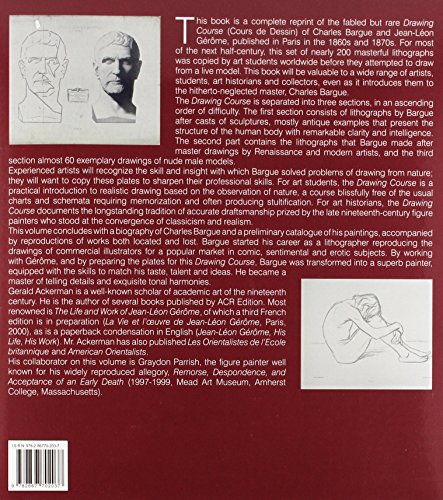
The Charles Bargue Drawing Course is a definitive paperback guide published on October 16, 2011, designed to teach aspiring artists the foundational skills of drawing through a series of structured lessons and exercises based on classical techniques.
| Best Sellers Rank | #1,711,098 in Books ( See Top 100 in Books ) #2,206 in Art Movements (Books) #2,250 in Individual Artist Monographs #7,798 in Art History (Books) |
| Customer Reviews | 4.7 4.7 out of 5 stars (295) |
| Dimensions | 9.91 x 1.24 x 10.98 inches |
| Edition | 3rd |
| ISBN-10 | 2867702038 |
| ISBN-13 | 978-2867702037 |
| Item Weight | 4.02 pounds |
| Language | English |
| Print length | 336 pages |
| Publication date | October 16, 2011 |
| Publisher | Acr Edition (Acc) |
A**H
The best drawing book I've ever seen...
... and I've seen quite a few. I have an entire library of art books, mostly on subjects like anatomy and drawing, and this course beats them all hands down. I am deeply impressed by the quality of this hefty hardbound book and its huge number of full-page plates. Just about every page is another drawing exercise to be copied, starting with the simple (an eye) and slowly working toward the more complicated (limbs, and eventually full figures). It shows you with beautiful visual simplicity how to sketch proportion, block out shape, and then refine with shading. The forms are classic; greek statuary and eventually master's drawings to copy. I think they're lovely and timeless, and look fantastic in my sketch book. If you copy all the material in this book, you WILL gain skill and be capable of refined drawings at the end. This is a technical skill book; it is not meant to preach expression or identity or philosophy, it's entirely about learning to draw what you see accurately and respectfully, very old school. I find that refreshing and invaluable, personally I see no value in paint splotches and grotesque cartoons on canvas. If you prefer creating non-representational modern art, this is NOT the book for you. I think a good supplement to the material in this book would be a quality book on anatomy, particularly musculature, so you can see the why and how behind the poses in this book, and get a good grasp on how the human body changes as it moves. Working through this book prior to taking life model classes is recommended. In fact, I recommend this book for anyone who wants to learn to draw or improve their drawing skills. The old method of copying first, to train hand-eye coordination and understanding of proportion, works best, which is why it was done this way for hundreds of years. Move on to real life subjects and more advanced mediums (like painting) after you've got these basics down.
M**B
For the serious student of classical drawing and painting
Purchased this as a part of my classical drawing program. Was not recommended because of the cost - but I wanted my own reference tool. If you are planning on studying classical drawing for painting or for the drawing itself and your focus is the human body - you can't go wrong with this book. This book is about the study of the structure, and the plates are meant to be copied over and over. The plates have a large white margin around them so they fit well on a photo copier and can be duplicated - leaving the book in good condition for future use. I can't say how well the book would be without instruction, but with instruction - it is a valuable learning tool. Did I mention that the contents are beautiful? This book is meant to be used by the serious Student of Classical Art / human figure.
A**R
Wonderful book.
Amazing book to learn traditional beautiful sketching techniques. For all level students.
J**N
An awesome find
The book is 25 x 27cm in size. The writer Gerald Ackerman is an art historian who went to Florence to study how to use this course at the atelier of Daniel Graves and Charles Cecil before writing this book. You can find all the Charles Bargue 197 plates in this book, with instructions on how to use them. Vol 1 plates are all whole-page drawings. Vol 2 plates are over 80% whole-page drawings. Vol 3 has only about 20 full-page illustrations and the rest are pretty tiny. Despite this shortfall, I still consider it a great book to have. The book also talks about Charles Bargue's life and his awesome paintings (in his later years). It is interesting to know that van Gogh worked through this course more than once on his own and Picasso copied these plates at the Barcelona Academy. This is one of the few drawing books that I find truly worth my money.
C**D
A refound lost link to the masters
The Charles Bargue and Jean-Leon Gerome drawing course is a set of 170 master drawings and schematics for a student to enlarge about 400% at a local print shop and then use to copy. Although it is no longer the trend, learning to draw by copying was a traditional way to learn to draw. First you learn to draw from master drawings like these, and then you begin drawing similar subjects, in this case from life and from plaster casts in the studio. Beyond that you would begin making your own compositions and learning to paint. It is easy to pick up this book and want to get started right away without reading it first. But you will get so much more out of it if you read the instructional sections and the descriptions of the drawings you are copying. The authors include little hints about what to focus on in each drawing and the essays on how to set up your easel and materials make it possible to make accurate copies. The intent of teaching students to copy is not to enslave them to copying for the rest of their careers. It is to train their eye to see and draw what they see. It also subtly exposes them to a classical sense of taste. Many of the most expressive and famous "loose" painters first trained in these methods. Van Gogh practiced with Bargue Plates. Monet and Sargent had traditional classical art training as well. I wonder if they felt constrained by this style, but regardless, I doubt they could have achieved the heights they did without a solid education first. I am an occasional student at a classical atelier, and my teacher has me drawing from these plates. I have been carefully working on the plates and I have completed three plates from it. The first few plates have several smaller drawings on them, so I was able to scan them and blow each of them up nearly 400% with my home printer. I will admit it is slow going, especially if you can only devote a few hours a week to it. However, I have already noticed my life drawing and my imaginative drawing improving.
E**B
Für alle, die das neuerwachsne Interesse an einer klassischen Ausbildung in künstlerischen Techniken interessiert sind, eine unbedingte Empfehlung. Die Vorlagen dürfen laut Impressum sogar in privaten Kunstschulen und Ateliers zur Ausbildung verwendet werden. Schade, dass es das Buch noch nicht in Deutsch gibt.
C**A
Its an essential book for those who take fine arts, drawing and painting seriously. Even better is that the well known classic drawing course comes in a book with excellent print quality, making the learning process even more pleasant!
A**ー
予想したとおりの商品でしたし、 内容、外観共に充分に満足しています。 もう少し価格が低ければ早く買いたい本でした。 このての商品は 中古で低価格の商品があれば、有り難いのですが。
M**A
The best drawing book I have ever read!
A**I
Ótimo
Trustpilot
Hace 2 semanas
Hace 1 mes