Kettlebell Rx: The Complete Guide for Athletes and Coaches
Product ID: 1205434
Desertcart purchases this item on your behalf and handles shipping, customs, and support to Panama.
In Kettlebell Rx, CrossFit certification instructor and world-renowned kettlebell coach Jeff Martone teaches you how to toughen-up your body, develop unbelievable conditioning and stamina, and acquire a chiseled physique by wielding the ball of iron known as the kettlebell. Drawing on his world-wide research and the thousands of classes he has taught to athletes around the world, Jeff breaks down kettlebell training like never before. He offers hundreds of movements, both beginning and advanced, shows dozens of the most common errors students make while training, and offers numerous workouts for athletes of all varieties. With more than 4,000 step-by-step photographs, descriptive narrative, and detailed programming, Kettlebell Rx is the only complete kettlebell book on the market. Review: A Must Buy - [...] When my copy of Jeff Martone's Kettlebell RX came in the mail, my roommate gave me a quizzical look. Why would I spend more of my money on a kettlebell book. I've already dropped a good penny on books and courses on kettlebells already. Its easy to get complacent or to rest on your laurels once you get enough letters behind your names or enough diplomas saying you're a ninja at swinging a cannonball with a handle. I first met Coach Martone in Fayetteville, NC at the Crossfit Kettlebell Trainer's Course. I had already been Crossfitting and aware of kettlebells for a while. However, we didn't have them in Baghdad and the only gym on Fort Bragg that had them only had half pood kettlebells. If I remember correctly, they were coated in purple plastic. I'm sure they also came in a cardboard box and had a picture of a lady posing next to a Bosu ball. Since I really started getting into Crossfit while I was in Iraq, I really did not have access to coaching or to all of the right equipment. So I learned the Olympic lifts with metal plates, I tried to learn how to swing with dumbbells, and I learned how to double under with barb wire (that last one may or may not have actually happened). My plan when I got back was to sign up for every Crossfit course that came within driving distance of Fort Bragg. It was less than a month after I got my Level I when Coach's course came through. Considering the fact that I've since gone on to get my HKC, RKC, and attended the Tactical Athlete Course and I now put on kettlebell workshops at Crossfit gyms you can imagine the influence that that weekend had on me. When I first saw the announcement for the book, I became pretty excited. First of all, the cover is hilarious. Its even funnier if you think about the conversation about the design and the influence of Jeff's sense of humor on it. The book is separated into three parts. The first part is the longest and focuses on kettlebells for Crossfitters, the next section on rotational power and hand speed, and the final section is on the sport of Kettlebell lifting. I still have my original manual from the Crossfit kettlebell course as well as the manuals from every other course that I've done. I've had the basics of the swing, the clean, the snatch, and the get up presented to me in many, many different ways. I can honestly say that this the Kettlebell RX has the easiest to understand explanations of the basic kettlebell movements as well as a quick and easy to use set of fixes and cues for the most common form errors that you see. There is no substitute for coaching with a competent master of the techniques, but this book does about as much as a book could do. The test I always use for a product like this is the "Iraq Test". I like to think how much better off would I be right now if I had this book when I was down range. A lot of coaches use a similar "High School Test" to accomplish the same thing. I think that having this book (and access to kettlebells) would have been as much of a difference maker as when Mark Rippetoe's "Starting Strength" came in the mail. I'll go out on a limb and say that this is the kettlebell equivalent of Starting Strength. Since I do consider myself to be pretty keen on the kettlebell movements, I will say that there are differences in the techniques shown in the book and how I teach them, how the RKC teaches them, and how I'm sure other organizations prefer to teach them. Specifically with the snatch and the get up. However, these differences are what makes the book strong. A coach should know multiple ways to accomplish a movement, have a plethora of cues in his coaching kit bag, and be able to articulate the benefits and drawbacks of one over the other. Which brings me to the section of the book that I enjoyed the most. The American Swing is one of the most controversial movements to ever come out of Crossfit. Regardless of if you love it or hate it, it is a valid and tested movement in the sport of fitness. Coach Martone is the really the first person to publish an explanation of why the two-handed swing and bottoms up press that you see athletes doing at Crossfit competitions is an inefficient means of accomplishing the task at hand. On game day, I don't really care about anything other than winning. Reinforcing and explaining why proper technique equals greater efficiency and faster times is the first step to eliminating this movement. Better times come from more efficient movement and more efficient movement comes from proper motor patterns and muscle recruitment. The rotational power chapter was great. It brought me back to the Tactical Athlete Certification. Rotational swings and kettlebell juggling are more than just parlor tricks and ways to impress a crowd before a workshop. They are one of the few easily quantifiable ways to train from rotational movements and unilaterally while still keeping to the Crossfit format. There are many effective ways to train rotational strength and hand speed, but very few ways to do them under the metabolic demands that mirror those experiences in sport and combat. The SHOT (Super High Output Training) is a great program to develop these. It is also a pretty easy and logical step for Crossfitters to slightly modify a WOD to include one of these elements and eliminate a gap in their training. After reading the last chapter all I want to do is find a kettlebell competition and try my hand at it. I would recommend this book to anyone from beginner to expert. Its a great as a quick reference guide and a learners manual as well. This product is amazingly well put together, with great pictures, easy to understand stories and analogies, and simple to understand, implement, and practice cues and progressions. Review: This is the kettlebell book you are looking for... - This book is an instant classic, and is destined to become the standard reference for kettlebell fitness and sport. You can only learn so much about kettlebells from a book, but Kettlebell Rx is as good as it is going to get. Jeff Martone's kettlebell resume speaks for itself. He is certainly an expert and also an excellent teacher and coach. Martone has experience with both of the two major styles of kettlebell lifting, the so-called "hard" and "fluid" styles. He is able to explain the styles clearly and also point out that these names are more about marketing than any kind of fundamental differences. Part one of Kettlebell Rx addresses flexibility drills and kettlebell exercises. This is by far the longest section of the book. The exercises are clearly explained and are accompanied by photos showing how they should be performed. Martone also demonstrates the common mistakes that people tend to make and gives advice on how to correct the errors. Also included is great information on how to structure the exercises into a safe and effective workout program. Not to be missed is the section on "lifting people" where Martone demonstrates his popular stunt of using a person in place of a kettlebell for a Turkish Get-Up. I don't think I'll be trying this anytime soon, but it is awesome to see! The production value of the book and the photos is very high. I am surprised the book does not cost more, given that every page is in full color on high quality paper. Part two deals with rotational power development, such as hand-to-hand drills, "hot potato" exercises and other drills that use a lighter weight. This part of the book has the same high quality of instruction and production value. Part three introduces kettlebell sport. Many people simply lift kettlebells for general fitness and/or to increase their performance in their other sports. However kettlebell lifting is itself a sport, with its own set of rules, tournaments, titles, etc. Martone introduces us to the sport, describes its history and champions, and also recounts his own experience in achieving his first title. As good as this book is, and as Martone himself points out, there is no substitute for having a trainer if you are just starting kettlebell lifting. Having a knowledgeable trainer watch and correct your form is the best and safest way to begin lifting kettlebells. I know it is expensive (believe me, I know!) but your health is worth it. In my experience, a trainer can teach you the basics that you need to know in around ten sessions. That and a kettlebell or two will be all you need for a lifetime of fitness. It is a terrific bargain! If you absolutely can not, or will not, get a trainer then at least have another person watch you lift and help you correct your form with the guidance in the book. But I would really recommend a trainer. I really can not recommend this book highly enough. If you are a kettlebell enthusiast, you simply must have this book. If you are thinking about starting kettlebell lifting, this should be your first book. It could really be your only book. It's that good.


| Best Sellers Rank | #378,680 in Books ( See Top 100 in Books ) #199 in Stretching Exercise & Fitness #345 in Sports Training (Books) #457 in Weight Training (Books) |
| Customer Reviews | 4.6 out of 5 stars 235 Reviews |
P**W
A Must Buy
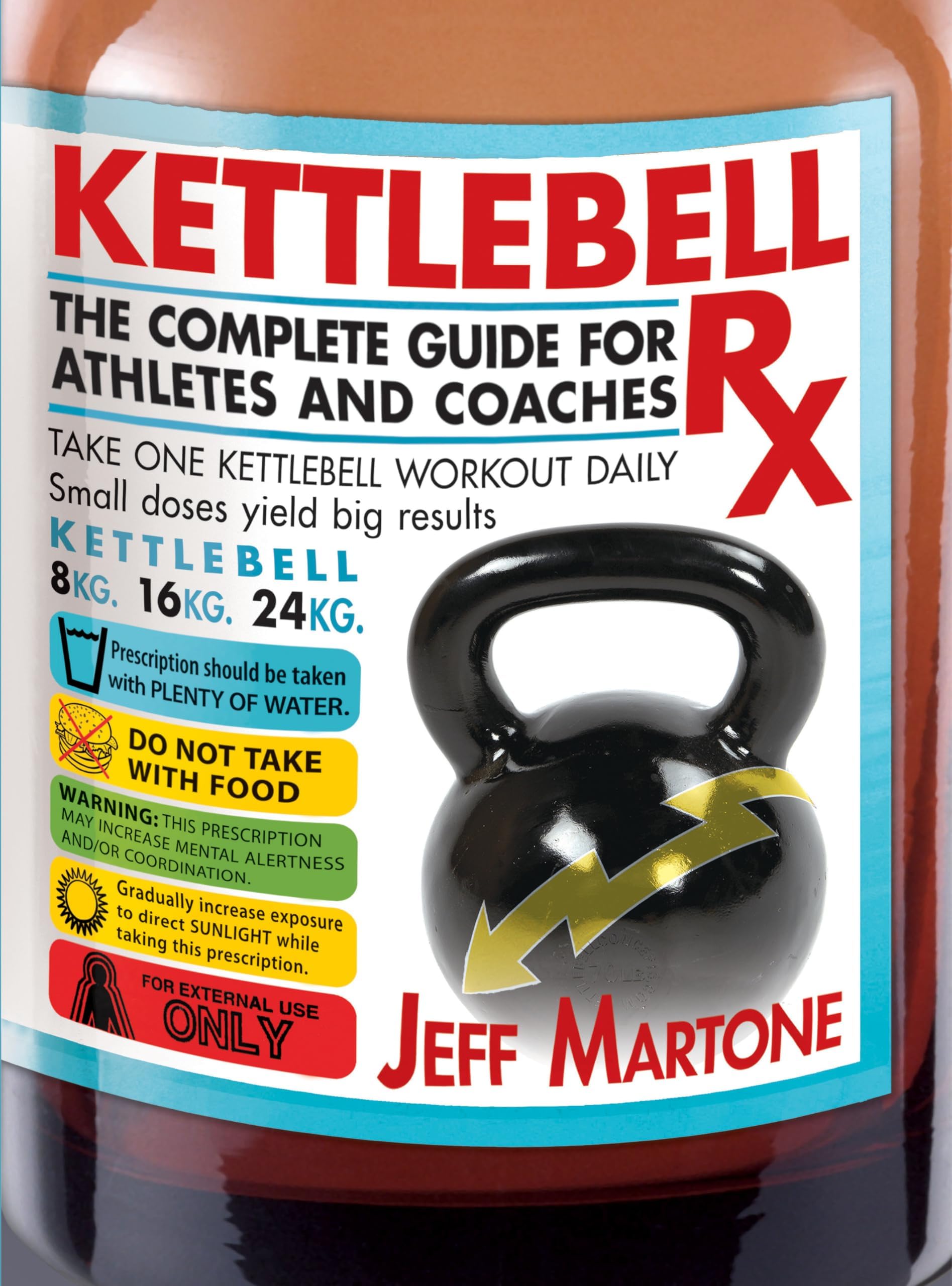
[...] When my copy of Jeff Martone's Kettlebell RX came in the mail, my roommate gave me a quizzical look. Why would I spend more of my money on a kettlebell book. I've already dropped a good penny on books and courses on kettlebells already. Its easy to get complacent or to rest on your laurels once you get enough letters behind your names or enough diplomas saying you're a ninja at swinging a cannonball with a handle. I first met Coach Martone in Fayetteville, NC at the Crossfit Kettlebell Trainer's Course. I had already been Crossfitting and aware of kettlebells for a while. However, we didn't have them in Baghdad and the only gym on Fort Bragg that had them only had half pood kettlebells. If I remember correctly, they were coated in purple plastic. I'm sure they also came in a cardboard box and had a picture of a lady posing next to a Bosu ball. Since I really started getting into Crossfit while I was in Iraq, I really did not have access to coaching or to all of the right equipment. So I learned the Olympic lifts with metal plates, I tried to learn how to swing with dumbbells, and I learned how to double under with barb wire (that last one may or may not have actually happened). My plan when I got back was to sign up for every Crossfit course that came within driving distance of Fort Bragg. It was less than a month after I got my Level I when Coach's course came through. Considering the fact that I've since gone on to get my HKC, RKC, and attended the Tactical Athlete Course and I now put on kettlebell workshops at Crossfit gyms you can imagine the influence that that weekend had on me. When I first saw the announcement for the book, I became pretty excited. First of all, the cover is hilarious. Its even funnier if you think about the conversation about the design and the influence of Jeff's sense of humor on it. The book is separated into three parts. The first part is the longest and focuses on kettlebells for Crossfitters, the next section on rotational power and hand speed, and the final section is on the sport of Kettlebell lifting. I still have my original manual from the Crossfit kettlebell course as well as the manuals from every other course that I've done. I've had the basics of the swing, the clean, the snatch, and the get up presented to me in many, many different ways. I can honestly say that this the Kettlebell RX has the easiest to understand explanations of the basic kettlebell movements as well as a quick and easy to use set of fixes and cues for the most common form errors that you see. There is no substitute for coaching with a competent master of the techniques, but this book does about as much as a book could do. The test I always use for a product like this is the "Iraq Test". I like to think how much better off would I be right now if I had this book when I was down range. A lot of coaches use a similar "High School Test" to accomplish the same thing. I think that having this book (and access to kettlebells) would have been as much of a difference maker as when Mark Rippetoe's "Starting Strength" came in the mail. I'll go out on a limb and say that this is the kettlebell equivalent of Starting Strength. Since I do consider myself to be pretty keen on the kettlebell movements, I will say that there are differences in the techniques shown in the book and how I teach them, how the RKC teaches them, and how I'm sure other organizations prefer to teach them. Specifically with the snatch and the get up. However, these differences are what makes the book strong. A coach should know multiple ways to accomplish a movement, have a plethora of cues in his coaching kit bag, and be able to articulate the benefits and drawbacks of one over the other. Which brings me to the section of the book that I enjoyed the most. The American Swing is one of the most controversial movements to ever come out of Crossfit. Regardless of if you love it or hate it, it is a valid and tested movement in the sport of fitness. Coach Martone is the really the first person to publish an explanation of why the two-handed swing and bottoms up press that you see athletes doing at Crossfit competitions is an inefficient means of accomplishing the task at hand. On game day, I don't really care about anything other than winning. Reinforcing and explaining why proper technique equals greater efficiency and faster times is the first step to eliminating this movement. Better times come from more efficient movement and more efficient movement comes from proper motor patterns and muscle recruitment. The rotational power chapter was great. It brought me back to the Tactical Athlete Certification. Rotational swings and kettlebell juggling are more than just parlor tricks and ways to impress a crowd before a workshop. They are one of the few easily quantifiable ways to train from rotational movements and unilaterally while still keeping to the Crossfit format. There are many effective ways to train rotational strength and hand speed, but very few ways to do them under the metabolic demands that mirror those experiences in sport and combat. The SHOT (Super High Output Training) is a great program to develop these. It is also a pretty easy and logical step for Crossfitters to slightly modify a WOD to include one of these elements and eliminate a gap in their training. After reading the last chapter all I want to do is find a kettlebell competition and try my hand at it. I would recommend this book to anyone from beginner to expert. Its a great as a quick reference guide and a learners manual as well. This product is amazingly well put together, with great pictures, easy to understand stories and analogies, and simple to understand, implement, and practice cues and progressions.
B**N
This is the kettlebell book you are looking for...
This book is an instant classic, and is destined to become the standard reference for kettlebell fitness and sport. You can only learn so much about kettlebells from a book, but Kettlebell Rx is as good as it is going to get. Jeff Martone's kettlebell resume speaks for itself. He is certainly an expert and also an excellent teacher and coach. Martone has experience with both of the two major styles of kettlebell lifting, the so-called "hard" and "fluid" styles. He is able to explain the styles clearly and also point out that these names are more about marketing than any kind of fundamental differences. Part one of Kettlebell Rx addresses flexibility drills and kettlebell exercises. This is by far the longest section of the book. The exercises are clearly explained and are accompanied by photos showing how they should be performed. Martone also demonstrates the common mistakes that people tend to make and gives advice on how to correct the errors. Also included is great information on how to structure the exercises into a safe and effective workout program. Not to be missed is the section on "lifting people" where Martone demonstrates his popular stunt of using a person in place of a kettlebell for a Turkish Get-Up. I don't think I'll be trying this anytime soon, but it is awesome to see! The production value of the book and the photos is very high. I am surprised the book does not cost more, given that every page is in full color on high quality paper. Part two deals with rotational power development, such as hand-to-hand drills, "hot potato" exercises and other drills that use a lighter weight. This part of the book has the same high quality of instruction and production value. Part three introduces kettlebell sport. Many people simply lift kettlebells for general fitness and/or to increase their performance in their other sports. However kettlebell lifting is itself a sport, with its own set of rules, tournaments, titles, etc. Martone introduces us to the sport, describes its history and champions, and also recounts his own experience in achieving his first title. As good as this book is, and as Martone himself points out, there is no substitute for having a trainer if you are just starting kettlebell lifting. Having a knowledgeable trainer watch and correct your form is the best and safest way to begin lifting kettlebells. I know it is expensive (believe me, I know!) but your health is worth it. In my experience, a trainer can teach you the basics that you need to know in around ten sessions. That and a kettlebell or two will be all you need for a lifetime of fitness. It is a terrific bargain! If you absolutely can not, or will not, get a trainer then at least have another person watch you lift and help you correct your form with the guidance in the book. But I would really recommend a trainer. I really can not recommend this book highly enough. If you are a kettlebell enthusiast, you simply must have this book. If you are thinking about starting kettlebell lifting, this should be your first book. It could really be your only book. It's that good.
B**S
Better Than I Thought
To begin, it is important to realize that this book is pretty substantial in size. The photo for this item does not really give a sense of what the book looks like. It is slightly bigger than a magazine size format, but much thicker. The quality of the paper and the pictures are also really good. So, enough of the aesthetics. The book itself is really informative. It does not cover a large variety of exercises, but it does a great job fully covering swings (1 and 2 hand, Russian and American), cleans, presses, the Turkish Get Up series, and a couple of other relevant exercises. The strength of the book is its in-depth descriptions of grips, hand position, body alignment, and trajectory of the kettlebells. I found the instruction very helpful for each of the exercises. As an instructor, he has had numerous shoulder issues, which he has overcome with kettlebells, but is also sensitive to the potential for injury in setting up the exercises. The book has a lot on technique, philosophy of progression, and some suggestions for pursuing kettlebells as a sport. The downside of the book is that there is not much in the way of individual workouts or an introduction to developing a personal workout. He is very minimalist in his approach, so he recommends a lot of 10 set, 10 rep workouts in very short sequences. He does recommend some crossfit routines at the end of the book, but as a kettlebell purist, I did not find these helpful. Overall, this is a great book for beginners or those that can use a visual reminder of good form and technique!
A**R
Fantastic book, a must read
This was my first book on kettlebell training and to this day remains my favorite book on kettlebell training. Since then I have read many great books and applied much in practice, but the frameworks that this book provided were what I found the most comprehensive. It has clear instructions, very thorough illustrations and step by step guides and explanations for movements and families of movements. The author writes in a straightforward language that is also imbued with a dry humor which makes it a fun and memorable read. I would recommend this book to everyone who uses kettlebells or is planning to use them.
W**N
Everything I was hoping for
I've owned Enter The Kettlebell! Strength Secret of The Soviet Supermen by Pavel Tsatsouline for a while, and while it got me off to a good start with my kettlebells, I eventually found it a little too minimalist in text and pictures to help me understand the nuances of the movements. I've supplemented the instruction from that book with online videos and articles, but still wished I had a single textbook for improving my technique in working with my kettlebells. Kettlebell Rx serves that role nicely, with tons of full-color pictures, plenty of instructional text, and some clear insights into the hows and whys of working out with kettlebells. It's very thorough (over 300 pages), and a great value compared to Pavel's Dragon Door books. I still refer to Enter the Kettlebell every once in a while, but Kettlebell Rx is the best book I've seen on the market for kettlebell instruction. My compliments to Jeff Martone!
S**N
A comprehensive guide to the Kettlebell
Pavel is rightfully considered to be the pioneer of the adoption of the kettlebell by today's fitness culture, and his books the first typically recommended. However, I believe Kettlebell Rx should be in every enthusiast's library. It is encyclopedic in it's discussion of form, exercises and solutions to correcting common mistakes. If I could only have one Kettelbell book, this would be it.
C**N
Strong Recommendation
Purchased 1st Kettle Bells in Uzbekistan after training with their Spetsnaz in 2002. Attended Jeff Martone's Crossfit Certification in 2007 & have practiced his advice ever since. This book has what you need to get started in Kettle Bell training. If you've wondered if Kettle Bell training is for you but can't afford the 'buy in' of both Kettle Bells & attending a cert...BUY THIS BOOK! The hallmark of a Martone Cert is that he treats all participants with grace/respect. This book is what every training introduction should be...Complete, Easily Readable, Entertaining, FUN, and Accessible. His step by step approach is the prescription for a stronger, more complete & happier athlete. If your on the fence regarding Kettle Bell training & you're old enough to have been burned by previous 'do as I say' type instruction, buy this book, read it, purchase quality 'Competition Type' Kettle Bells & get busy with the business of getting better. I stand by this recommendation & wish only he had written this thing sooner!
M**N
2nd only to Simple & Sinister by Pavel.
This is a great book but takes a backseet to Pavel's Simple and Sinister. If only buying one book on kettlebells I would buy Pavel's Simple and Sinister. If you are buying two or more books then get Simple and Sinister Kettlebell book first and this second. The difference is the programming. The programming here is a bit too much all over the place whereas Simple & Sinister has a very simple and easy to understand and effective program. For those wondering, Pavel taught Jeff about Kettlebells.
E**G
Kettlebell RX: The Complete Guide for Athletes and Coaches
Excellent. I love, love, love KB. I loved, loved, loved the no-nonsense approach of J. Martone. It is well worth the money and the time to read through
A**R
Great kettlebell exercising book
Each kettlebell exercise - even complicated ones were represented in easy to understand step by step pictures. Possible mistakes and errors in posture when exercising was also shown in pictures- helping reader in avoiding errors when exercising.
F**S
Un must, bravo!!!
Une vraie bible du Kettlebell, tout les mouvements de base y sont détaillés et illustrés, les erreurs les plus communes montrées et corrigées. De plus il est assez attrayant (à part la couverture) et facile à lire.
B**A
Great reference book.
Great photos and illustrations. Great routines. Perfect reference for when workout is feeling stale or I need to brush up on proper technique.
R**N
Gute Anleitung zum Kettlebell lernen
Einfach zu verstehen. Bilder erklären das gut. Leitfaden, an dem man sich entwickeln kann. Funktioniert. Wer auf saubere Bewegungserklärungen steht, findet das hier. Das Zusammenwirken der Funktionskette wird hier klar.
Trustpilot
3 days ago
2 weeks ago