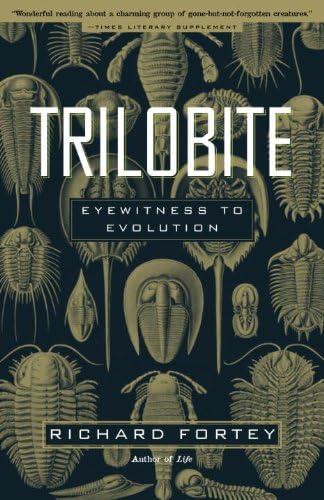
Trilobite: Eyewitness to Evolution
Product ID: 127946044
With Trilobite , Richard Fortey, paleontologist and author of the acclaimed Life, offers a marvelously written, smart and compelling, accessible and witty scientific narrative of the most ubiquitous of fossil creatures. Trilobites were shelled animals that lived in the oceans over five hundred million years ago. As bewilderingly diverse then as the beetle is today, they survived in the arctic or the tropics, were spiky or smooth, were large as lobsters or small as fleas. And because they flourished for three hundred million years, they can be used to glimpse a less evolved world of ancient continents and vanished oceans. Erudite and entertaining, this book is a uniquely exuberant homage to a fabulously singular species. Review: Beetles of the Paleozoic. - As this is my first book written by Richard Fortey I didn't quite know what to expect from this British paleontologist. Part science, part history and autobiography, Trilobite is written with a poetic slant that can take the reader off on some of the author's personal musings on a variety of subjects that are seemingly unrelated to trilobites but, sooner or later, he reveals the connection. Fortey's first job as a professional paleontologist was at a museum, a dream come true, "Getting paid for what I loved doing!". I found the chapter on museums and the process of naming a new species to be to be very interesting, but some readers might not agree with me on that. The opening chapter takes place on the North Cornwall Coast of South West England near the town of Boscastle and starts with the author retracing the steps of a fictional character, from a novel that I was not familiar with, who encounters a fossil trilobite on a storm-tossed cliff overlooking the Atlantic. In this round about way he brings you to the heart of his book: trilobites. And this book is indeed about trilobites and everything you ever wanted to know about them. In the late 17th century we find the earliest reference to trilobites when a "gentleman fossil-collector" wrote of finding some fossil "flat fish" that turned out to be trilobites. In exploring the history of trilobite research the author introduces you to some early workers like Charles D Walcott (about 1910) and Harry B Whittington (late 1960's) of Burgess Shale fame (see S Gould's 1989 Wonderful Life). Walcott discovered appendages (legs) in a fossil trilobite (1876). In 1893 William D Matthew was the first to spot fossilized antennae, plated with Iron Pyrite, confirmed by a Professor Charles E Beecher. All of these early workers were not only finding fossils, they were also doing research on trilobite anatomy, evolution and number of species. The research continues to this day. Traditionally, trilobites were considered, by some, to be losers in their evolutionary race for success but they were around for over 300my, had thousands of species and each were finely tuned to their environment--sounds like success to me. What caused their extinction is open for debate but changes in their habitat and environmental conditions that they were unable to keep up with is a good bet, that's the fate of all species and maybe us humans as well. I found Fortey's writing style to be ornate and, at times, quite technical, but not so technical that it overwhelms the layperson reader. The chapter on trilobite eyes was outstanding, some had them mounted on long stalks others were large and bulbous and some species were even blind. I had no idea that trilobites were so diverse, evolving to fill a wide range of habitats from shallow seas to the abyssal deep with numbers beyond counting. Some sported an assortment of spines or bumps that must have served some sort of function. Fortey covers it all in fine detail mixed with some speculation. While not for everyone, this book is right on track for anyone interested in paleontology, evolution and nature in general. I had no technical or formatting problems with this Kindle edition and, as far as I could tell, all of the illustrations and plates are included. LastRanger Review: Another Winner from Richard Fortey - This is a wonderful book! Trilobite! Eyewitness to Evolution is a skillfully crafted narrative that displays Fortey's impeccable scientific credentials and his engaging and highly entertaining style of writing. Readers unfamiliar with these remarkable creatures and their 300 million year history will benefit from well organized chapters that explain the physiology, life habits, evolutionary patterns and geological time line with insight and clarity. Those readers with a better understanding of the class Trilobita, will enjoy the personal observations and anecdotes of a superb writer, who just happens to be a leading authority on the subject. Fortey even tackles the role of ombudsman in his attempt to soften the contentious battles between Simon Conway-Morris and Stephen J. Gould over those controversial early arthropods and other creatures of arguable affinity. I applaud his restraint and gentle hand in dealing with the emotional fervor of his contemporaries. If I have any criticism of this book, it would be to step on to the soapbox and point out that Fortey details the moment when he chipped out his first trilobite at age fourteen as an epiphany that determined his lifes work. He discusses Walcott and other self taught geologists and paleontologists who started as eager young fossil hunters. Sadly, in several places throughout the text, Fortey explains that these sites are now closed to collecting. Typically, these closures are to protect the area from the hammers of interested collectors (with special emphasis on those who might profit from the sale of their collections) in the misguided notion that invertebrate fossils are national treasures that must be protected for all through restrictions and the intervention of government agencies. I subscribe to the belief that a fossil left uncollected is a fossil that is lost. If common sense prevails, the search for specimens- even for profit- can benefit us all. Instead, we get over zealous regulation and permanent site closures. In the final pages of his book, Fortey marvels at the recently discovered trident Comura trilobite. (now Walliserops trifurcautus) I only wish he'd made it clear that this unique fossil discovery resulted from the activities of Moroccans digging the Devonian strata for a modest profit and that future fossil wonders, as well as future paleontologists, are much more likely to occur when people are allowed to freely explore the rocks, as Fortey was allowed to do in his youth.
| Best Sellers Rank | #1,092,580 in Kindle Store ( See Top 100 in Kindle Store ) #54 in Biological Science of Fossils #111 in Biology of Fossils #133 in Paleontology (Books) |
L**R
Beetles of the Paleozoic.
As this is my first book written by Richard Fortey I didn't quite know what to expect from this British paleontologist. Part science, part history and autobiography, Trilobite is written with a poetic slant that can take the reader off on some of the author's personal musings on a variety of subjects that are seemingly unrelated to trilobites but, sooner or later, he reveals the connection. Fortey's first job as a professional paleontologist was at a museum, a dream come true, "Getting paid for what I loved doing!". I found the chapter on museums and the process of naming a new species to be to be very interesting, but some readers might not agree with me on that. The opening chapter takes place on the North Cornwall Coast of South West England near the town of Boscastle and starts with the author retracing the steps of a fictional character, from a novel that I was not familiar with, who encounters a fossil trilobite on a storm-tossed cliff overlooking the Atlantic. In this round about way he brings you to the heart of his book: trilobites. And this book is indeed about trilobites and everything you ever wanted to know about them. In the late 17th century we find the earliest reference to trilobites when a "gentleman fossil-collector" wrote of finding some fossil "flat fish" that turned out to be trilobites. In exploring the history of trilobite research the author introduces you to some early workers like Charles D Walcott (about 1910) and Harry B Whittington (late 1960's) of Burgess Shale fame (see S Gould's 1989 Wonderful Life). Walcott discovered appendages (legs) in a fossil trilobite (1876). In 1893 William D Matthew was the first to spot fossilized antennae, plated with Iron Pyrite, confirmed by a Professor Charles E Beecher. All of these early workers were not only finding fossils, they were also doing research on trilobite anatomy, evolution and number of species. The research continues to this day. Traditionally, trilobites were considered, by some, to be losers in their evolutionary race for success but they were around for over 300my, had thousands of species and each were finely tuned to their environment--sounds like success to me. What caused their extinction is open for debate but changes in their habitat and environmental conditions that they were unable to keep up with is a good bet, that's the fate of all species and maybe us humans as well. I found Fortey's writing style to be ornate and, at times, quite technical, but not so technical that it overwhelms the layperson reader. The chapter on trilobite eyes was outstanding, some had them mounted on long stalks others were large and bulbous and some species were even blind. I had no idea that trilobites were so diverse, evolving to fill a wide range of habitats from shallow seas to the abyssal deep with numbers beyond counting. Some sported an assortment of spines or bumps that must have served some sort of function. Fortey covers it all in fine detail mixed with some speculation. While not for everyone, this book is right on track for anyone interested in paleontology, evolution and nature in general. I had no technical or formatting problems with this Kindle edition and, as far as I could tell, all of the illustrations and plates are included. LastRanger
S**Y
Another Winner from Richard Fortey
This is a wonderful book! Trilobite! Eyewitness to Evolution is a skillfully crafted narrative that displays Fortey's impeccable scientific credentials and his engaging and highly entertaining style of writing. Readers unfamiliar with these remarkable creatures and their 300 million year history will benefit from well organized chapters that explain the physiology, life habits, evolutionary patterns and geological time line with insight and clarity. Those readers with a better understanding of the class Trilobita, will enjoy the personal observations and anecdotes of a superb writer, who just happens to be a leading authority on the subject. Fortey even tackles the role of ombudsman in his attempt to soften the contentious battles between Simon Conway-Morris and Stephen J. Gould over those controversial early arthropods and other creatures of arguable affinity. I applaud his restraint and gentle hand in dealing with the emotional fervor of his contemporaries. If I have any criticism of this book, it would be to step on to the soapbox and point out that Fortey details the moment when he chipped out his first trilobite at age fourteen as an epiphany that determined his lifes work. He discusses Walcott and other self taught geologists and paleontologists who started as eager young fossil hunters. Sadly, in several places throughout the text, Fortey explains that these sites are now closed to collecting. Typically, these closures are to protect the area from the hammers of interested collectors (with special emphasis on those who might profit from the sale of their collections) in the misguided notion that invertebrate fossils are national treasures that must be protected for all through restrictions and the intervention of government agencies. I subscribe to the belief that a fossil left uncollected is a fossil that is lost. If common sense prevails, the search for specimens- even for profit- can benefit us all. Instead, we get over zealous regulation and permanent site closures. In the final pages of his book, Fortey marvels at the recently discovered trident Comura trilobite. (now Walliserops trifurcautus) I only wish he'd made it clear that this unique fossil discovery resulted from the activities of Moroccans digging the Devonian strata for a modest profit and that future fossil wonders, as well as future paleontologists, are much more likely to occur when people are allowed to freely explore the rocks, as Fortey was allowed to do in his youth.
S**Y
Best popular nature book EVER
I am going to have trouble adequately describing this book, which I have read many times. I am not a scientist, I am an attorney, but for recreation I have read many popular science books. (My complete inability to understand mathematics shut me out of the sciences.) Of all the popular science books I have read, and there are perhaps 100, this is the best, by which I mean, the most interesting and enjoyable for someone with no formal background in the sciences. (I was even motivated by this book to do a little amateur poking around in the California desert and I scored my own (very unimpressive, but for real!) trilobite fossil! These little beings from long ago were exceedingly common, so their fossils are not in any sense rare if you know where to look.) Professor Fortey, as other reviewers have observed, does not bore the novice by leading the reader through dry charts and learned explanations. The book sparkles with anecdotes, personal diversions, and fascinating insights into these ancient life forms. He really brings them alive! As the title tells us, trilobites were among the first life forms with complex eyes, a particularly interesting form of eyes utilizing mineral crystals. This type of eye died with the trilobites, so we have no modern examples. Fortey takes us through the entire story in his charming way, from the genetic basis of "eye" all the way through to dedicated people taking photographs through fossil trilobite eyes in an effort to understand how the world looked to a trilobite. Then there are legs, and the work that was done to figure out first, that they HAD legs, and second, what these difficult to fossilize legs looked like. It reads like a little detective novel. The whole book sparkles with little gems of this kind. Obviously this book is not for everyone, but if this kind of thing appeals to you, buy this book and read it, you are in for a treat!
D**E
A nice introduction to Trilobites, however, it just misses the mark. Still, a good beginner book.
This book is arranged a bit like a memoir written by the author of his many years studying trilobites. This seems to be one of the main styles, which for lack of a better definition, I call the "personal theme" method of writing. The author walks along ancient shale cliffs reflecting on both literature about the cliffs and the existence of ancient life fossilized & buried in the shale of the cliffs. While the style leads to a nice narrative, it just misses that 'je ne sais quoi' of the theme: TRILOBITES! It gets close, but is a bit of a mishmash in working through both the evolution of those most durable & long lasting families of creatures the world has ever seen. He then continues with a narrative of his introduction to trilobites at a young age through his many years of study in academia. Some highlights: The development of the three parts (as in the tri) of the animal & the fact that it is also split three ways symmetrically on its vertical axis are explained in detail. The absolute wonder of the "crystal" eyes. (Yes, the trilobites that could see had eyes of solid crystal!) This method of sight died out with the last of the trilobites. The specialization & fusing of the segments (as in a segmented animal we see today like the centipede) into groups. Ex. The front most segments group together & form a head. One segment sends out a pair of antennae (segments further down in the animal's torso create legs instead). The research of Prof. Harry Whittington & some of his very special methods of analyzing the animals. Note that Prof. Whittington actually dissected some of his samples & also X-Rayed them to identify structures hitherto undiscovered. For further reading: Steven J Gould, "Wonderful Life"; Harry Whittington, "The Burgess Shale" A final note: Once nature figures out a method, or structure, that works, it repeats it through its descendants. Think not? Just look at your fingernails. They are made of chitin. This is basically the same material used by a shrimp, or a lobster, to create its exoskeleton! The next time you have a shrimp cocktail, examine the shell on the shrimp tail. Then be amazed at the beauty of nature to produce a material some time in the Precambrian era that is used both by mammals and crustaceans! Ancestors of the modern shrimp lived hundreds of millions of years ago and were present when trilobites were present and living in the world, long, long before man arrived on the scene.
E**T
The Paleozoic seas as viewed through crystalline eyes
Natural history, deep-time may conjure up images of Stephen J. Gould's wondrous creatures of the early Cambrian (530 million years ago), dug out of the Burgess Shale in British Columbia. I realize that other paleontologists have had problems with some of his anatomical descriptions and theory of punctuated equilibrium ("Trilobite" spends a chapter defending Gould from some of his more vigorous critics), but the world that he created was strange, beautiful, and compelling. Fortey creates a similar vision of Earth as it existed for 300 million years, starting like Gould, in the Cambrian. No animals better exemplify the drama of evolution and extinction than trilobites, except perhaps for the Johnny-come-lately dinosaurs. If you are interested in really deep time, you must travel back before the dinosaurs and peer with the author through the eyes of a trilobite. "'Look into my eyes,' the trilobite seems to say, 'and you will see the vestiges of your own history.'" And very strange eyes they are. In the chapter, "Crystal Eyes" the author plays an exuberant, complex riff on vision as it first evolved, most specifically on the uniquely developed eyes of trilobites. I used to think of these creatures as mud-colored beetles that spent their lives crawling around on the bottoms of shallow Paleozoic seas--interesting basically because they lasted so long. But according to Fortey, their eyes were made of calcite crystals, which "makes them unique in the animal kingdom...Look into a crystal of Iceland spar and you can see the secret of the trilobyte's vision." The author then goes into quite a bit of detail as to why double vision was not a problem for these amazing arthropods, even though their eyes were made up of six-sided crystals. Since the trilobite's eyes were part of its exoskeleton and just as hard, it had to shed them with each molt. Imagine, a new set of eyes every time you shed your 'skin!' Trilobites ranged from platter-size down to bitty bugs that were barely a millimeter long. Fortey describes them in loving detail and also defends the need to collect and study trilobites. Lord Rutherford's remark that 'all science is either physics or stamp collecting' is vigorously repudiated (I think Rutherford's aphorism must have really stung, because it gets a good bashing in nearly every natural history book in my library). Just one of the reasons why trilobites are not like stamps is that studying their distribution helps us determine the outlines of continents and islands that predated not just the modern world, but the ancient supercontinent of Pangaea. Trilobites managed to squeeze through several evolutionary bottlenecks, surviving and multiplying for over 300 million years. In his heart of hearts, the author admits to hoping that, like the ancient coelacanth, a remnant of this once-vast family of arthropods will be rediscovered, curled up on some unexplored sea bottom, or gazing through crystalline eyes at a newer denizen of the deep. After reading Fortey's "Trilobite," I can only hope the same.
C**N
A tour of the life of trilobites and those that study them
What a lot of fun! Richard Fortey takes us on an adventure that began about 500 million years ago. He uses his lifetime of experience and study to share with us the amazing things scientists have learned about trilobites over the past 300 years. Not only are there more kinds of trilobites than I had ever imagined, scientists have figured out more about their lives (as species not as individuals) than I would have ever believed possible. It is just incredible. But the book isn't just about trilobites. The author shares wonderful stories from his own life and the lives of those that have spent their lives learning about these creatures. We also get to learn about science and the various arguments that have arisen over the centuries and how they were resolved (or continue to this day). The author even throws a yellow flag on a heated debate between the now sadly late Steven Jay Gould and Simon Conway Morris for becoming unprofessionally vitriolic. This is a fabulous book for anyone who wants to read a non-technical book about natural history. It is written with great style and a deft touch that never overwhelms the non-specialist nor becomes so frothy that it loses the ability to communicate serious and wonderful things. I think this would be an especially wonderful book for young people to read who are interested in science and want to learn more about what it is and what a life spent studying science is really about and what it is like. Fortey demonstrates clearly the work involved, the rigors required, and the where the rewards are. Reading this book made me wish I knew where I put that trilobite head and tail I found in an Ohio quarry when I was a boy. It makes me want to go out with a geologists hammer and find some more. Maybe it will inspire some young men and women to take that inspiration more seriously and take it on as a career. Just great. Thanks, Dr. Fortey.
W**Y
Geek out! Read good writing! Have a great time!
A great book for a geek who likes good writing. Geekish, of course, because - hey - it's a whole book about trilobites, for Pete's sake! But Fortey is so cheerfully enraptured by his subject that it's hard not catch his enthusiasm. And he knows how to sprinkle in descriptions of scenery at dig sites, amusing anecdotes about himself and his colleagues, bits of historical trivia - all of which add variety and interest. And at times, his writing is downright lyrical. (Really!) And if you're actually interested in ancient life forms (this is a time before anything had crawled onto the land) or in how evolution works, the book is filled with enlightening scientific information. I bought it with some trepidation (as I said, a whole book about trilobites?), and I've enjoyed it immensely.
J**K
Good read
Odd little book written in a much more personal style than traditional texts I liked it
I**N
Everything you want to know about trilobites
Trilobites were some of the most successful organisms to ever populate the planet and most people have never heard of them. This book is both an indepth look at trilobites and a story of one man's lifelong passion for his work. You don't have to like fossils, geology or bugs to like this book. I would recommend this book to anyone with an innate curiosity for life on earth. If nothing else, your new found knowledge of trilobites will make you the center of attention at cocktail parties...
A**T
Comprehensive book about the Trilobite from A Scientist who knows how to write a readable book.
Excellent book by Richard Fortey, a world expert on the Trilobite. What surprised me most was the easy writing style, light, humorous at times but very informative. A good read easy to understand and I gained much from reading it.
C**S
Incredible Diversity
Richard Fortey never fails to make his science books interesting, even entertaining, and true page-turners. An avowed trilobite fan, he describes both these creatures' evolution in connection with shifting conditions in their ecosystems and the evolution of other lives as well. His story offers autobiographical elements that illustrate how Fortey chose his career - no surprise, considering his childhood fascination with fossils. Adaptive radiation, catastrophes that led to the loss of biodiversity, Fortey manages to make it all eminently readable. For those who are leery of science texts, this book is the one to select to become truly hooked on the subject at hand.
S**S
As good as his other books
I enjoyed Richard Fortey's other books, and this one is just as good.
S**W
Granny Grunter is the Star
When you consider that Trilobites really are no more than marine woodlice, it is is remarkable that someone can write a book about these things that is great from beginning to end. But here it is - a masterpiece. Thanik you Dr Fortey. Once more
Trustpilot
2 weeks ago
3 days ago