We remain fully operational. Our teams are working around the clock to ensure your deliveries continue safely.

DOWNLOAD THE APP


Customer Services
Copyright © 2025 Desertcart Holdings Limited
DOWNLOAD THE APP
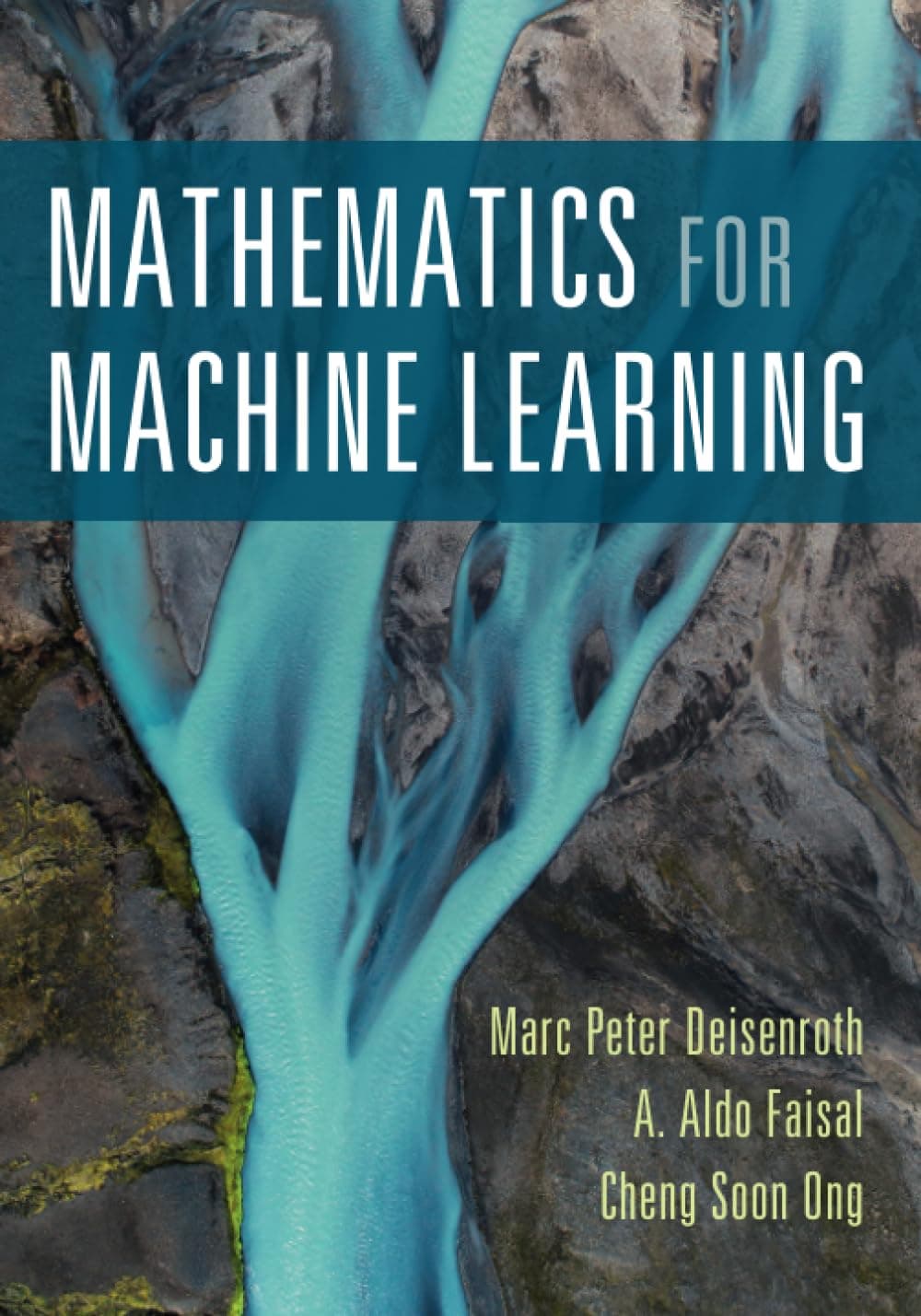
Mathematics for Machine Learning [Deisenroth, Marc Peter] on desertcart.com. *FREE* shipping on qualifying offers. Mathematics for Machine Learning Review: Wonderfully illustrated, welll laid out, great website and extra content - If you already have a background with linear algebra, calculus, statistics, then this will be a nice refresher applied to the subject in question, machine learning. In that regard, it serves perfectly as a way to organize your study to get into AI/ML in a deeper way. Certainly deeper than from a purely user perspective. If you don't have a background with linear algebra, calculus, statistics, it'll still provide a well organized studies plan for you to dive deeper. It cannot, of course, be a textbook for these areas, it would take hundreds, thousands of pages to do so, and that's clearly not feasible. What it does is introduce you to some concepts, refresh them, or refer you to further studies where there is a need to dive deeper in certain topics. The book is clearly organized, well illustrated. For that alone I'm thankful, for many mathematics textbooks, even the ones targeting the professional mathematician, make the fatal mistake of assuming the reader finds images insulting. They're not. Images help you organize thoughts visually, geometrically, providing important insights. For that alone, the content and organization, I would give the book 5 stars. The examples are well laid out, the cases well illustrated, giving room for the reader to breathe without being crushed by a dense monolith of rendered equations. Where it exceeds and stands above others is that the companion website provides, freely, the PDF of the book, an errata, instructor solutions to the exercises, and Jupyter Lab notebooks. While other publishers would try to rob the customer blind by offering each of these as a separate product, for a hefty sum naturally, this publisher thought it would best serve the reader to have access to all this content for free. Naturally, in this day and era, seeing someone focused on spreading knowledge for the sake of science and knowledge is commendable, and I cannot give me more than 5 stars sadly, for I would. If you read it this far, this is a no-brainer. Visit the website, take a look at the PDF, buy it, so that you can have the version with you for your daily studies, and the PDF for that morning reading on the tablet. The Jupyter notebooks make exploration fun and interesting, even if you're not experienced in the field. It does not assume you are an expert in these areas, though naturally, it would benefit you greatly if you have experience or if at least you have some textbooks on linear algebra and some knowledge of differential, integral calculus. To the authors, congratulations, and to the publisher, may you have a thousand years of prosperity and good fortune for making the auxiliary content freely available and in such a open and honest manner. Bravo. Highly recommended. Review: Incredible Resource - I had been looking for a book to bridge the gap between implementing machine learning code on the granular level and understanding it from a theoretical perspective and the search wasn't going well. Lots of other books that I tried before finding this one promised to help programmers become better mathematicians (or at least show them the math they need to learn in order to achieve that goal) but would almost always just provide code without context, or run through some incredibly basic, introductory level math without explaining at all how it connects to the various machine learning algorithms you'll be implementing as a programmer. This book, however, takes the math seriously, and is incredibly direct and efficient in the introduction of new, relevant topics in calculus, linear algebra, and probability and statistics that you'll need to know if you want to truly understand the libraries you're using. I find myself reading a section in the book, going back to a "dedicated" textbook on the subject at hand - linear algebra or calculus or probability and statistics - and further studying the material, and then going back to Mathematics for Machine Learning to make sure I understand the topic better. This is the exact learning flow that I wanted, and the book delivers. Can't recommend enough!

| Best Sellers Rank | #38,009 in Books ( See Top 100 in Books ) #7 in Computer Vision & Pattern Recognition #33 in Computer Science (Books) |
| Customer Reviews | 4.6 4.6 out of 5 stars (1,012) |
| Dimensions | 7 x 0.88 x 10 inches |
| Edition | 1st |
| ISBN-10 | 110845514X |
| ISBN-13 | 978-1108455145 |
| Item Weight | 1.8 pounds |
| Language | English |
| Part of series | Studies in Natural Language Processing |
| Print length | 398 pages |
| Publication date | April 23, 2020 |
| Publisher | Cambridge University Press |
L**S
Wonderfully illustrated, welll laid out, great website and extra content
If you already have a background with linear algebra, calculus, statistics, then this will be a nice refresher applied to the subject in question, machine learning. In that regard, it serves perfectly as a way to organize your study to get into AI/ML in a deeper way. Certainly deeper than from a purely user perspective. If you don't have a background with linear algebra, calculus, statistics, it'll still provide a well organized studies plan for you to dive deeper. It cannot, of course, be a textbook for these areas, it would take hundreds, thousands of pages to do so, and that's clearly not feasible. What it does is introduce you to some concepts, refresh them, or refer you to further studies where there is a need to dive deeper in certain topics. The book is clearly organized, well illustrated. For that alone I'm thankful, for many mathematics textbooks, even the ones targeting the professional mathematician, make the fatal mistake of assuming the reader finds images insulting. They're not. Images help you organize thoughts visually, geometrically, providing important insights. For that alone, the content and organization, I would give the book 5 stars. The examples are well laid out, the cases well illustrated, giving room for the reader to breathe without being crushed by a dense monolith of rendered equations. Where it exceeds and stands above others is that the companion website provides, freely, the PDF of the book, an errata, instructor solutions to the exercises, and Jupyter Lab notebooks. While other publishers would try to rob the customer blind by offering each of these as a separate product, for a hefty sum naturally, this publisher thought it would best serve the reader to have access to all this content for free. Naturally, in this day and era, seeing someone focused on spreading knowledge for the sake of science and knowledge is commendable, and I cannot give me more than 5 stars sadly, for I would. If you read it this far, this is a no-brainer. Visit the website, take a look at the PDF, buy it, so that you can have the version with you for your daily studies, and the PDF for that morning reading on the tablet. The Jupyter notebooks make exploration fun and interesting, even if you're not experienced in the field. It does not assume you are an expert in these areas, though naturally, it would benefit you greatly if you have experience or if at least you have some textbooks on linear algebra and some knowledge of differential, integral calculus. To the authors, congratulations, and to the publisher, may you have a thousand years of prosperity and good fortune for making the auxiliary content freely available and in such a open and honest manner. Bravo. Highly recommended.
A**R
Incredible Resource
I had been looking for a book to bridge the gap between implementing machine learning code on the granular level and understanding it from a theoretical perspective and the search wasn't going well. Lots of other books that I tried before finding this one promised to help programmers become better mathematicians (or at least show them the math they need to learn in order to achieve that goal) but would almost always just provide code without context, or run through some incredibly basic, introductory level math without explaining at all how it connects to the various machine learning algorithms you'll be implementing as a programmer. This book, however, takes the math seriously, and is incredibly direct and efficient in the introduction of new, relevant topics in calculus, linear algebra, and probability and statistics that you'll need to know if you want to truly understand the libraries you're using. I find myself reading a section in the book, going back to a "dedicated" textbook on the subject at hand - linear algebra or calculus or probability and statistics - and further studying the material, and then going back to Mathematics for Machine Learning to make sure I understand the topic better. This is the exact learning flow that I wanted, and the book delivers. Can't recommend enough!
E**C
Brilliant and Precise
The book is the missing piece between books like Artificial Intelligence: A Modern Approach and the mathematics you require to take such an undertaking. The authors do assume very little prior knowledge from the reader, but it t is recommended that you've had exposure to some of the mathematical topics prior to reading the book. But don't let that stop you if you're a beginner: you'll have to make a few detours to grasp some terms and such. Having said that, a course on single variable calculus ought to be under your belt. That's basically the only prerequisite. The explanations are clear, and the book is designed to bring clarity and lucidity onto the topics, not send the student on an endless pit of proofs and rigor.
S**R
Nachdem ich vor 25 Jahren Informatik studiert habe und dort bereits "Neuronale Netze" (feed-forward back-propagation) kennengelernt hatte, wollte ich, motiviert durch den Hype der aktuellen AI (insbesondere machine learning sowie deep learning) mehr darüber lesen. Daher zunächst das "Standardwerk" (Titel "Deep Learning") gekauft. Die dort enthaltene Mathematik ist, meines Erachtens, so stark ver-klausuliert und auch von der Notation her schwer zu lesen, dass ich dieses Buch hier "Mathematics for Machine Learning" gekauft habe: Ich muss sagen/schreiben: Das ist die BESTE Darstellung der verschiedenen mathematischen Themenbereiche (Vektoren, Matrizen, Lineare Algebra, Wahrscheinlichkeitsrechnung, u.s.w.), die ich als Praktiker der Informatik je gesehen habe. Sehr gut verständlich (mit dem math. Grundwissen eines Informatikers), sehr tolle praxis-bezogene Beispiele zu den mathematischen Verfahren. Darüber hinaus in einem hervorragenden Englisch geschrieben, das wirklich Freude macht, es zu lesen. Ich denke, dass jeder, der sich intensiv mit Machine Learning auseinandersetzen möchte, hier sowohl ein Lehrwerk als auch ein Nachschlagewerk erhält. Übungen mit Lösungen (auf github) runden dieses Buch ab. Ich bin begeistert!!!
G**A
Le basi matematiche di questo libro non sono da super specialisti. Ma anche per chi è un ricercatore, questo libro offre un approccio diverso su molti temi standard, facendoti guardare a cose che conosci bene da un punto di vista inaspettato
F**L
Les bases mathématiques et analyse numériques de niveau Master1 (Bac+4). Agréable à avoir en format papier. + accès au site web pour suivre les quelques coquilles. Simple regret : impossible d'accéder aux corrections des nombreux exercices sans être un enseignant dans une faculté.
S**S
This is a very structured approach to gain a strong grasp of the mathematical fundamentals required for machine learning. If you pair this up with "Understanding Machile Learning: From Theory to Algorithms" by Shai Ben-David and Shai Shalev Shwartz, then that's a clear winner combo for ML theory.
J**R
Good book
Trustpilot
1 month ago
3 weeks ago