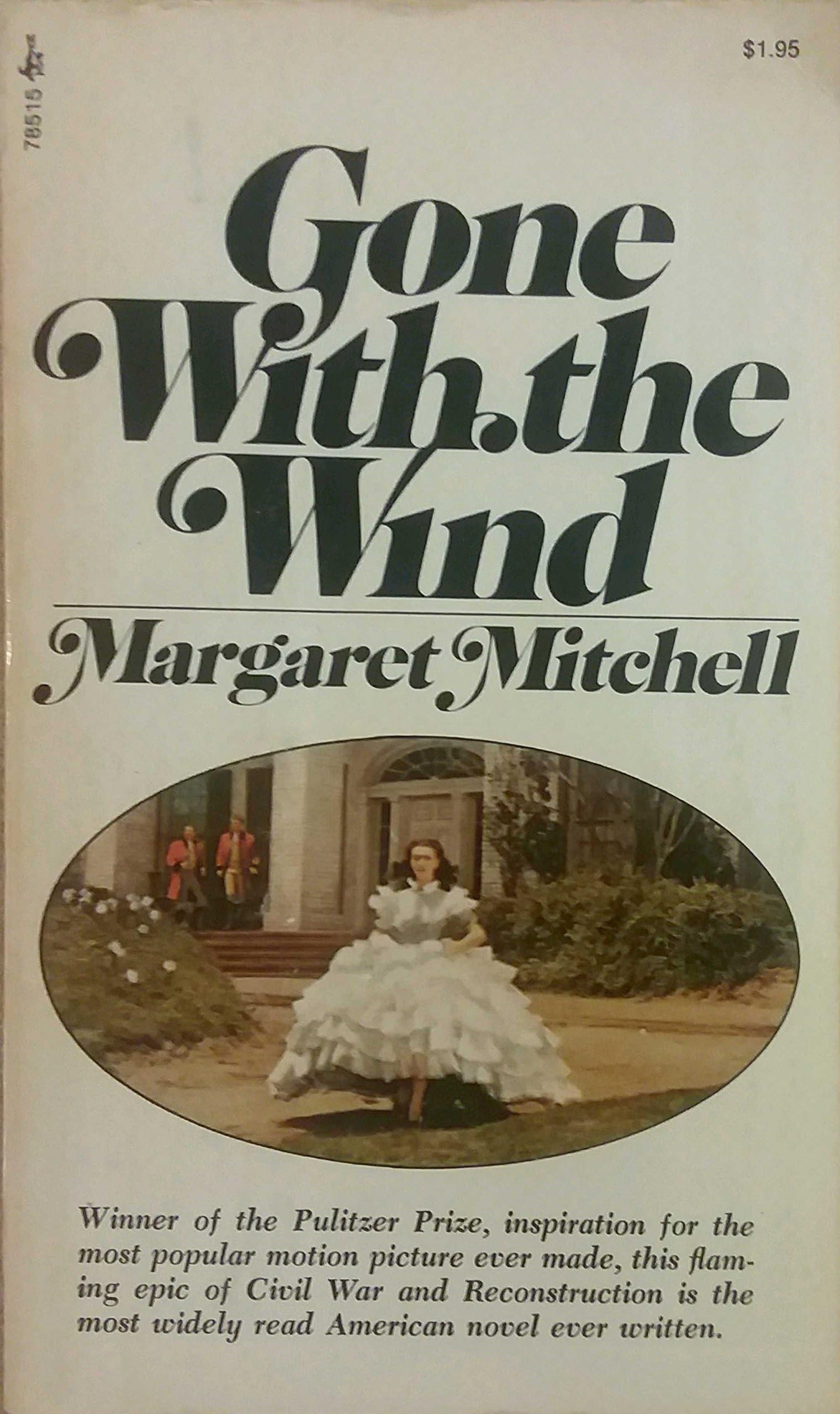
Gone with the Wind
Product ID: 202444158
Desertcart purchases this item on your behalf and handles shipping, customs, and support to Panama.
Nominated as one of America’s best-loved novels by PBS’s The Great American Read. Margaret Mitchell's epic novel of love and war won the Pulitzer Prize and went on to give rise to two authorized sequels and one of the most popular and celebrated movies of all time. Many novels have been written about the Civil War and its aftermath. None take us into the burning fields and cities of the American South as Gone With the Wind does, creating haunting scenes and thrilling portraits of characters so vivid that we remember their words and feel their fear and hunger for the rest of our lives. In the two main characters, the white-shouldered, irresistible Scarlett and the flashy, contemptuous Rhett, Margaret Mitchell not only conveyed a timeless story of survival under the harshest of circumstances, she also created two of the most famous lovers in the English-speaking world since Romeo and Juliet. Review: My musings on a classic! - The first time I read Gone With the Wind, I was around sixteen years old. It made a lasting impression on me. I have probably read this book at least ten times during my youth and my young adult years and watched the movie as many times. I realized that it must have been thirty years since I last read it and decided it was time to read it again with new eyes. I downloaded it and also purchased the audio book to go along with it. I must say this has been a different experience listening to the audio along with the book. Linda Stephens is the narrator and truly brings this huge cast of characters to life. I could easily distinguish the different voices. She does an outstanding job with all the varying accents from Scarlett, to Rhett, to Mammy. Now at times, I did cringe when I listened to all the racist dialogue, but I tried to remember this is written when this was the normal attitude of that time, not how we feel today. Obviously Gone With the Wind is NOT politically correct to say the least! I think that it also important to understand that Margaret Mitchell was a gentile southern woman and her upbringing was vastly different from how my generation was raised. My mother was also raised during the same time period and even though she grew up in the north, her attitude was a bit prejudged as well. I thank God I became an adult in the seventies and have a much more enlightened attitude. With that being said, I also listened/read with knowledge of books written in my time. While Margaret Mitchell’s writing style is vastly different from the norm today, I am sure it was brilliant in 1936. I kept that in mind and focused on this epic story that swept me up in the midst of a war torn world and the aftermath of that war. I can understand why Ms. Mitchell took ten years to write this story. I cannot even imagine the amount of research she must have done to get the historical details accurate. I am not going to do a synopsis of the book other than to say that it covers the years of the Civil War and the reconstruction period that the south endured. Most individuals today have either read the book or watched the movie, at least my generation. Our children are aware of it as well, even if they have never read the book or watched the movie. When I read Gone With the Wind as a young girl, I think I concentrated on all the history and pageantry and not the character’s defects. While Scarlett is an incredibly narcissistic character, she does have an indomitable spirit and personality. I am not sure I could have grown up in those times where a woman’s only purpose in life was to be ornamental and where men believed them hen-witted and should not be concerned by any issues beyond beauty and refinement and the need to be a lady at all times, and not have been just like her. I would hope I would have been more like Melanie, but I doubt it. I am as strong-willed and as stubborn as Scarlett. I just do not like to admit it. Scarlett is a complex character with many layers to her personality and while I do not like her character, I do admire her tenacity and determination to survive and flourish in a changed world, so different than what she could have imagined as a young girl. Margaret Mitchell has written a character with such depth that it takes my breath away. If I could write a heroine with a tenth of her depth, I am sure it would be an immediate best seller. Rhett Butler is a rogue that as a reader I always love. For some reason, while it is not acceptable for a woman to be scandalous, it is desired in heroes as long as there is a tender, caring side to them. Rhett’s character has a huge arch that satisfied my need for ‘a bad boy gone good’. While I wish that their love story could have had a ‘Happily Ever After’, it is much more realistic for Rhett to give up on ever having Scarlett return his love and to grow so cynical that he finally does not “give a damn”. It would have been out of character if he had been able to forgive and forget. Well my musings are getting a bit deep so I will close. If you have not read this amazing book, I highly recommend it, but do read with an open mind to fully appreciate the artistry of the writing and the pageantry of a time long dead. Happy reading! Review: Not PC--live with it! It's the very home of powerhouse writing - Say what you want about political correctness (or lack thereof). It's all ridiculous anyway, because this book was written in a different age and about a different age. At its heart, this book is an intimate look at the American Civil War from a Southerner's perspective. And it's also got a whopping great (doomed) romance. I grew up for 10 years in Chicago and then when I was nearly 11, we moved to a rural area in South Carolina. A few years later we moved to a small town in North Georgia. My father was from Philadelphia, but my mother and stepfather were Georgians. I always considered myself a hybrid, but I was the only one who thought so. Northerners ridiculed the soft drawl I picked up from my Georgian family; Southerners ridiculed my Northern speech patterns and LACK of a proper drawl. This was in the 1960s and 1970s. So tell me that nobody remembered the Civil War anymore. In both North and South a mere hundred years later, it defined a great many of my own relationships. In the North, elementary school history was all about the evil South and the the evils of slavery. When I got to the evil South--to a fully integrated school (as opposed to the totally white suburb of Chicago I'd inhabited before) I got the Southern perspective--the war came about because of unfair taxes, a federal government that took away states' rights, AND slavery. In some ways, GWTW provides a more comprehensive look at the reasons for secession than some of the history books I've seen. Although it's told from the perspective of rich plantation owners (does anyone even remember that rich plantation owners accounted for about 5% of the South's population??), rather than the "white trash" and "poor Crackers" (this would be people like my family) who made up most of the Southern army, the real focus is on why there needed to be a war at all. And the answer, of course, is, there didn't need to be one. The character of Rhett Butler, who serves the purpose of the one who got away; selfish Scarlett never knew she loved him until he left her--but in addition to that, he is the voice of hard, cold practicality, and 20/20 hindsight. He puts the war into economic terms, questions the motives of all the great heroes (I loved his sneer at Abe Lincoln's "crocodile tears") ridicules everything the Southerners claim to believe, but when the chips are down, he goes to fight too. Melanie and Ashley mourn the loss of their gentle way of life, but both sacrifice everything they have for their "Cause." Better descriptions than mine have already been written about the plot of this book: Selfish Scarlett wants to marry Ashley, but he marries Melanie, so Scarlett sets out to make everyone miserable when the war intervenes. For years she is forced to put her energies into things she'd never given thought to before--like surviving. In the course of surviving she finds out women--herself in particular--are nowhere near as weak or silly as she's been raised to think, and she discovers talents she never knew she had (such as making money) as well as making the knees weak of most men in her vicinity. But of course in the course of surviving, becoming successful, and finally even gaining Ashley, she makes herself the most miserable of all. But there's so much more to it than that. So much about the rapid change of society (anyone who's lived more than 40 years should be able to appreciate that), the horror and ultimate futility of war (anyone who's ever been in the military, or had a son or daughter or friend in the military, should understand that), changing values (such as priorities going from what dress I should wear to the party to will I be able to eat tomorrow). And it makes the war up-close and personal, whether in the scenes leading up to and including the burning of Atlanta or the destruction of Tara's pathetic cotton harvest. Gettysburg notwithstanding, the vast majority of the battles in the war were fought in the South. So most of the destruction was in the South. Rich plantation and tiny sharecropper acreage alike were destroyed, and most of the 50,000 civilians killed in the war were Southerners. This is why “Little Women,” technically also a Civil War novel, doesn’t seem like one—the March sisters were comfortable and untouched in Massachusetts, at worst suffering an occasional shortage or worrying about their father—while GWTW touches every horror women in the South faced, from starvation to rape and worse. I first read this book when I was eleven, not long after we had moved south. It was an eye-opener. I’ve read the book at least fifteen times since then (I’m now 56), most recently purchasing it as an ebook to replace a worn-out hardcover. I read it again, specifically focusing on some of the descriptive passages in the last days of Atlanta, the trip back to Tara and the settling there only to be attacked again by the dreaded Yankees, and I marvel that Mitchell can write such vivid description while the reader (in my case a professional editor) isn’t even aware that it’s just a description. I don’t like reading long descriptions, and some of the worst (in several famous books I could name) have prompted me to skim pages to get back to the story, but with Mitchell I never noticed. I felt the gumminess of Scarlett’s skin in the heat of the day; saw the bloody and dying soldiers on the streets around the train depot, felt the hunger gnawing in her gut when she dug that radish out of the ground. There’s a reason a blockbuster movie came from this book (but is not as good as the book); there’s a reason Carol Burnett’s parody of the story is the most popular of all her wonderful comedic sketches. This book transported ordinary people into the setting and made them feel the agony. And considering how unlikable Scarlett O’Hara really is, it’s doubly amazing that Mitchell makes me root for her. Maybe I don’t want her to get Ashley (heavens, what would she DO with him—he bores her stiff!) but I want her to survive. You want Tara to regain its former glory even as you know it never will. And no matter how many times I read it, I still keep hoping Scarlett will recognize that Rhett loves her before it’s too late. Now THAT is powerful writing.
| Best Sellers Rank | #2,636,308 in Books ( See Top 100 in Books ) #57 in Classic Literature & Fiction #341 in Literary Fiction (Books) #26,015 in American Literature (Books) |
| Customer Reviews | 4.8 out of 5 stars 20,737 Reviews |
R**Y
My musings on a classic!
The first time I read Gone With the Wind, I was around sixteen years old. It made a lasting impression on me. I have probably read this book at least ten times during my youth and my young adult years and watched the movie as many times. I realized that it must have been thirty years since I last read it and decided it was time to read it again with new eyes. I downloaded it and also purchased the audio book to go along with it. I must say this has been a different experience listening to the audio along with the book. Linda Stephens is the narrator and truly brings this huge cast of characters to life. I could easily distinguish the different voices. She does an outstanding job with all the varying accents from Scarlett, to Rhett, to Mammy. Now at times, I did cringe when I listened to all the racist dialogue, but I tried to remember this is written when this was the normal attitude of that time, not how we feel today. Obviously Gone With the Wind is NOT politically correct to say the least! I think that it also important to understand that Margaret Mitchell was a gentile southern woman and her upbringing was vastly different from how my generation was raised. My mother was also raised during the same time period and even though she grew up in the north, her attitude was a bit prejudged as well. I thank God I became an adult in the seventies and have a much more enlightened attitude. With that being said, I also listened/read with knowledge of books written in my time. While Margaret Mitchell’s writing style is vastly different from the norm today, I am sure it was brilliant in 1936. I kept that in mind and focused on this epic story that swept me up in the midst of a war torn world and the aftermath of that war. I can understand why Ms. Mitchell took ten years to write this story. I cannot even imagine the amount of research she must have done to get the historical details accurate. I am not going to do a synopsis of the book other than to say that it covers the years of the Civil War and the reconstruction period that the south endured. Most individuals today have either read the book or watched the movie, at least my generation. Our children are aware of it as well, even if they have never read the book or watched the movie. When I read Gone With the Wind as a young girl, I think I concentrated on all the history and pageantry and not the character’s defects. While Scarlett is an incredibly narcissistic character, she does have an indomitable spirit and personality. I am not sure I could have grown up in those times where a woman’s only purpose in life was to be ornamental and where men believed them hen-witted and should not be concerned by any issues beyond beauty and refinement and the need to be a lady at all times, and not have been just like her. I would hope I would have been more like Melanie, but I doubt it. I am as strong-willed and as stubborn as Scarlett. I just do not like to admit it. Scarlett is a complex character with many layers to her personality and while I do not like her character, I do admire her tenacity and determination to survive and flourish in a changed world, so different than what she could have imagined as a young girl. Margaret Mitchell has written a character with such depth that it takes my breath away. If I could write a heroine with a tenth of her depth, I am sure it would be an immediate best seller. Rhett Butler is a rogue that as a reader I always love. For some reason, while it is not acceptable for a woman to be scandalous, it is desired in heroes as long as there is a tender, caring side to them. Rhett’s character has a huge arch that satisfied my need for ‘a bad boy gone good’. While I wish that their love story could have had a ‘Happily Ever After’, it is much more realistic for Rhett to give up on ever having Scarlett return his love and to grow so cynical that he finally does not “give a damn”. It would have been out of character if he had been able to forgive and forget. Well my musings are getting a bit deep so I will close. If you have not read this amazing book, I highly recommend it, but do read with an open mind to fully appreciate the artistry of the writing and the pageantry of a time long dead. Happy reading!
M**S
Not PC--live with it! It's the very home of powerhouse writing
Say what you want about political correctness (or lack thereof). It's all ridiculous anyway, because this book was written in a different age and about a different age. At its heart, this book is an intimate look at the American Civil War from a Southerner's perspective. And it's also got a whopping great (doomed) romance. I grew up for 10 years in Chicago and then when I was nearly 11, we moved to a rural area in South Carolina. A few years later we moved to a small town in North Georgia. My father was from Philadelphia, but my mother and stepfather were Georgians. I always considered myself a hybrid, but I was the only one who thought so. Northerners ridiculed the soft drawl I picked up from my Georgian family; Southerners ridiculed my Northern speech patterns and LACK of a proper drawl. This was in the 1960s and 1970s. So tell me that nobody remembered the Civil War anymore. In both North and South a mere hundred years later, it defined a great many of my own relationships. In the North, elementary school history was all about the evil South and the the evils of slavery. When I got to the evil South--to a fully integrated school (as opposed to the totally white suburb of Chicago I'd inhabited before) I got the Southern perspective--the war came about because of unfair taxes, a federal government that took away states' rights, AND slavery. In some ways, GWTW provides a more comprehensive look at the reasons for secession than some of the history books I've seen. Although it's told from the perspective of rich plantation owners (does anyone even remember that rich plantation owners accounted for about 5% of the South's population??), rather than the "white trash" and "poor Crackers" (this would be people like my family) who made up most of the Southern army, the real focus is on why there needed to be a war at all. And the answer, of course, is, there didn't need to be one. The character of Rhett Butler, who serves the purpose of the one who got away; selfish Scarlett never knew she loved him until he left her--but in addition to that, he is the voice of hard, cold practicality, and 20/20 hindsight. He puts the war into economic terms, questions the motives of all the great heroes (I loved his sneer at Abe Lincoln's "crocodile tears") ridicules everything the Southerners claim to believe, but when the chips are down, he goes to fight too. Melanie and Ashley mourn the loss of their gentle way of life, but both sacrifice everything they have for their "Cause." Better descriptions than mine have already been written about the plot of this book: Selfish Scarlett wants to marry Ashley, but he marries Melanie, so Scarlett sets out to make everyone miserable when the war intervenes. For years she is forced to put her energies into things she'd never given thought to before--like surviving. In the course of surviving she finds out women--herself in particular--are nowhere near as weak or silly as she's been raised to think, and she discovers talents she never knew she had (such as making money) as well as making the knees weak of most men in her vicinity. But of course in the course of surviving, becoming successful, and finally even gaining Ashley, she makes herself the most miserable of all. But there's so much more to it than that. So much about the rapid change of society (anyone who's lived more than 40 years should be able to appreciate that), the horror and ultimate futility of war (anyone who's ever been in the military, or had a son or daughter or friend in the military, should understand that), changing values (such as priorities going from what dress I should wear to the party to will I be able to eat tomorrow). And it makes the war up-close and personal, whether in the scenes leading up to and including the burning of Atlanta or the destruction of Tara's pathetic cotton harvest. Gettysburg notwithstanding, the vast majority of the battles in the war were fought in the South. So most of the destruction was in the South. Rich plantation and tiny sharecropper acreage alike were destroyed, and most of the 50,000 civilians killed in the war were Southerners. This is why “Little Women,” technically also a Civil War novel, doesn’t seem like one—the March sisters were comfortable and untouched in Massachusetts, at worst suffering an occasional shortage or worrying about their father—while GWTW touches every horror women in the South faced, from starvation to rape and worse. I first read this book when I was eleven, not long after we had moved south. It was an eye-opener. I’ve read the book at least fifteen times since then (I’m now 56), most recently purchasing it as an ebook to replace a worn-out hardcover. I read it again, specifically focusing on some of the descriptive passages in the last days of Atlanta, the trip back to Tara and the settling there only to be attacked again by the dreaded Yankees, and I marvel that Mitchell can write such vivid description while the reader (in my case a professional editor) isn’t even aware that it’s just a description. I don’t like reading long descriptions, and some of the worst (in several famous books I could name) have prompted me to skim pages to get back to the story, but with Mitchell I never noticed. I felt the gumminess of Scarlett’s skin in the heat of the day; saw the bloody and dying soldiers on the streets around the train depot, felt the hunger gnawing in her gut when she dug that radish out of the ground. There’s a reason a blockbuster movie came from this book (but is not as good as the book); there’s a reason Carol Burnett’s parody of the story is the most popular of all her wonderful comedic sketches. This book transported ordinary people into the setting and made them feel the agony. And considering how unlikable Scarlett O’Hara really is, it’s doubly amazing that Mitchell makes me root for her. Maybe I don’t want her to get Ashley (heavens, what would she DO with him—he bores her stiff!) but I want her to survive. You want Tara to regain its former glory even as you know it never will. And no matter how many times I read it, I still keep hoping Scarlett will recognize that Rhett loves her before it’s too late. Now THAT is powerful writing.
M**B
This is More Than Five (5) Stars [24][26][36]
Margaret Mitchell's requiem of the South succeeds to embrace both the reader and her topic because of the tremendous blend of themes which resound throughout this masterful novel. First, she introduces us to the concept of peace versus war: "All wars are sacred, to those who have to fight them. If the people who started them did not make wars sacred, who would be foolish enough to fight?" And, of course business pragmatist Rhett Butler concludes, "All wars are in realty money squabbles. But so few people ever realize it. Their ears are too full of bugles and drums . . . " This dialogue of sanctity of war versus business pragmatism constantly resounds in the book. Secondly, is how men treat other men. And, within this theme are numerous subtopics. The most obvious is the North versus the South. "Arrogance and callousness for the conquerors, bitter endurance and hatred for the conquered." When you start a war - know that at the end you still have an enemy, and that enemy's feelings toward you may be stronger and more bitter! The other obvious theme is white versus black. Slavery versus freedom for the "darkies." And, although that serfdom appears to symbiotically exist in the Camelot of the Georgian south, Ashley Wilkes tells Scarlett O'Hara at one time that had there been no war and had his father died with slavery still intact, he would have freed his slaves as his methodically conceived logical conclusion was to do the right thing : free men. Ashley Wilkes, who displays another great theme of old antebellum South's gentlemen in the new world of the Reconstruction South, is both hero and goat. Rhett Butler always tells Scarlett that Ashley's days of importance ended when his environs were burnt to ashes at the war's end. She never agrees, at least until the end. And, while she disagrees with Rhett about Ashley, they gang up on her on yet another masterful man versus man theme: employment of convict labor. Treated worse than slaves, convicts are the backbone to cheap labor after the war. But, for their hard work they are beaten and fed little and paid less. Ashley, in her post-starvation period, will do almost everything to avoid experiencing hunger again - including hiring white northerners to be her conscripted laborers. Thirdly, we learn about truth versus appearance. Rhett and most of the old South depict the wonderment of southern civility - never say a bad thing about anyone, and always show respect and manners to those about you. This applies to many slaves as well. Ashley and his wife, Melanie (Melly), are embodiments of such gentile mannerisms. Scarlett's mother Ellen was another. Scarlett's father, Gerald O'Hara, and Scarlett are not. But, Scarlett and her father were truthful. The Irish in father and daughter refused to fub, they refused to be concerned about the foderol scurried about by gossip - holding such lack of care when the idle gossip festered to outright defamatory lies. Rhett, who loves the lack of deception in Scarlett's character, often criticizes his peers for their hypocrisy. Rhett admits to engaging in the same for purposes of business; but, as a man he refuses to be known as another who says what he does not mean. But, Rhett, as time progresses in the book, succumbs to the gossip and engages in the very hypocrisy he despises. Fourthly, the issue of uneven playing field resounds. Rich versus poor. Slave owner versus slave. Business owner versus convict labor. South versus North. And, hidden within these themes is Mitchell's greatest announcement: feminism. Scarlett who owns businesses after the war, is criticized by all men and societal women for engaging in a man's world. Even with her success, she is snubbed by the hob nob crowd. But, perhaps greatest in this theme is the concept of men having rights which women cannot. Rhett gallivants with the local prostitute Belle without concern, while one emotional hug held by life-long friends and neighbors Scarlett and Ashley is identified as "adultery." When Rhett confronts her about this, Scarlett retaliates, "You are nothing but a drunken beast who's been with bad women so long that you can't understand anything else but badness. You've lived in dirt too long to know anything else. You are jealous of something you can't understand. Good night." Other themes also exist: building versus destroying; growing up versus growing old; Catholics versus Christians; love for family versus love for spouses; raising children versus burying children . . . As these themes ebb and flow and occasionally eddy in this ocean-sized novel, the characters' personalities grow and become embodiments of many stereotypical Southern mainstays. And, to add to the characters, Mitchell uses incredibly detailed phonetic spellings for the crackers' and slaves' dialogues. Her detailed description of people's clothing and household interiors (and exteriors) brand indelible images into the readers' minds. This is writing! Mitchell, whose own life is a mixture of angelic Melly and defiant Scarlett, had three marriages and worked (as a journalist) in a man's world. She knew that her publication would be much more difficult than a man's work - especially one of such largess. But, like Scarlett, she persevered and triumphed. Mitchell's name remains among the most known in the American literary world - not bad for a small girl from Atlanta. So many passages of this book flow with delicate prose that make it an incredibly easy 960-page read. In Pat Conroy's preface, that great southern writer states, "This is The Illiad with a Southern accent, burning with the humiliation of Reconstruction. . . Gone with the Wind was not just a book, it was an answer, a clenched fist raised to the North, an anthem of defiance. If you could not defeat the Yankees on the battlefield, then by God, one of your women could rise from the ashes of humiliation to write more powerfully than the enemy and all the historians and novelists who sang the praises of the Union."
G**E
Enthralling and Brilliant Literary Masterpice
I saw the movie before I read the book, and I thought it would be too much to read a book that was so long. But I was enthralled by the 2nd page, by the descriptions and the dialogue. The rest of the novel kept me enthralled because of the unconventionality of Scarlett and Rhett, and the messages about war, the finished past and the unavoidable future of the South in the mid-1800's. I loved the richness of the descriptions of the Old South, which made me feel so nostalgic even though I'm not even from the South! Also, I found the many characters to be well-developed and each major character had a distinct and sympathizable personality. My favorite parts are the ones with Scarlett and Rhett at each others' throats, before and during their "courtship" and even after they were married. Their dialogue is hilarious and clever, though admittedly the wit is all from Rhett and the amusement comes from seeing Scarlett brought down a few notches. Though it hurts to know that even though Scarlett FINALLY matures enough to dump Ashley and realize she needed to change, Rhett is no longer willing to give her another chance. It seems whenever Scarlett is actually sincere about something nobody believes her or is willing to give her the benefit of the doubt (except Melanie of course). What's great about the novel is that if one was one of the characters, he would just see Scarlett on the surface: selfish, conniving and coy, but with the narration, one can see where Scarlett is coming from, and actually sympathize with her actions. She was definitely a woman born in the wrong era. She would do just fine in the 21st Century. Scarlett is very much my favorite character, because even with her insensitivity, selfishness, and materialism, she is oftentimes the strongest person in the passel of main characters. She worked to the bone when she returned to Tara, knowing that her hands would have to be ruined in order to eat and live and provide for the family that looked to her for leadership. Sometimes it seemed she was the only practical, level-headed person in the whole book (excepting Rhett), especially since people like Suellen were just refusing to work because it was "beneath" them, refusing to admit things have changed and work had to be done. Scarlett knows what she wants and has the sense to go ahead and try to get it. Although, many times Scarlett's selfishness comes up so unexpectedly I burst out laughing at the outrageousness of her personality. For example there would be a long conversation or narrative about how the past was so beautiful and peaceful or about a nice thing a person has done, and the book has Scarlett completely overturn the comments with her contemptous thoughts on the contrary of what was just described. Her problem is that though she sees what's in front of her, she doesn't get the POINT of what she's seeing. Hence the character of Rhett. He is so much like her, but he is able to see what she misses. He points them out to her plainly, and in Rhett Scarlett meets her match. He has what she's missing. As a result, another piece of the novel comes together: through Rhett, Scarlett is able to mature and bridge, to an extent, the gap between the ideals of people living in the past and those living in the present. Unfortunately, this maturation is not without consequences. Because of Scarlett's headstrong personality, I found GWTW endlessy amusing, and I think it was meant to be - in showing the huge gap between the over-the-top, in-the-moment practicality of Scarlett and the immaterial dreams of yesterday held so tightly by Old Southerners like Ashley, Melanie, and the rest, Mitchell tells us that both ways of thinking have their benefits and faults. It's not good to hold on to the past without moving forward, but only worrying about current physical security without holding tight to family and identity will cause pain and loneliness in the future. The messages are many in GWTW, and none of the 1000+ pages are superfluous. It was a pleasure to read, to laugh at the witty dialogue, sigh with sadness or nostalgia, scoff with annoyance at characters' actions, and feel the pain of the bitter ironies that define the lives of characters like Scarlett and Rhett. GWTW is not just a love story to me; it's so much more than that. It makes you think about what's past, but warns you not to dwell on the memories. Also, issues about war, race, and gender are definitely touched upon, oftentimes subtly, and it makes for great analysis. I can see why this novel won the Pulitzer Prize. Many issues are laid out all at once in front of you, forcing you to acknowledge their presence, whether it's painful to do so or not. "Gone With the Wind" made it to my "favorite books" list by page 150. It's an amazing literary work; a real masterpiece.
J**E
If you love the movie, read the book.
My favorite book! I haven’t read it since high school until now. The cover was a little creased.
R**S
Thank you Margaret Mitchell
When I first read Gone with the wind many years ago at age 25, I had watched the movie many times and loved it. Then when I read the book, I fell in love with it hailing it as the best book I'd ever read in my life. At that time though, I did find the in depth descriptions of the surroundings and of backgrounds of people a little tedious. Other than that, I loved it and my lifelong love of Civil War history was started right then and there. As the years went by and I read so many more books, a few years ago there began to be other books that took the title of "best book" in my eyes, always keeping that great love of GWTW in my heart. However, at age 52, I decided to read it again. It just called to me for some reason. This time, I loved it even so much more than I did then, and what I disliked about it years ago, the descriptive writing of Margaret Mitchell, is one of the things I loved about it most of all. It takes a tremendous amount of talent for a writer to totally immerse the reader into the setting they have created, when they can just see the lush beauty, the red clay, the desolation, the dying wounded, everything that was written, you lived it, smelled it, and felt it. I was in this story from beginning to end, and I lost myself in it completely. It now has rightfully taken its place as my favorite book of all time. Yes, It is a book where the main character is a selfish, spoiled rich plantation owner's daughter, that lost everything she had that she knew in the world, her home, her parents, many friends, her money, and how she clawed herself back to the top no matter who she ran over or hurt along the way. She is an unlikeable character that you cannot help but like anyway for the sheer will and determination she has to survive. Somewhere along that road of selfishness, she developed a conscience even though she stifled it whenever it reared it's head and went on being ruthless anyway. Also somewhere along the road, she realized that there was a feeling she could not quite identify in her heart about Melanie and Rhett, a feeling she did not realize was love until it was too late to enjoy that love. Oh you knew she was ruthless and hard, but you knew there was some good in her somewhere (was there?) and you rooted for her. Then there's Rhett. The rebellious, sarcastic, making money at the ruin of others, handsome man that fell in love with her the moment he cast eyes upon her. He was there for her so many times over the years, but she never really appreciated him. He loved her so much, but never let on in words that he did because he knew anyone that admitted they loved her, she would run over like she did so many other poor men that loved her, may they rest in peace. She realized she loved him much too late. There's Melanie, the mild, sweet shy girl-like woman who Scarlett said she hated because she was Ashley's wife (and of course Scarlett was in love with Ashley). So sweet and mild, she has a fierce loyalty and love for Scarlett, which Scarlett also didn't fully realize until it was too late. And Ashley, poor pitiful Ashley who she just thought she loved all these years only to finally realize she was In love with an idea of him, not him. She wasted all those years not realizing this, again, until it was too late. Mixing with all these wonderful characters and more, is a story about the south and how the world they knew was lost. Though it was a world that had many wrongs that should not have happened and that I'm glad was put an end, you can't help but feel their loss, feel the horror as they watched their houses and Atlanta burn to the ground. You feel their hungriness as they have nothing to eat, feel their shame as they have nothing but rags left to wear, feel their bitterness as they are under Yankee rule during the reconstruction. It's also a story about what different people do to survive. In this case, does one go with the flow and make the best out of a new situation and reap the benefits that they can in the situation they're in, or does one stay loyal to a cause that was burned to the ground and is no more and stay humbled and hungry? Does one sell their soul and prosper at the cost of others? Scarlett took advantage of the situation she was in and it made no difference who she ran over to do it or if she did forget the cause for which a war was fought. However, in the end, I think she realized that to have all she acquired, a very high price was paid for it all. This book was so great on so many levels, even more that what I've written here. For to go on, it would be way longer that this. I think it's a masterpiece. I do want to say one more thing, last but not least, about the author Margaret Mitchell. Though this was her only published novel, she did not drop down out of the sky to write this book out of nowhere. Growing up she wrote complete stories all the time as a little girl, was in drama at school, and as a young adult, worked as a journalist until she had to quit due to an ankle injury. She was born into a family rich in civil war history and many of her family had actually fought and lived during the civil war and she sat on many a lap listening to these stories throughout her childhood. She was born, lived and died in the city she wrote about, Atlanta. She knew of what she wrote about and it's historically accurate. She died, unfortunately, at the age of 48, hit by a drunk driver, crossing Peachtree St. (a street mentioned many times in the book), with her husband on the way to the movies. 5 days later she died, she was buried in Oakland Cemetary, (a graveyard mentioned in the book). To me, this book could have never been surpassed and I feel so good knowing that in her short life, she chose to leave this masterpiece for us all to enjoy forever. I, for one, am grateful. Thank you Margaret Mitchell.
K**N
A stirring and inspiring classic, with three dimensional characters
I have been looking for a Kindle version of this beloved book, and was very happy with this one. There were a few formatting issues that bothered me, but at the end of the book I found a note from the publisher asking readers to report any issues... so hopefully they have been ironed out now! The Exclusive Bonus Features at the end of the book proved to be a summary of the book's history, a list of characters with limited explanation about their role in the book (not so useful) and a list of Civil War battles with notes about their context in the book (quite interesting, but disappointing to find it after the war was over!) So if you are reading this edition and curious about the characters or the battle history, skip to the end for these notes. (I was secretly hoping for photos, but no such luck!) Before you read this book, it is a good idea to do a little Wikepedia level research on the Civil War. This story is completely and infamously from the perspective of the Southerners who persisted in believing the slaves were happy being slaves and felt like "family" with their white owners. Considering the O'Hara family had about 300 slaves, and 3 stayed loyal to the family after the Yankees won, this is probably a statistically accurate account of how many slaves saw their white owners as "family". There are some ingenuously racist statements, such as the time Scarlett told a Yankee woman that she wouldn't consider white servants... to enjoy GWTW, you have to see it as a time capsule, and remember that the economy of the time was based on slave labour to keep the cotton crops flourishing. Margaret Mitchell fails to mention Lincoln's assassination, but his untimely death had something to do with the chaos of Reconstruction, when there was no good economic model to replace the slave labour one. I read and re-read Gone with the Wind throughout my teens and twenties, and I'm now coming back to it after many years. The characters and scenes remained so clear to me, but still I came up with some new insights about this classic story. When I first read GWTW, the term "narcissistic personality" wasn't so common, but now I see that Scarlett O'Hara is the most impeccably drawn narcissist in literature. She only cares about the people she can't have, discarding them as soon as they show any interest in her (including her own son, who she only seems to notice when he's having fun with someone else); she drifts into boredom when other people talk about their problems, including the old lady who told of how she watched her mother being murdered by Indians.Yet because the book is so completely from Scarlett's perspective and she's living through such difficult times, we relate to her completely. Mitchell did an incredible job of juggling an enormous cast of characters and keeping them all memorable so the stories within stories are easy to follow. Some characters like Tony Fontaine only appear briefly every few hundred pages, but you know exactly who he is and understand exactly why he acts as he does. Even though I'd hate to know Scarlett in real life (unless I needed financial support after a war), you have to admire the way she tackles each challenge so single mindedly, whether she has to lie, steal, cheat, kill... or even pick cotton once the slaves are gone. I know sequels have been written but there is no decent sequel for this story. She will always be a self-centred narcissist, craving whatever she can't have.
B**B
Farewell to eras passed; resigned acceptance of the new
Re-reading `Gone With the Wind' I still think, as I did upon my first reading sixteen years ago, that the novel is harsher and less romanticized than the classic film. It also possesses a denseness of detail, both of the historical era and the actions and thoughts of the primary characters than the film was able to convey. I think one of its most significant achievements was in placing at the heart of it the least self-aware character in the novel, a thoroughly selfish and vain woman, a spoiled adult child only different from her chronological childhood in that she has more spectacular toys to play with or to desire, with greater stakes involved in acquiring and keeping them. That Mitchell places us in the mind and machinations of this unscrupulous character and yet enables us to understand her and stay with her saga for a thousand pages is a major accomplishment. There were headstrong female lead characters in American and European fiction before `Gone With the Wind'--Becky Sharpe in Thackeray's `Vanity Fair' comes to mind as perhaps the closest to resembling Scarlet as a predecessor; the proud and independent Elizabeth Bennett in Austen's `Pride and Prejudice'; characters that marry the wrong people for the wrong reasons such as Dorothea Brooke in George Eliot's `Middlemarch' and Isabel Archer in Henry James' `The Portrait of a Lady.' Yet none of these characters are so utterly clueless as Scarlett about the psychology of the characters surrounding her. Scarlett sees everyone through the prism of her massive, endless hunger for anything that gratifies her ego. And yet we are compelled to read on, to follow her through her paces and find out what she won't do to fulfill her selfish desires. Children are an unwelcome annoyance and not one of her three children from three separate marriages elicit any kind of unconditional, maternal love from her. In fact, one of the weaknesses of the novel is the sense that Mitchell almost forgets that Scarlett is the mother of three children, as often as they make their appearance. She proceeds through the novel like a single, unattached woman and is so unfettered by filial attachment, despite her claim that she is working so hard to ensure the survival of the rest of her clan at Tara in the lean years after the devastation the Union wreaked upon the South and that the price she pays for this sacrifice is to be in almost constant exile from her beloved family home. The film simplified the parental issue by giving her one child and a pregnancy with another. Both are dispatched through fatal accidents. Scarlett's clueless cynicism is contrasted with Melanie Wilkes' saintly refusal to believe anything but the best in everyone until proved otherwise. This obliviousness makes her the perfect unwitting victim of Scarlett's duplicity. Only that absolute, unquestioning devotion enables Scarlett to spend so many years deceiving Melanie into believing her to be honorable, giving her ample opportunities to be exactly the opposite. Her opportunism is contrasted with the equally opportunistic nature of Rhett Butler, who would be the perfect soul mate for Scarlett if she could only disabuse herself of her futile fantasy that Melanie's husband Ashley in his heart loves only her, Scarlett, refusing to countenance any of the evidence that proves the contrary. Rhett is a realist, amazingly detached and objective about his native culture. He knows the Old South is dying and takes advantage of the fact that as much financial gain can be made from the fall of a culture as from a rise. Mitchell's other major coup with this novel is in making both of her majn characters social outsiders attempting to join clubs that will not have them for members, both with questionable moral integrity, and rendering them sympathetic even though most of their compatriots refuse to bestow anything but grudging respect. This novel is possibly unique in the fact that its heroine learns far less about herself throughout the novel than almost any other character. Unlike Scarlett. Rhett learns to move on and stop beating his head against a wall. He's devoted enough energy on all levels to Scarlett and he has the sense to move on with his life. Scarlett has the dawning of an awareness of other people's perspectives but her mantra, "I'll think about it tomorrow; after all, tomorrow is another day' indicates to me that she will continue to perpetuate the cycle of behavior that has propelled her throughout her life and will be doomed to repeat it ad infinitum. She may love Rhett but only to the extent that he gives her exactly what she wants in the way she wants it. She has looked on her surviving children as nuisances so long that their fear and distrust of her may flare up into active resentment and hate, so she has no consolation from them. She has evolved perhaps a centimeter from the beginning to the end of the novel. Despite the novel's faults, it is a grand and ambitious linguistic structure, a sincere attempt to capture the essence of the culture of the South through the years encompassing the Civil War and its aftermath. Although Mitchell would probably balk at the mention of her name in the same breath with ambitious literary masters such as Tolstoy and Hugo who also attempted to capture the essence of a society in flux at a pivotal moment in its history, the ambition of `Gone With the Wind' is indeed comparable in its use of broad canvases and large personal gestures. Perhaps it never will be considered one of the greatest American novels although its ambitious scope could be compared with the best European novels and, for good or ill, it has distilled a very potent image of the chapter in our history that has been rightly referred to as `The American Iliad.'
D**A
Indispensável
Livro essencial para quem da literatura do século 20! A leitura é deliciosa!!!
C**T
Book jacket is damaged
The book jacket has scratches and tears around the edges and it makes me curious whether this is actually new. But the crisp pages reassured me, though I'm incredibly disappointed by the wear and tears on the book jacket.
L**R
Underrated
I bought this book primarily because I am a huge fan of the film. To be honest, I wasn't expecting to be bowled over and sort of imagined a Mills Boon/Jilly Cooper type read - entertaining but not particularly substantial. Well, I was wrong. For context, my usual novels of choice are classics so I was pleasantly surprised to find this wouldn't be completely out of one with those. First clue is this book actually won the Pultizer Prize - so whilst it's not seen as 'serious' writing in our time, it was considered a masterpiece back in the day, the great American novel, etc. Yes, times were different then but I find it slightly sad that the book's reputation has fallen somewhat. Whilst it probably not 'top tier' next to the greats of Fitzgerald, Salinger, Dickens and so on, it's not a million miles away and to be honest, far better written than a lot of highly acclaimed novels today. To get over the inevitable - yes the book is racist. The KKK do feature but they are not seem as wholly positive - while some characters are in favour, interestingly our heroine and hero do not think highly of them. Yes, the n word is used and whenever a black person speaks their speech is rendered phonetic which is derogatory (as it's not done for the white people who would also be speaking with an accent). (Although, interesting I believe Bronte does a similar thing in Wuthering Heights with the servants speaking in a phonetic manner and the main characters not and this hasn't received as much comment.) Racist comments are made about the appearance of some blacks and there are some 'whitewashing' statements around how 'good' black slaves actually like being slaves and would never leave their masters, and the North has corrupted them etc etc. All of this is of course offensive and wrong. However, should we claim a book is 'bad' or ban it or not read it just because we disagree with some of the things it says? Whilst not a defence of these ideals at all, this book was written in a different time (far before the Civil Rights movement) and set in a time even more different (when black people were still 'property'). The ideas represented by the characters and the author themselves are (sadly) indicative of common opinion of the time, and whilst they are wrong and would not and should not be tolerated today, arguably you could not set the book during this period without giving voice to some of these opinions. As for the writing itself, I found it well written and highly entertaining. Fans of the film will enjoy it I think, on the whole it sticks remarkably close to the plot of the film (even some speech is the same in the film!), although notably Scarlett's first two children are not present in the film (but I think this was the right decision as I don't think they add much in the book to be honest). Yes, the book does drag in some places but saying that a lot of the content is relevant and I think you could probably only cut it down 50-100 pages or so without losing a lot of meaningful writing and events for the characters, which for a book this long I think is quite good. The characters are all 'real' and fleshed out, with the exception of the annoying Ashley (and the slaves as to be expected, unfortunately). He is slightly ridiculous but this is somewhat forgiven as I think he's meant to be. Rhett is somewhat darker in the book than the film, and some say that Scarlett is as well although actually I find the book makes her somewhat more human as we are privy to her inner thoughts and deep down she is a 'good' character and does a lot of 'bad' things for the right reasons. Overall, if you're a fan of the film or interested in a fiction of the American south/Civil War this is worth a read. The plot is cracking and whips along, covering a span of twenty odd years and many dramatic events. For a long novel I got through it relatively quickly as it is very readable and highly entertaining.
A**S
Worth the read. Worth the money.
It is easy to see why this novel has been so popular so long. It is beautifully written. Yes, there is racist language in it. Most of it is relevant to the story and the period, accurately reflecting the attitudes of the antibellum South. The edition is quite nice, and for the money, the hard-cover is a very good purchase.
A**A
Amazing Classic
This is one of the most amazing books I have ever read. This book is considerably longer than my typical read and most modern books I come across so if you are going to read it, be prepared to make a commitment to finish it. Although this isn't a book you'll have to push yourself through in any fashion. It's impeccably written and because of it's length I became so invested in these characters that by the end I was literally sobbing. This is one of those books that is less about the story ending with everything tied up into a finish. It's more about this group of characters and their relationships with each other. It's a story of war time and struggle, yes but also a story of days gone by and a point and time that was put to death in one war-torn night. Absolutely worthy of every ounce of praise and so much more.
Trustpilot
2 days ago
2 weeks ago