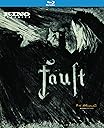
Faust (F.W. Murnau, Restored Deluxe Edition)
Product ID: 24042476
Details
- ContributorEkman Gosta
- FormatBlu-ray NTSC
- GenreHorror Special
- LanguageEnglish
- Runtime1 hour and 46
Desertcart purchases this item on your behalf and handles shipping, customs, and support to Panama.
RESTORED DELUXE EDITION Mobilizing the full resources of the Ufa Studios, F.W. Murnau (Nosferatu, Sunrise) orchestrated a colossal adaptation of Goethe's FAUST that ranks alongside Fritz Lang's Metropolis as the greatest achievement of the German silent cinema. Gösta Ekman stars as the titular alchemist who, struggling with his faith amidst a devastating plague, is offered the power to cure and the gift of youth...in exchange for his soul. As the diabolical Mephisto, Emil Jannings (The Last Laugh) delivers a performance of operatic scale and intensity, by turns charming, comical, and horrific. This special Kino edition contains the Friedrich Wilhelm Murnau Foundation’s meticulous restoration of the original German version of the film (with unique hand-painted intertitles), as well as a lengthier alternate cut prepared by the Ufa Studios in 1930. FAUST: Eine deutsche Volkssage Germany / 1926 / 106 Min. / B&W / 1.33:1 Directed by F.W. Murnau From the play by Johann Wolfgang Goethe Produced by Erich Pommer Photographed by Carl Hoffmann With Emil Jannings, Gösta Ekman, Camilla Horn, Wilhelm Dieterle Score compiled from historic photoplay music by The Mont Alto Motion Picture Orchestra Previous U.S. Release Version 116 Min. / B&W / 1.33:1 Music composed and conducted by Timothy Brock Performed by The Olympia Chamber Orchestra Produced for video by David Shepard Special Features: • Piano score by Perez de Azpeitia, adapted from the original 1926 orchestral arrangement • Orchestral score by the Mont Alto Motion Picture Orchestra • Orchestral score by Timothy Brock, performed by the Olympia Chamber Orchestra (U.S. Release version) • "The Language of Shadows: Faust" (53-minute documentary on the making of the film and its subsequent restoration) • Screen test footage of Ernst Lubitsch's abandoned 1923 production Marguerite and Faust Review: A Most Unpredicatable Journey - Familiarity with neither Marlowe's "Tragedy of Doctor Faustus" nor Goethe's "Faust" will prepare you for this Murnau masterpiece. It is a film that truly surprises, clearly echoing its protagonist's own journey from greatness to aimless indecision, unintended disaster, and finally a strong resolution. This insanely brilliant yet highly uneven work is a clear and beautiful transition from the fantastic expressionistic horror of Murnau's " Nosferatu " to the dark and stunningly beautiful tragic romance of " Sunrise ." It is almost schizophrenic in its scope, but it pays off masterfully in the end. "Faust" begins as a stylized satanic horror film, rife with the most absolutely jaw-dropping special effects that would not be outdone for decades to come. At the heart of this first act is (unsurprisingly) Faust, a spiritual, saintly man who is forced to play Job to a quarreling Angel and Devil. Unfortunately, Faust has his breaking point and descends, brilliantly, into the world of the damned. For the first hour of the film, we are subjected to cinematic wonder after cinematic wonder as Murnau and crew constantly manage to top each and every visual that they throw at you. Even when Faust signs away his soul and seems to lose all of his dramatic potential, the visuals keep you glued to your seat. About an hour into the film, though, the film takes an abrupt turn. Just as Faust becomes bored and indecisive with his newfound powers, Murnau seems to become bored and indecisive with the direction of his powerful film. It descends into a black comedy which, although humorous at points, feels highly tedious and out of place. Fortunately, as this chapter wraps up after approximately 30 minutes, it's purpose becomes clear. The film then transitions into a gritty tragedy about Gretchen, Faust's love interest introduced in the previous act. Like the previous one, this dark and depressing act seems to come out of nowhere, not even featuring Faust and seemingly having little to do with the story begun in the first act. However, just as Gretchen's fortunes take an even greater turn for the worse, the film makes a stunning transition, leaping to life with brilliant action, drama, effects, camera work, and acting. For the rest of my life, I doubt that I will ever forget Gretchen's primal cry for Faust, visually transcending distance and the boundaries of Hell itself. The film ends soon after, but not before delivering gorgeous, dramatically saturated moment after moment. The end leaves you with a feeling of elated sorrow -- something I never would have expected from what began as an expressionist horror film. In the end, Faust is a wonderfully cruel love tragedy, soaring with emotion even higher than it ever soared with the best cinematic imagery of its day. "Faust" is a must see for anyone that shares an equal love for satanic horror and divine tragedy. You'll get both in equal measure, here. Regarding the transfer itself, Kino does an adequate job, but there's certainly room for improvement. The transfer has its share of jumps, scratches, imperfections, and minor over-all graininess, all while suffering from seemingly poor contrast. It's absolutely watchable, but I'd love to see the Murnau Foundation take this film to the next level, making it shine in the way that it deserves to. I do have to say that the score on Kino's release is incredible, though, absolutely complimenting and nurturing every aspect of Murnau's masterpiece with a Wagner-inspired energy. I'd hate to watch this film without it. **Note: This review pertains to the 2001 Kino release. Kino has since released a newly remastered edition with a different score. Review: My new favorite silent film - I just watched the F. W. Murnau silent film version of Faust from 1926 and it was surprisingly good. It's from the director of Nosferatu and heavily based on the Goethe version of the Faust legend, not the Christopher Marlowe verison. Marlowe's Faust ends in a bleak and very hopeless kind of way whereas Goethe has Faust redeemed at the end with the idea that caring about others and love is the most powerful and most transcendent force in the universe and that, as it is the ultimate goodness, you cannot be damned if you can love. This silent film is heavily based on the more hopeful version of the story by Goethe, containing elements of both part 1 and part 2 of Goethe's Faust. I strongly recommend this for anyone who is a fan of Goethe's version of Faust. I sort of wish it would get a remake, still set in the fifeenth / sixteenth century and with the same ending (even if people do find the idea of love redeeming you to be saccharine). I think we need stories like this. And it is a shame the Goethe version of Faust isn't more well known in the English speaking world. This two disc DVD contains my now favorite silent film. This is the only film version of Faust to cover both Part 1 and 2 of Goethe's Faust. It strays a bit but the bulk of the story, particularly most of the Faust / Gretchen storyline is in tact. Most people only adapt the Christopher Marlowe version of the Faust legend if they are even familiar with it at all, which is sad because Goethe's version is the only one where Faust gets redeemed at the end. Faust is the German legend loosely based on a real life alchemist and self-proclaimed sorcerer. From this legend we get the demon name Mephistopheles AKA Mephisto, who in the legend, was not Satan himself but actually a high ranking demon. This adaptation is from the director of Nosferatu. Apparently he loved to refilm many scenes several times in several different ways so at one point there were thirty different versions of this film floating around, some with differing dialogue, some with scenes shot slightly different, some with scenes missing, some with scenes added. Film historians have found five. This DVD contains two of them. An American release, and the original German version restored as much as possible to it's original content. The German version is on disc 1 with an option for English subtitles. The American cut is on disc 2. One scene that was changed in some versions is there's a scene with a bear. Some versions it's a man in a bear costume. Some with a live bear and in one cut the bear obviously actually hurt one of the actors but they leave it in. I have seen people complain that Mephisto is too comical and not dark enough but clearly these people are not that familiar with Goethe's version of Faust. Mephisto was flamboyant, comical, but yes, evil. And that's what you get here. I have also seen the complaint that they "Tacked on" Faust going to Heaven and even the love story because "That's not in Marlowe's version." This is NOT Marlowe's Faust. Most of this version is based on the Goethe version of the story. One thing that they changed for this film is one thing that they probably should have left alone. in Goethe's Faust the deal was for the ultimate experience, the moment Faust would wish to never end. In this film that's not the bargain. But considering how easily bored and distracted Faust gets at times I think it would have made certain parts better if that had been the deal. In general though this is the only film version to truly tackle both parts of Goethe's Faust and they did it very well.
| Contributor | Ekman, Gosta, Jannings, Emil |
| Customer Reviews | 4.7 out of 5 stars 411 Reviews |
| Format | Blu-ray, NTSC |
| Genre | Horror, Special Interest |
| Language | English |
| Runtime | 1 hour and 46 minutes |
S**R
A Most Unpredicatable Journey
Familiarity with neither Marlowe's "Tragedy of Doctor Faustus" nor Goethe's "Faust" will prepare you for this Murnau masterpiece. It is a film that truly surprises, clearly echoing its protagonist's own journey from greatness to aimless indecision, unintended disaster, and finally a strong resolution. This insanely brilliant yet highly uneven work is a clear and beautiful transition from the fantastic expressionistic horror of Murnau's " Nosferatu " to the dark and stunningly beautiful tragic romance of " Sunrise ." It is almost schizophrenic in its scope, but it pays off masterfully in the end. "Faust" begins as a stylized satanic horror film, rife with the most absolutely jaw-dropping special effects that would not be outdone for decades to come. At the heart of this first act is (unsurprisingly) Faust, a spiritual, saintly man who is forced to play Job to a quarreling Angel and Devil. Unfortunately, Faust has his breaking point and descends, brilliantly, into the world of the damned. For the first hour of the film, we are subjected to cinematic wonder after cinematic wonder as Murnau and crew constantly manage to top each and every visual that they throw at you. Even when Faust signs away his soul and seems to lose all of his dramatic potential, the visuals keep you glued to your seat. About an hour into the film, though, the film takes an abrupt turn. Just as Faust becomes bored and indecisive with his newfound powers, Murnau seems to become bored and indecisive with the direction of his powerful film. It descends into a black comedy which, although humorous at points, feels highly tedious and out of place. Fortunately, as this chapter wraps up after approximately 30 minutes, it's purpose becomes clear. The film then transitions into a gritty tragedy about Gretchen, Faust's love interest introduced in the previous act. Like the previous one, this dark and depressing act seems to come out of nowhere, not even featuring Faust and seemingly having little to do with the story begun in the first act. However, just as Gretchen's fortunes take an even greater turn for the worse, the film makes a stunning transition, leaping to life with brilliant action, drama, effects, camera work, and acting. For the rest of my life, I doubt that I will ever forget Gretchen's primal cry for Faust, visually transcending distance and the boundaries of Hell itself. The film ends soon after, but not before delivering gorgeous, dramatically saturated moment after moment. The end leaves you with a feeling of elated sorrow -- something I never would have expected from what began as an expressionist horror film. In the end, Faust is a wonderfully cruel love tragedy, soaring with emotion even higher than it ever soared with the best cinematic imagery of its day. "Faust" is a must see for anyone that shares an equal love for satanic horror and divine tragedy. You'll get both in equal measure, here. Regarding the transfer itself, Kino does an adequate job, but there's certainly room for improvement. The transfer has its share of jumps, scratches, imperfections, and minor over-all graininess, all while suffering from seemingly poor contrast. It's absolutely watchable, but I'd love to see the Murnau Foundation take this film to the next level, making it shine in the way that it deserves to. I do have to say that the score on Kino's release is incredible, though, absolutely complimenting and nurturing every aspect of Murnau's masterpiece with a Wagner-inspired energy. I'd hate to watch this film without it. **Note: This review pertains to the 2001 Kino release. Kino has since released a newly remastered edition with a different score.
A**E
My new favorite silent film
I just watched the F. W. Murnau silent film version of Faust from 1926 and it was surprisingly good. It's from the director of Nosferatu and heavily based on the Goethe version of the Faust legend, not the Christopher Marlowe verison. Marlowe's Faust ends in a bleak and very hopeless kind of way whereas Goethe has Faust redeemed at the end with the idea that caring about others and love is the most powerful and most transcendent force in the universe and that, as it is the ultimate goodness, you cannot be damned if you can love. This silent film is heavily based on the more hopeful version of the story by Goethe, containing elements of both part 1 and part 2 of Goethe's Faust. I strongly recommend this for anyone who is a fan of Goethe's version of Faust. I sort of wish it would get a remake, still set in the fifeenth / sixteenth century and with the same ending (even if people do find the idea of love redeeming you to be saccharine). I think we need stories like this. And it is a shame the Goethe version of Faust isn't more well known in the English speaking world. This two disc DVD contains my now favorite silent film. This is the only film version of Faust to cover both Part 1 and 2 of Goethe's Faust. It strays a bit but the bulk of the story, particularly most of the Faust / Gretchen storyline is in tact. Most people only adapt the Christopher Marlowe version of the Faust legend if they are even familiar with it at all, which is sad because Goethe's version is the only one where Faust gets redeemed at the end. Faust is the German legend loosely based on a real life alchemist and self-proclaimed sorcerer. From this legend we get the demon name Mephistopheles AKA Mephisto, who in the legend, was not Satan himself but actually a high ranking demon. This adaptation is from the director of Nosferatu. Apparently he loved to refilm many scenes several times in several different ways so at one point there were thirty different versions of this film floating around, some with differing dialogue, some with scenes shot slightly different, some with scenes missing, some with scenes added. Film historians have found five. This DVD contains two of them. An American release, and the original German version restored as much as possible to it's original content. The German version is on disc 1 with an option for English subtitles. The American cut is on disc 2. One scene that was changed in some versions is there's a scene with a bear. Some versions it's a man in a bear costume. Some with a live bear and in one cut the bear obviously actually hurt one of the actors but they leave it in. I have seen people complain that Mephisto is too comical and not dark enough but clearly these people are not that familiar with Goethe's version of Faust. Mephisto was flamboyant, comical, but yes, evil. And that's what you get here. I have also seen the complaint that they "Tacked on" Faust going to Heaven and even the love story because "That's not in Marlowe's version." This is NOT Marlowe's Faust. Most of this version is based on the Goethe version of the story. One thing that they changed for this film is one thing that they probably should have left alone. in Goethe's Faust the deal was for the ultimate experience, the moment Faust would wish to never end. In this film that's not the bargain. But considering how easily bored and distracted Faust gets at times I think it would have made certain parts better if that had been the deal. In general though this is the only film version to truly tackle both parts of Goethe's Faust and they did it very well.
K**L
Great silent film adaption of a classic story
As is to be expected of a great director, (F.W. Murnau, "Nosferatu", "The Man Who Laughs"), "Faust" delivers a brilliant adaption of this classic story concerning the perennial subject of good versus evil. Though, not apparently the first telling of this story, (IMDB lists 5 previous films with this title), it's perhaps, (to my knowledge) the oldest surviving version available. Its brilliance deserves preservation. In a world struggling against pestilence, famine, and disease Mephisto decides he can attempt a hostile take-over through a real estate deal. The Archangel Michael agrees, that if Mephisto can win Faust over to his side, he gets the kit and kaboodle. Faust is a tired old doctor/alchemist who is disappointed at his inability to offer healing to those with the rampant-running plague. Soon, he calls on Mephisto and strikes up a deal with him. Mephisto gives him youth and pleasures of the world, until Faust falls for a simple girl. This film is brilliantly done, with fantastic effects and brilliant storytelling. Some scenes are downright eerie, like Mephisto standing over the town with ravens wings. Emil Jennings plays a brilliant Mephisto, somewhere between the brilliant humor of mythical Loki and the dark evil vision of Zarathrustra's Angra Mainyu. Gösta Ekman is brilliant as Faust as well, from withered old man to young libertine, he shows talent rarely seen on the screen in recent time. Though there aren't a lot of features on this disc, (including a nice photo gallery, a link to Kino's website, and scene selection), the print is beautiful for its age, and the music recently recorded and very appropriate. The price is a little high, but your not purchasing a sad copy for a few bucks, but a masterpiece both in original content and painstaking preservation. This film is worthy of being in any collection interest in great filmmaking.
L**)
wonderfully atmospheric
This is a 1926, feature-length (the disc cover says 85 minutes, but it ran closer to two hours) silent version of Goethe’s supernatural story, directed by F. W. Murnau (Nosferatu) and starring Emil Jannings (The Blue Angel) as Mephisto. I don’t know how much of its wonderfully spooky atmosphere was created intentionally and how much of it is due to the inevitably aged (almost 100 years!) film, but whatever produced it, it certainly works. Everything is very dark and seemingly glimpsed through thick fog or smoke, and at time the screen even seems to pulse, like Poe’s Telltale Heart—a perfect accompaniment to this tale of temptation, seduction, and ruin. (For the record, the version I bought was the one labeled Desert Island Classics; I don’t know how the film restoration quality on this compares with other versions.) I found it interesting that Jannings played Mephisto, not as the suave trickster usually pictured, but as smarmily ingratiating, a sort of demonic Uriah Heep. There were some other interesting variations on the usual Faust story (at least as I’d heard it), too, including the fact that Faust initially signs on with Mephisto for the laudable motive of curing his fellow townspeople who are dying from an epidemic of plague. (They are as ungrateful to him as later townspeople are cruel to poor Gretchen, the pure maiden whom Faust seduces and abandons.) There’s also a semicomic subplot (a rather unnecessary distraction, in my opinion) involving Mephisto and Gretchen’s lusty Aunt Marthe, in which the hapless devil comes out second best. I strongly recommend this Faust version to anyone interested in the Faust story, in dark fantasy, or in early films with occult/magical themes.
J**Y
Fantastic Silent.
I bought this without having previously viewed it, because so much has been written about the visuals and atmosphere. I'm no film expert, but I can tell that this film is something very special. Its like David Lynch only good. Murnau basically keeps a theme while being an expressionist; something modern "art" film makers can't seem to do. Murnau has done the impossible: told a full length story with a beginning and end using only images and feelings. You feel every one in your bones and if you're like me, you'll appreciate every frame of the movie. There seems to be not one shot in the whole movie that doesn't have meaning on its own. All this being said, what is the film about? I was not previously familiar with Faust except for knowing he was the "guy who made a deal with the Devil" thing. Devil makes deal with archangel (stunning depictions by the way), Devil in part of deal tries to corrupt long-bearded Faust. Faust is a pompous academic whose piety and devotion to God you always doubt from the beginning (probably from his alchemist background). The Devil easily entices Faust to make a 24 hour pact in which time he successfully introduces Faust to all the things he normally reserves for those who either have good looks, youth, riches or all three and Faust; about to partake of a beautiful woman for (what we assume) his first time, is forced to either lose his newly found youth or make the pact eternal in the face of end of the 24 hour pact immediately impending. The rest is a spoiler so I won't ruin it except to say that there is much joy and sorrow the rest of the way. The acting by Faust and the Devil is first rate. The rest of the acting is good. Gretchen is fun to watch, especially when she shuffles around her house. The movie itself lives on its own. The ending seems abrupt upon first watching, but upon subsequent watchings it seems to make far more sense. Favorite moment: I have two, when Mephisto makes a scary face at Gretchen when she is going to church, and when the archangel raises his flaming sword in judgement against the Devil. Greatest wonderful surprise: The orchestral score that plays with the movie is fantastic. Better than any I've ever heard with a silent. Extras: Not many. Just some production photos and a hard copy of an essay written about the movie by some guy. Movie rating: 9 out of 10. Some may say the middle part drags a little, but I think that was intentional in order to bring out some thematic ideas.
D**R
I enjoy these early 1900's movie classics.
Classic movie.
M**K
Murnau at his best
For those few who like the classics, this 2-disk DVD set of Faust is one of them. This is Weimar moviemaking at its best, guided by Murnau's genious. Keep in mind that there are 3 versions of the movie in the box. The "original" (1926) version, an extended (1930) UFA version, as well as the "american" edition (with English inter-titles). Though I do not speak German, I very much prefer the two european versions. The "subtitles" are perfectly good in translating, and one gets to see and "read" the German writings, Gothic fonts and all. The restoration work needed (and done) for bringing this 90-year old film to life is phenomenal. For all the magic seen here these folks might as well be Hogwarts grads. On a more technical note, the sound track (music score performed by the Mont Alto Motion Picture Orchestra) can be heard in 2.0 stereo, or better yet in 5.1 surround. The latter provides a wonderful sonically immersive experience.
D**E
IMHO
Classic story, classic movie, well done restoration, product is more than advertised. The most astounding thing is the musical score for the US version by the Olympia Chamber Orchestra - the score, the scoring and the performance are all masterful. These restorations - good as they are...are dark with age and best viewed on a bright screen. I have watched both DVDs in real time and with media player classic - a freebie player that can run the show at 1.2 speed (I am sure this is not unique). Digitally is doesn't effect pitch, and the characters seem to be more human and less movie -like. I presented the film along with the Goethe play at book club and not one person could tell that I had sped up the video...perhaps it's the modern world we live in...
I**I
Capolavoro
Questo film è una straordinaria visione gotica del creatore di Nosferatu. Sono immagini che si mescolano ad una sensazione di incubo. Da non perdere anche per la doppia versione DVD e Blue Ray.
J**4
Einer der allerwichtigsten Stummfilmklassiker überhaupt in mehreren Versionen
Der Bielefelder Regisseur Friedrich Wilhelm Murnau (1888-1931) ist einer breiteren Masse eigentlich nur durch einen einzigen Film überhaupt ein Begriff:"Nosferatu- Eine Symphonie des Grauens" (1926). Unter seinen 22 Filmen-etliche davon heutzutage verschollen- gibt es aber noch andere Highlights zu entdecken. Sein "Faust- Eine deutsche Volkssage"(1926) zumindest ist so faszinierend, dass es eigentlich in einem Atemzug mit Werken wie "Metropolis", "Cabinet des Dr. Caligari" oder "Der Golem" genannt werden müsste. Das Setdesign war großartig, und der Aufwand, der für den Film betrieben wurde immens. In einer Szene am Hof der Herzogin von Parma des opulenten Werkes tauchen sogar zwei wie verkleidet aussehende Elefanten auf (die allerdings aus Stoff waren, aber absolut echt wirkten) ; in einer anderen ringt ein Mann mit einem echten Bären. Die Schauspieler und auch die Statisten sind großartig, allen voran natürlich Emil Jannings ("Der blaue Engel") als Mephisto. Murnau liess sich auch unglaublich viele Effekte und Kameraratricks einfallen, die das Werk auch nach über 90 Jahren noch visuell interessant wirken lassen. Und nicht zuletzt hat er mit "Faust" ein urdeutsches Thema gewählt und es in die Welt hinausgetragen. Die unglaublich gute Box enthält zwei DVDs, eine BluRay und ein informatives, 44 Seiten starkes Booklet zur Entstehung des Films. Von dem Film existieren viele verschiedene Schnittversionen, von denen die zwei besten hier vertreten sind, die völlig anders gefilmt und geschnitten wurden: Eine für den deutschen Markt und eine Exportversion mit englischen statt altdeutschen Zwischentiteln. Murnau filmte mit zwei nebeneinanderstehenden Kameras, weshalb sich die Filme in den gewählten Blickwinkeln deutlich unterscheiden. Manchmal weist eine Kamera auch eine Nahaufnahme vor, die in der anderen Version nicht enthalten ist. Ausserdem unterscheiden sich die Filme im Schnitt bzw in der Länge einzelner Szenen und der Gesamtlänge. Während die heimische Version eine Länge von 1:47:20 Minuten vorweist kommt die Exportversion auf eine Spielzeit von 1:55:43 Minuten. Unter den Extras befindet sich ein 26:46 Minuten langes Special, das die beiden Versionen miteinander vergleicht. Natürlich bleibt es immer der gleiche Film, aber die Unterschiede sind schon erheblich, auch wenn es einem wahrscheinlich nicht sofort von alleine auffallen würde. Die Friedrich Wilhelm Murnau-Stiftung restaurierte nur die "domestic Version", weshalb sich auch die Bildqualität auf interessante Art voneinander unterscheidet. Alleine diese ist mit vier verschiedenen Tonspuren anwählbar. Es gibt eine Version mit Orchestermusik, eine mit Harfenmusik und eine mit Pianobegleitung. Die vierte Tonspur enthält einen informativen Audiokommentar. Ein weiteres Extra ist ein 39:24 Minuten langer Kommentar zu dem Film des britischen Filmhistorikers Tony Rayns und eine 58:59 Minuten lange Dokumentation mit deutschem Ton und englischen Untertiteln namens "The language of Shadows". Dieses Special erklärt auch, warum überhaupt verschiedene Schnittversionen existieren. All diese Extras sind auf der BluRay enthalten, während es auf den DVDs vor allem die verschiedenen Filmversionen zu begutachten gibt und nicht alle Extras hier vorhanden sind. Insgesamt gesehen ist das Paket jedoch von atemberaubender Qualität und Pflichtprogramm für jeden, der sich für Stummfilmklassiker interessiert.
Y**U
綺麗🌟
到着予定日より早く届いてたから良かったです。問題無いです。
S**E
Great story telling and visually stunning
I have to say that the more I delve deeper into these silent movies, the more I am impressed by the art direction, attention to detail and the over all quality of these movies. I bought Faust on the strength of Nosferatu and I have to say that I was most certainly not disappointed. The first thing I will say about this film is how nicely simple the story is. The plot is pretty basic with some nice religious themes, love, betrayal and some more dark elements thrown into one big mixed bag. But the director has done a great job of taking these qualities and making it so easy to follow that the pacing was absolutely perfect. My favourite thing about this movie is the visual element. There are a lot of heavy religious themes, most of which are fairly stereo typical old time Christianity. On top of that you have a fantastic intro sequence featuring the Devil and an Angel, this sequence alone is absolutely beautiful and had me taken back. The rest of the film features some beautiful set work all of which had a magnificent use of lighting. It didn't matter whether the set was made to look heavenly, devilish or to emphasise the look of death and decay, it looked absolutely gorgeous without, and all this is without mentioned some of the incredible visual effects sequences. Those are a sight to behold. Extremely impressive for the technical limitations of the day. Those looking for a stunning fantasy movie about selling your soul to the devil, falling in love and reaping the consequences will absolutely adore this film. The bluray transfer whilst scratchy in places (it is 90 years old after all) still looks very sharp and is well suited to modern high definition television sets. I had an absolute blast with this movie and I couldn't recommend it more.
H**H
Good movie.
Good movie.
Trustpilot
1 month ago
4 days ago