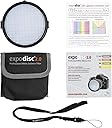
🎨 Capture True Colors with Confidence!
The ExpoDisc 2.0 82 mm Professional Balance Filter is a must-have tool for photographers and videographers seeking to achieve accurate white balance effortlessly. With user-selectable warming filters, precise 18% incident exposure metering, and a unique dust mapping feature, this hand-calibrated filter ensures your images are always pristine and true to life. Proudly made in the USA, it's designed for professionals who demand the best.


| ASIN | B00O4CWC4C |
| Brand | ExpoDisc |
| Built-In Media | Calibration Certification Card, ExpoDisc 2.0 Professional 82mm White Balance Filter, Lanyard, Lanyard Carry Pouch, User Quickstart Guide |
| Coating Description | No Coating |
| Coating description | No Coating |
| Color | black |
| Customer Reviews | 4.6 out of 5 stars 1,543 Reviews |
| Enclosure Material | Optical Glass |
| Global Trade Identification Number | 00751751000176 |
| Item Dimensions L x W | 8.3L x 8.3W centimeters |
| Item Weight | 0.1 Pounds |
| Manufacturer | ExpoDisc |
| Manufacturer Part Number | EXPOD2-82 |
| Material | Optical Glass |
| Model Number | EXPOD2-82 |
| Photo filter effect type | Color Correcting |
| Photo filter thread size | 82 Millimeters |
| Screen Size | 82 Millimeters |
| Special Effect | Color Correcting |
| Thread Size | 82 Millimeters |
| UPC | 696720684769 751751000176 |
| Water Resistance Level | Not Water Resistant |
| Water resistance level | Not Water Resistant |
M**R
Really great product, well thought out.
Nicely made, details are well thought out, and instructions are very thoughtful and comprehensive. I don't need the instructions or theory behind the ExpoDisc's use given my photography knowledge, but it surely was appreciated when I read the brief manual that it was put together with care in this day and age of poorly translated generic instructions. The silicone case with tether points exceeded my expectations. I think that maybe a metal frame would be on my list of desires for the next ExpoDisc iteration.
T**A
ECCELLENTE (se usato bene).
Uso ExpoDisc da 72mm (versione precedente) già da alcuni anni e ho acquistato questa ver. 2.0 da 77 mm a maggio 2015 per comodità d'uso su ottiche Nikon con questo diametro frontale. Basta comunque averne solo uno con il diametro dell'obiettivo più grande e, con adattatore opportuno o semplicemente poggiato davanti alla lente, può essere usato per qualsiasi diametro inferiore. In quest'ultimo caso, anche se non strettamente necessario, consiglio di usare un anello adattatore così da avere le mani libere e per ottenere una posizione più stabile dell'accessorio. Sia la prima che questa versione sono, se impiegati correttamente, eccellenti, sia per il bilanciamento del bianco che per la misurazione dell'esposizione in egual misura. La luce filtrata rispecchia un valore espositivo pari alla luce riflessa dal classico grigio 18% che è quello su cui sono tarati gli esposimetri incorporati delle fotocamere qualora fossero usati normalmente senza l'uso di ExpoDisc, vale a dire che se si effettua una misurazione della luce riflessa dal grigio 18% (cartoncini, tesserine, pannelli o altri accessori appositamente costruiti per la misurazione dell'esposizione fotografica in luce riflessa) si avrà la stessa lettura esposimetrica data dalla luce filtrata da ExpoDisc posizionato al posto del grigio 18%. ExpoDisc va usato in luce incidente. Montato davanti all'obiettivo, si posiziona al posto del soggetto, rivolto verso il punto di ripresa, e si può misurare sia WB che esposizione. Questo nell'uso generale. Per uso più specialistico invece, per il WB é corretto rivolgere ExpoDisc verso la fonte luminosa, a patto che sul soggetto non cada luce riflessa da superfici colorate circostanti che creino dominanti cromatiche, in tal caso queste ultime verrebbero ignorate. Potrebbe essere un vantaggio oppure un problema, la valutazione spetta all'esperienza del fotografo. Per l'esposizione andrebbe invece orientata la superficie di ExpoDisc come la parte del soggetto che si vuole esporre correttamente ed esattamente nella stessa posizione, considerando nel contempo dove e come ottenere, se presenti, alte luci e/o ombre nel risultato finale; anche qui conta molto l'esperienza del fotografo. Se orientato e posizionato correttamente per l'esposizione, basterà impostare sulla fotocamera valori conformi alle indicazioni dell'esposimetro interno senza sovra o sottoesporre, salvo che si vogliano ottenere volutamente effetti particolari. Questa versione 2.0 si aggancia al filetto dell'ottica (o a quella dell'anello adattatore) molto meglio della versione precedente ed è molto più comoda da maneggiare dato il maggior profilo (13,5 mm anziché 10 mm), nella parte anteriore ha prismi da 4 mm di lato (3 mm nella versione precedente) ed è molto ben fatta. Nella confezione originale ho trovato una comoda custodia semirigida nera, un pratico cordino con clip a sgancio rapido, 4 filtri "portrait" in gelatina (usabili singolarmente o combinati da montare all'occorrenza sulla stessa montatura) e un cartoncino che ne certifica la calibrazione. ExpoDisc non sostituisce esposimetri o colorimetri costosi e blasonati, ma è certamente un fedele "compagno" sempre pronto a fare un ottimo lavoro ..... e non ha neppure bisogno di pile!!!..
R**G
Fantastic
This product really has made a significant difference to my photo & video work. Even when I'm shooting in RAW video format, I can shoot a short reference clip through the filter to get a good reference point for colour correction. For photo work, this is indispensable. I particularly like that it has a quick release and I don't have to thread it on & off.
M**O
Perfect add-on for my camera
Excellent it does magic when you use it properly
H**Y
Both White-Balance and Exposure, But Don't Throw out the Cards
This is a very trick tool. It serves two functions at once, white-balance and exposure metering. Ever wonder why this is called "Expo" Disc? For this combined role, this is a convenient tool. However, there are times when cards are better. Where space is tight or precision is crucial, such as macrophotography or product photography, a separate white-balance card and exposure card will be more convenient. They can be put in positions where I simply cannot manuever my camera with this filter on. It is useful as a reference. I use this one device as reference for other white-balance cards and gray cards. It is particularly useful for measuring exposure offset of a given white-balance card; white-balance cards are usually a stop brighter than 18. Using the offset, I can use the white-balance card for exposure as well. Good for above tight situations. The build and finish are cheap for the price. This is made entirely out of plastic. And the outer plastic is not particularly well formed. It fits but it could definately use improvement. If you are on the cheap, you can do with a white-balance card and a gray card. But the quality cards are not cheap either. This is a good product and serves its purpose well.
Trustpilot
1 week ago
1 month ago