


Desertcart purchases this item on your behalf and handles shipping, customs, and support to Panama.
๐ Find studs like a pro, drill with confidence!
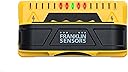
The Franklin Sensors ProSensor M150/X990 is a top-tier stud finder featuring 9 sensors for superior accuracy, a deep 1.5-inch scan range for wood and metal studs, and built-in live AC wire detection to ensure safe drilling. Its no-calibration, instant-scan design and full-width stud visualization via LED display make it the go-to tool for professionals and DIYers alike.
| ASIN | B0917TH83L |
| Best Sellers Rank | #844 in Tools & Home Improvement ( See Top 100 in Tools & Home Improvement ) #3 in Stud Finders & Scanners |
| Brand | Franklin Sensors |
| Brand Name | Franklin Sensors |
| Customer Reviews | 4.4 out of 5 stars 4,410 Reviews |
| Included Components | Range |
| Item Dimensions | 5.51 x 2.99 x 2.01 inches |
| Item Highlight | Accurate Stud Finder Wall Scanner With Electric Wire Finder, Wood and Metal Stud Detector, Made in the USA |
| Item dimensions L x W x H | 5.51 x 2.99 x 2.01 inches |
| Manufacturer | Franklin Sensors |
| Material | Plastic |
| Material Type | Plastic |
| Model | ProSensor M155 |
| Number of Items | 1 |
| Output Type | Digital |
| Part Number | FSM15002HD |
| Sensing Distance | 1.5 inches |
| Style | Compact |
| Style Name | Compact |
| UPC | 853435004415 |
| Unit Count | 1 Count |
B**.
Much better than single sensor stud finder
makes finding the stud fast, easy and accurate. Also the live wire detection has been really helpful in tracing wires behind the wall. This is a huge leap forward compared to my old single sensor stud finder!
M**A
Unbelievably Impressive
Stud finderโs are a tool every person should have in their toolbox, whether you are a tradesman, handyman, or DYI. As for myself, I am handyman and invested in about 3-4 of them. The reason I decided to try this brand is the previous brands would detect a stud but it was hard to find out where the center was. This is very important because when installing or hanging something, you want to be in the center because the item you are installing can dislodge from the stud and cause damage to the home. In my opinion, THIS BRAND IS THE GREATEST and you will not purchase another after using this product. I speak so highly of this product because of its consistent accuracy of detecting the stud and reveals the center. You actually see the light bar detect the edge of the stud, and then as you maneuver the device, it tracks the stud until you notice a green light, which is the center of the stud-mind blowing!!!! I built a simulated wall with studs, electrical wiring, and sheetrock. So, I did not conceal all of the studs with sheetrock, therefore I could witness exactly what the device is monitoring. I placed the device on the sheetrock and maneuvered side to side, as if I am looking for a stud on a finished wall. As, I reached the edge of the stud, the light-bar illuminated red, which indicated the device had detected the stud. As I continued towards and over the stud, the light-bar continued to illuminate and tracked the stud. However, as I reached the center of the stud, there was a green light in the middle of the device. This product revealed the green light 10/10 tries and every attempt was directly in the centerโฆ.did I hear someone say marksman! Another impressive feature of the product, โMX150/X990 with live wire detection,โ there is an amber lighting bolt on both sides of the device, therefore it can detect live wires. To test this feature, I wired an outlet on two different studs and on opposite sides (left and right), So, not only did the green light reveal the center but also the side the electrical wire was secured. Shockingly, 10/10 times, the amber lighting bolt was correct every time I maneuvered the device close to the wire or over the stud. The product arrived in a small box and neatly seated inside a plastic wrapping with instructions and a thank you card. The instructions were easy to read, clear to understand, and imprinted on the bottom of the device. Once, you remove the item from the box, there is a black cover, and on the left side, there are about 3-5 lifted lines. You gently push away from you and donโt go too fast because on the oppose side of the removable cover are slide inserts, which can break if you are not careful. The product is very durable and thoughtfully constructed. So, nothing should break unless you handle the product very aggressively. As the instructions state, the product does not get shipped with batteries, so you will have to purchase or if you have some around the house, you will need (2xAAA) batteries. After inserting the batteries, reinsert the battery cover, and you are ready to go. Above the battery cover, the handle has 3 wavy indents which are purposely designed for your fingers, typically the index, middle, and ring ringers. Below the handle is a small arch with lifted lines, which is designed for seating your thumb. Now, you have a full grip on the device and it will not fall. After, you have a comfortable grip position on the handle, compress your three fingers and you should notice the device do a quick flash of the led bars. After, you will have to test the device. Do so by compressing the device with your three fingers and with the opposite hand, not holding the device, way you index finger under. You should notice the led bar tracking your finger. Your finger simulates a thin space then density, just like a finished wall with studs-Genius! Once the device is able to track your finger, now you can test the device on the walls and find those studs. Just an fyi, the product was thoughtfully designed to operate ambidextrously (both hands). I was able to hang pictures, televisions with brackets, electrical outlets, and basically anything you want to hang on a wall which you will fasten into the stud. Each attempt, the device pinpointed the of center of the stud and I did not have any self doubt. Overall, I am extremely impressed with this product and very happy with the purchase.
J**M
The Worst Case Scenario (Maybe)
Having had a basic Zircon unit from around 2005, it was at times frustrating to use with concerningly inconsistent results. You'd get a beep, then pick it up and try to place it over a stud bay, reset it and try again, and then there would be nothing where the prior hit was. Studs would seemingly move as if something changed in The Marix or the house was dynamically rearranging itself. Then I bought a magnetic stud finder (Hanson) which is great at finding drywall screws. That simple solution works most of the time, but not always: I have a home office that's a finished room in my barn. Inside the barn is an old carriage house that someone built a barn over without tearing it down. The history is pretty interesting to me. My office is in the old carriage house part, and to run new outlets, Ethernet, hang shelves, etc, I obviously needed to know where the studs are. The walls out there are an odd combination of weirdly spaced studs and there are old window openings that have since had studs placed in them and have been walled over. Some of the studs are 14" apart, some 18", a couple are standard 16" and there's a 20ish" stud bay in one spot. I'd love to know what the history is there. Maybe an inhebriated farmer with a hammer? In some places there's some kind of exterior cladding and siding in there with a gap between it and other material. Some of the drywall was hung from this intermediate material rather than the "studs," (using that term loosely) so using the screws as a guide with the magnet was useless. The interior wall looks completely normal, but finding studs in the mess beneath it was an absolute nightmare. In desperation, I bought this device. While unsurprisingly, even it struggles with the scenario above, I was able to map out the odd placement of studs in the wall, including the outlines of old windows. That was still a tedious process, but was infinitely easier with this device. I love that you can see the thickness of the studs, since some of the lumber in there is pre WW2 and is actually true to dimension. You can also find doubled up studs easily. The tech has come a long way over the years and in my opinion this is absolutely worth the money.
P**N
Sometimes better, sometimes worse than my old Craftsman.
I have been using an old Craftsman stud finder for many years. It works well, shows approach to a stud, contact and then the departure via LEDs and audible signal for strength of the contact. I purchased this one while putting up a garage storage lift that would be holding 400 lbs. I was having issues locating floor joists reliably. Not sure if it was insulation density, duct work, pipes or what, but some areas just gave weird readings. This seemed to be the best rated item for the money, so I gave this one a go. It was definitely better in the problem areas. The false signals went away, and I was able to accurately identify the joists. Where it is worse is finding the center of the joist. With the old one, I would mark where the signal went to full reading and again when it started to decline and then split the difference. That was pretty reliably the center. I checked this new one by actually probing for the edges a few times to see exactly where it was and how close the ProSensor was. It was frequently off by about 1/4 to 1/2 inch, which seems significant for 2x lumber.
R**8
Very precise
Easy to use and very precise. Also located wire in a wall I did not realize was there
M**U
Accurate. Great for any homeowner or DIYer
Great stud finder. Needed a good stud finder for my old 1913 house. Thankfully most of it has been updated with drywall - but the studs are not always standard so this has been invaluable. Highly recommended well worth the extra few bucks over a standard unit.
R**P
So simple, a 15 year old located 3 studs, first time trying.
Works amazingly well for the price point Teaching my 15 year old some basic skills. He wanted to hang a desktop hutch on the wall. Had this stud finder delivered. Had him do everything himself. Read the directions, located the studs first try, I held the hutch against the wall and he did the rest.
T**M
Love it ! easy to show correctly. Works great
This works so good best one I harried yet . Gshow you center and length of wood. Itโs been a huge help with the remodel .
R**Y
Great
Why is Franklin products so hard to get a hold of in Europe? .. this device is everything I wanted for a stud finder
P**S
Very easy to use and accurate (in most cases)
This stud finder is a big step up from a single "wand" type in terms of visualising what's behind plasterboard. No calibration phase; just pick up and use. I found it effective for finding studwork and even the "dots and dabs" used for securing plasterboard against a solid wall. The only time I had trouble was when I didn't believe what it was showing me! There are some surfaces where accuracy will not be good. The instructions make this clear. Some reviewers found the plastic case flimsy, but it's fine - I'll just not be throwing it into a bag of heavy tools. An easy 5* rating.
O**.
Visar dina reglar, รคven dess bredd
fungerar kanon!
N**S
Finally a stud finder that works
This stud finder is an absolute must-have! The Franklin Sensors ProSensor stands out with its incredible accuracy, thanks to its advanced multi-sensor technology. It clearly shows the full width of studs, making any mounting task straightforward and precise. A standout feature is the integrated live wire detection, which adds a crucial layer of safety, giving you peace of mind when drilling into walls. It's incredibly user-friendly, automatically adjusting for depth and material, allowing it to scan up to 1.5 inches deep. For anyone tackling home projects, this tool simplifies the job, ensures accuracy, and prioritizes safety. Highly recommended!
M**K
Uncannily good: don't waste your money on anything else.
I've had a few studfinders (Stanley, Zircon) and they have been completely useless. So useless, in fact, that I would say it would be more accurate to just throw a dart blindfolded at the drywall and drill there. Every finder I have had has been a mess of beeping, calibrating, false positives, and not knowing whether what you've found is something you should or shouldn't drill into. Maybe I'm just too dumb to use them, and that would be fair enough. What I can say is that I recently had a wall built, and I took the time to photograph and measure where the studs were before the drywalling was installed: none of my existing meters came anywhere close to detecting where the studs actually were. Enter the Franklin Sensors device. No beeps, no calibration, doesn't seem to care if you happen to have a hand resting on the drywalling etc. You stick it on the wall and you turn it on. That's it. I tested it on the new wall that I had built, and it found every stud exactly where I knew it was because I had photos to prove it. I also found that the Franklin was able to detect the metal studs used to hang ceilings from with great accuracy, and that, together with wooden studs in the walls, is all I need. Finally, a real advantage of the Franklin is that it shows the exact thickness of the stud, and you can see where it starts and ends. None of this uncertainty about whether you are finding the start, end or centre of the stud. As I said above, perhaps it's my lack of competence with other units, but this thing just works and that suits me just fine.
Trustpilot
1 month ago
2 weeks ago