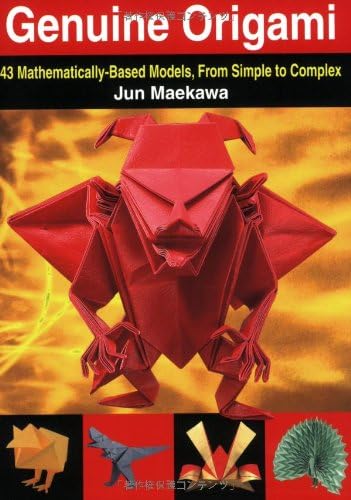
Genuine Origami: 43 Mathematically-Based Models, From Simple to Complex
Product ID: 4150116
🎨Multi-style origami techniques
📐43 mathematically-based models
📚Step-by-step guided learning
Desertcart purchases this item on your behalf and handles shipping, customs, and support to Panama.
📐 Fold the future: where art meets math in every crease!
Genuine Origami by Jun Maekawa is a definitive guide featuring 43 origami models that blend mathematical theory with artistic creativity. Structured from simple to complex, it offers clear, two-toned diagrams and covers diverse folding styles, making it an essential resource for both beginners and seasoned folders seeking to master sophisticated techniques.
| Best Sellers Rank | #256,497 in Books ( See Top 100 in Books ) #156 in Origami (Books) |
| Customer Reviews | 4.8 out of 5 stars 97 Reviews |
S**N
My favorite origami book so far
Not only does this book have a great array of models, it includes the theories and principles behind them, which is something that most books of this nature lack. Each model if focused around understanding a particular technique, ranging from the most fundamental to advanced. Another thing I like about this book is rather than just exposing the reader/folder to one type of origami, there are models for different types so you can learn about multi-piece, 3 dimensional, modular, tessellation, and even teabag folding. There is also a model for each of the Chinese zodiac which I found to be really cool. The diagrams are all very clear and easy to follow showing 2 toned paper (as most origami paper is), which tends to be a fundamental problem among origami books. I'd also like to point out that Genuine Origami caters to all levels. A beginner can pick this up to learn the basics and get started with some really neat models and still be learning from it much later. I would say I'm fairly intermediate and I still have quite a bit to absorb from this book, and I still enjoy the simple models as well.
M**G
An Origami Must Have!
This book is AMAZING! I’ve had it on my “wish list” for ages because I love Maekawa-san’s rabbit. After borrowing Genuine Origami from an online library, I knew I would need far longer than 3 weeks to accomplish this book. So I decided I must own a copy. First, I have a CAUTION. The title says “simple to complex.” Simple does not mean easy. The giraffe which looks almost rudimentary was my most difficult model in the fundamental section. It has a sink fold, an asymmetrical inside reverse fold, and two tuck folds that are so tiny I needed tweezers. I folded SEVEN giraffes before I had one that is presentable. The point isn’t to fold a giraffe. Rather it is to present a model which allows you to focus on one or two specific techniques or principles so you can hone those skills. This book isn’t for the novice folder. If you are still trying to master inside and outside reverse folds, you aren’t ready for this book. If you are familiar with folds like rabbit ear, petal, squash, and sink, you might be ready to give it a try. Even if you don’t want a mouse, start from the first model. Maekawa-san refers to Genuine Origami as a textbook. Start from the beginning. That said, before I started the book, I did fold the rabbit, which is an intermediate model. However, I first tried the rabbit four years ago. After pouring over the diagrams and watching several YouTube tutorial videos, I got as far as the head before I gave up. Recently I decided to give it another go. After watching more YouTube videos, I was able to fold a decent rabbit. If I had worked through the book from the beginning, I wouldn’t have needed four years. Also even though Maekawa-san indicates using 15 cm paper for the first models, I started with 17.6cm and even 24cm paper.
R**G
methodical and consistent
This is an almost flawless origami text. The author knows his subject well and includes references to the history of the techniques he's teaching. The symbols used throughout the book are neatly catalogued and explained at the beginning of the book, and at the same time methodically "unpacked" as one goes from the simple models at the beginning toward complex at the end. He shows an understanding and respect for pure forms (no cutting, single-color vs. inside-out etc.) but at the same time doesn't get hung up in the dogma. It's great for any level from beginner to advanced. A note to beginners: every set of origami instructions, even the ones in this book, will seem obtuse & mind-boggling when you first work through them. But trust me, Maekawa is perfectly consistent throughout this book so if you stick with it you will get used to his notation and be an expert before you have done even half of the models. My only gripe might be that at times the English translation is just a tiny bit awkward, but far from enough to deduct a star: it's always very clear on a technical level.
C**E
Very interesting for motivation and inspiration
This book is great for persons interested in knowing more of origami than folding from diagrams. It is based on diagrams, but they are used to present more challenging concepts, to increase autonomy of folder and also introduce design of origami based on CPs. The quality of paper and photos is very good and it is a good book to be used as motivation or to increase curiosity. I don't find it adequate as a complete reference of complex origamis, but a nice companion text.
R**G
Improve your origami skills!
Things we love about this book: + Very detailed instructions + Models grouped by complexity + Lots of side notes explaining various origami concepts and symbols + Variety My 10 YO bought this book to improve his origami and we have been working through it together. He is becoming very skilled. The fundamental models really improved his techniques and taught him what all the symbols meant. Sometimes it took more than one try to get the hang of it, and we are still working out way though the book. This is a great book for beginners and intermediates who want to expand their origami techniques and build some very cool models.
N**N
One of the best
I distinctly remember getting a copy of Maekawa's Viva! Origami in Japanese via interlibrary loan during college, photocopying directions for his "Devil", and then spending hours folding it instead of studying. I was immensely pleased to discover that I can now throw away my dog-eared photocopy and replace it with this English version. As another review mentioned, this has clearer diagrams than the original. Additionally, some earlier reviewers said that the photographs were tough to follow, implying these weren't line drawings. At least in my copy, all the instructions are standard origami line drawings, finishing occasionally with a picture of the finished product. This book does not, however, reproduce every model found in the original Viva! Origami. Sadly, and notably missing is the Seated Deer. There are a few others, I'm certain, but I don't have access to the original anymore. Entertaining for the intermediate to high intermediate folder, and probably worth it just for English-language instructions for the Devil.
J**N
Favorite origami book so far
This is definitely not a book for people just getting started -- even the very first "simple fold" might require a bit more patience and understanding than a beginner could handle. But for someone who is "intermediate" -- this book perfectly helps you transition towards the more advanced mechanics. The papillon, the T-rex, and the horse are my favorite models of the book. You can get away with the first half of the book using standard 6" kami paper but you'll probably want bigger and thinner paper for the advanced models. The most complete origami book I've seen yet -- highly recommended.
R**R
Great instructions, but read carefully
In the beginning of the book, there's a legend for all the symbols and meanings for the arrow types, so pay attention if you see an arrow with a black or white triangle at the tip. Plus, in case you don't know, valley folds create a V-shape, where the crease lines are dashed dotted lines that wouldn't be seen after the fold, while mountain folds are solid and dotted lines where the line of the instructed fold would still be visible after folding (like bending your finger, the wrinkle inside the skin are valley folds, and the knuckles are mountain folds). I was able to make every diagram except the one that required a tea bag, but I would highly recommend this book if you like making animals and a few dinosaurs.
B**Z
Beau livre
Tres bon livre. Des modeles du plus simple au plus complexe mais tous d une grande beauté. Adapté meme aux niveau debutant
M**C
Real high quality book for beginner+ to intermediate+/advanced
I like this book. I only bought some absolute entry-level books before but quickly got bored with them as they don't really offer "cool" and challenging enough models. You fold the first few things and feel satisfied, then eventually you've managed to fold the most difficult model at the end of the book and you think "what now?" Now you start searching the internet for some help but everything you find is either teaching you to do one boring mountain fold OR it's trying to show you how to build a 12-dimensional alien world, and you're stuck. "Where do I go from there?" Well you come here. There are so many good things in this book so I'll just put a list without specific ordering: - The feel of the book is great, they aren't cheap about it, it's all in colour with thick pages, and printing & binding are 100% good - The models are ACTUALLY interesting and make me want to fold them, both for the challenge and for the looks! - This is pretty much the only resource I found that works for my level, as all the entry-level books are usually boring except for the last couple models but all the advanced books are just some kind of alien world to me. This book lands just right - Paper suggestions (size and type) and crease patterns are given for every model - The whole spectrum of origami is covered including even alternative ways: Fundamental models, Simple models, A few different varieties (like modular or irregular models), Intermediate and then Complex models - Preface, introduction, paper selection, and all the little grey boxes during the folding of various models are extremely interesting comments/advice/additions/suggestions by the author regarding what is the best strategy to do something and what are the different options, how to deal with a problem, how to visualize things, what geometrical or mathematical approximations can be done, etc.. I know the world of teaching and I can very much sense the pedagogy there (every model teaches you something on top of previous learning, much like a textbook - which is the aim of the author) - I've lived in Japan for a bit and I can 100% tell that the author is a quirky funny artist who's very passionate, smart and empathetic. There are some heavy-duty explanations in that book (and I've got a maths M.Sc) but there are also accurate illustrations, references to other artists and books, little bits of poetry, and genuine feedback (for example with wet folding the author explains alternative techniques by other artists but mentions that he himself has little experience with that technique) ------------------------------------- This book is NOT FOR YOU if: - you've never tried origami and you want an introduction that takes you by the hand while you fold the most absolute basic shapes many times over (for me this was done with Margaret Van Sicklen's Joy of Origami, for reference) - you feel like you already are at ease with the whole range shown in the book and therefore would be bored with the book (unless you are interested in the author's notes which usually go further and give mathematical and geometrical insights as well as cross-references) - you want to focus specifically on the less "usual" origami (modular shapes, wet folding, cutting shapes, etc..), because this book gives a decent introduction to that world but it really isn't the focus at all and you'd be paying for 10% of the book really ------------------------------------- This book is FOR YOU if: - you've already folded some basic things and you feel like you want to take on the world and make more interesting stuff than the entry-level books that now feel a bit gimmicky - you can be an absolute beginner because everything is explained, but you aren't afraid of messing up the very first few models many times over until you figure it out (if you want more immediate enjoyment while learning the absolute basics, perhaps try something else first and then come back to this wonderful book) - you are tired of finding old black and white esoteric stuff trying to teach you how to fold models without any reference of what it's supposed to look like, or any explanation along the way (this book is thankfully the exact opposite) - you enjoy origami for the folding aspect but you are also open to the big picture understanding ("why do we do this?", "how do I think about this shape?", "how do I make curved surfaces from flat ones?", etc) ------------------------------------- TL;DR: Tired of the entry-level supermarket books, but anything advanced feels like Robert J. Lang showing you how to create the universe and you're left in the dust? Want some challenge in a book that is genuinely well made? That's your book.
B**3
Extremely high quality but rather difficult models; perfect for the intermediate paperfolder
This review comes from my son aged 11: This book contains some of the most detailed diagrammed instructions you will ever see, incredibly beautiful models of marked complexity and some amazing mathematical theories for each model to be experimented on. If you are an origami designer, it gives you loads of new bases, folds and ideas for new designs. But just a word of warning; the models in this book are of high complexity, so I recommend not buying it until you have been folding for at least two-and-a-half years. If you want a beginner's origami book, you'd best go for Everything Origami by Matthew Gardener, or one that specifically says "for beginners" in some sort of way.
M**E
Polita eta zaila
Liburu polita da, berezia, irudi bereziak baititu, baina zaila da aldi berean. Edo erdimailako zailtasuna du, ez da hasiberri batentzako liburua. Zer edo zer egiten jakin ezkero, ordea, interesgarria suerta liezaioke edonori.
B**I
Gute Anleitungen und tolle Modelle
Ich falte erst seit einiger Zeit regelmäßig Origami und suchte ein Heft mit einer guten Anleitung, da in vielen Heften oder Online-Anleitungen die Skizzen eher schwer nachvollziehbar sind. Dieses Heft bietet diverse Modelle von sehr einfach bis total komplex und führt der Reihe nach neue Faltungstechnicken und -schritte ein. Es ist wirklich jeder Schritt abgebildet und die Faltlinien und -Typen exakt markiert. Wenn man nicht immer auf Online-Videos zurückgreifen will auf jeden Fall lohnenswert.
Trustpilot
5 days ago
1 month ago