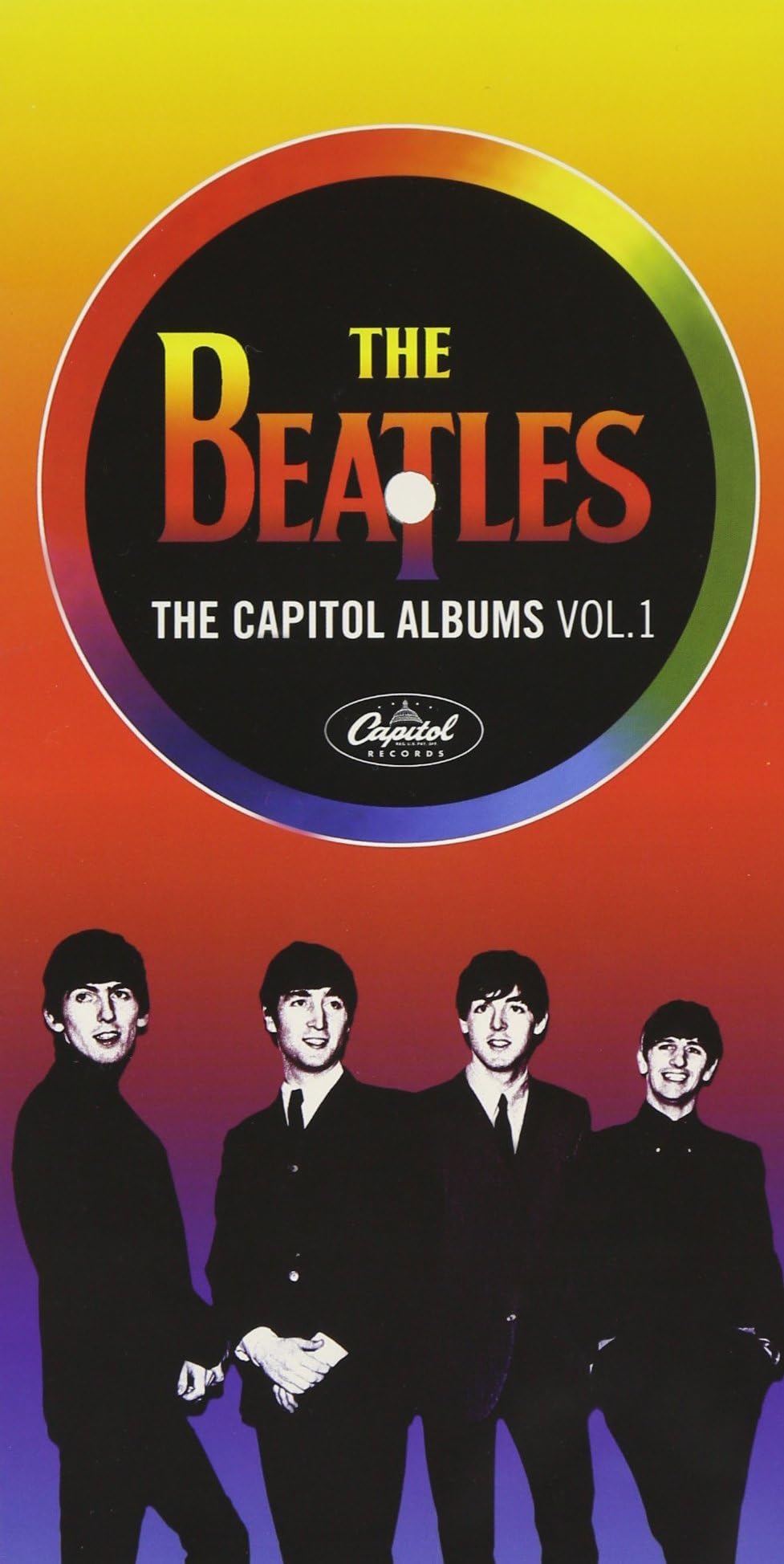
The Capitol Albums Vol. 1
Product ID: 4320543
Desertcart purchases this item on your behalf and handles shipping, customs, and support to Panama.
*First Time Ever on CD...Meet The Beatles, The Beatles Second Album, Something New and Beatles 65....presented in both Stereo and Mono *Compiled from the original U.S. master tapes *Special packaging including original album cover artwork and 48 page collectors booklet When the Beatles catalog was first issued on CD in the '80s, an attempt was made to standardize the releases (which often varied wildly in content internationally) by using their original British format. But this confounded many Fabs fans in the U.S. who now found CDs with track listings that often differed dramatically from their original American LPs. More maddening, the initial four releases were only available in not-so-glorious mono mixes. This four-CD collection of the band's 1964 American album releases finally addresses those concerns, and then some. Meet the Beatles , The Beatles Second Album , Something New , and Beatles '65 have been digitally prepared from Capitol's vintage album masters and presented in both the original stereo and mono mixes released back in '64. This set gives younger fans a chance to finally hear the band's epochal early music in stereo--and should please an older generation by returning massive hit singles like "I Want to Hold Your Hand," "She Loves You," "She's a Woman," and "I Feel Fine" to their original American album contexts. The booklet contains a wealth of rare photos and concise notes by noted Beatles historian Mark Lewisohn. --Jerry McCulley *First Time Ever on CD...Meet The Beatles, The Beatles Second Album, Something New and Beatles 65....presented in both Stereo and Mono *Compiled from the original U.S. master tapes *Special packaging including original album cover artwork and 48 page collectors booklet THE FAB FOUR FROM 64 -- MEET THE BEATLES! THE WAY AMERICA FIRST DID The set brings together for the first time on CD the album that began it all - Meet The Beatles and the three other Capitol albums that were released in 1964 - The Beatles Second Album, Something New and Beatles '65. Each of the discs will include two versions of each song - one in stereo (or duophonic in some cases) - then the selections are repeated in mono. The duophonic sound was carefully created by Capitol, using 2 channels of mono which were equalized, compressed and then reverb was added. The Capitol Albums Volume 1 have been carefully mastered from the original masters, taken from the vaults at Capitol Records, to ensure that they sound as they did when first released. With the release of The Beatles catalog on CD in 1987, releases were standardized on a worldwide basis and eventually the U.S. albums, which had last appeared on vinyl and cassette, were deleted. Since that time there has been increasing demand for these original U.S. albums to make their CD debut which they now do as part of this specially priced and uniquely packaged 4 CD boxed set. The Capitol Albums Volume 1 includes all four of the group's (Capitol) 1964 album releases, and each of the discs is housed in a MINIATURE REPLICA OF THE ORGINAL ALBUM COVER. It will also feature a 48 PAGE BOOKLET, along with a scrap book effect of photos and clippings from that amazing year. The Capitol Albums Volume 1 is a special release, commemorating the close of the 40th Anniversary of when America first met The Beatles. First Time Ever on CD...Meet The Beatles, The Beatles Second Album, Something New and Beatles 65....presented in both Stereo and Mono Compiled from the original U.S. master tapes Special packaging including original album cover artwork and 48 page collectors booklet THE FAB FOUR FROM 64 -- MEET THE BEATLES! THE WAY AMERICA FIRST DID The set brings together for the first time on CD the album that began it all - Meet The Beatles and the three other Capitol albums that were released in 1964 - The Beatles Second Album, Something New and Beatles '65. Each of the discs will include two versions of each song - one in stereo (or duophonic in some cases) - then the selections are repeated in mono. The duophonic sound was carefully created by Capitol, using 2 channels of mono which were equalized, compressed and then reverb was added. The Capitol Albums Volume 1 have been carefully mastered from the original masters, taken from the vaults at Capitol Records, to ensure that they sound as they did when first released. With the release of The Beatles catalog on CD in 1987, releases were standardized on a worldwide basis and eventually the U.S. albums, which had last appeared on vinyl and cassette, were deleted. Since that time there has been increasing demand for these original U.S. albums to make their CD debut which they now do as part of this specially priced and uniquely packaged 4 CD boxed set. The Capitol Albums Volume 1 includes all four of the group's (Capitol) 1964 album releases, and each of the discs is housed in a MINIATURE REPLICA OF THE ORGINAL ALBUM COVER. It will also feature a 48 PAGE BOOKLET, along with a scrap book effect of photos and clippings from that amazing year. The Capitol Albums Volume 1 is a special release, commemorating the close of the 40th Anniversary of when America first met The Beatles. Review: AT LAST, THE REAL ALBUMS - In 1987, the decision to release the Beatles work on CD was made by EMI (not Apple, as some think). Unfortunately, instead of getting the albums we Americans (who put most of the money in the Beatles pockets) were familiar with, all we got were foreign compilations. And to add insult to injury, some were only available in flat mono. The British albums numbered only 13, so to fill up the gaps they added MAGICAL MYSTERY TOUR (one of those "butchered" American compilations created by Voyle Gilmore in Hollywood, although so-called "purists" seem to overlook this fact) and the two PAST MASTERS volumes (two more compilations, these cooked up by Mark Lewisohn). However, as Lewisohn pointed out in the liner notes for PAST MASTERS, if you bought all these CDs, you had everything the Beatles commercially recorded between 1962 and 1970. Although the mixes could be better, I could live with that. All the Beatles work on 15 CDs. But after Apple gained control of the catalog in the 1990s, that neat little batch of 15 CDs containing the complete Beatles corpus changed. First they reissued 1962-1966 and 1967-1970, two compilations made by Allen Klein in the 1970s. These were unneccessary since everything was already available. What's that? Some of the tracks were stereo? Well, they should have been in the first place. Then came LIVE AT THE BBC and the ANTHOLOGY series, previously bootlegged scraps that only served to cheapen the Beatles' recording legacy. There's a reason all of that junk was unreleased in the sixties. It was supposed to be! These were followed by YELLOW SUBMARINE SONGTRACK and LET IT BE NAKED, revisionist perversions of classic albums. (What's next? A new and improved "White Album"? "Sgt. Pepper Revisited"?) What's that again? The sound is great? Why couldn't the originals have been released with good sound? And finally, the ultimate rip-off, BEATLES 1, which gave us nothing new and far too few hits, in spite of all the hype. Now the four of the original albums are back. Each disc is presented in its original form, both stereo and mono. These are the original AMERICAN Beatles albums, the ones that I knew when I first exposed to the Beatles. The ones that appeared in that little handout you got with THE BEATLES/1962-1966 (and 1967/1970) titled "FOR YOUR INFORMATION." I know that these records were only released in America, but I'm an American. I don't care about how the Beales' product was peddled in Britain, or Germany, or Japan. I want the U.S. albums. MEET THE BEATLES is arguably the most important Beatles album. It is the one that introduced most Americans to the group. Promoted by the single "I Want to Hold Your Hand," it brought Beatlemania to the U.S. and was responsible for all that followed. In that sense, its effect is still felt today. It is, of course, roughly the U.S. version of the group's second British album WITH THE BEATLES, but it's a stronger work. By including all of the original compositions from the British album and eliminating all but one of the cover songs, it showcases the group's songwriting abilities. The single "I Want to Hold Your Hand" is included, along with both its American ("I Saw Her Standing There") and British ("This Boy") flipsides. These tracks, all originals, add additional weight to the group's songwriting reputation. The only cover version is "Till There Was You," a Broadway tune from THE MUSIC MAN, and shows the group as masters of mainstream pop as well as rock and roll. THE BEATLES' SECOND ALBUM, a compilation cooked up at the Capitol Tower in Hollywood, was rushed out in the wake of the Beatles' tremendous American success. Just like "She Loves You" was that OTHER single, this was that OTHER album. Although good, the SECOND ALBUM doesn't quite measure up to MEET THE BEATLES. It's a patchwork album, made up of the 5 tracks cut from WITH THE BEATLES (all cover songs, most of them Motown), various single sides, and 2 brand- new tracks, "Long Tall Sally" and "I Call Your Name." SOMETHING NEW was Capitol's attempt to release the band's third British album A HARD DAY'S NIGHT. The British album contained the songs from the film A HARD DAY'S NIGHT on one side and various filler tracks on the other. The film company (United Artists) released the soundtrack album in the U.S. and it became a multi-million seller. Beaten out by UA, Capitol compiled SOMETHING NEW, containing 8 songs from the British album (4 from each side), plus 3 additional filler tracks. They heavily promoted this album, and released 3 singles from it, but it never could match the success of the United Artists album. Which is a shame. Despite its patchwork origins, SOMETHING NEW is a great album. It was the first album released completely in stereo, and there are many differences between the mono and stereo versions. BEATLES '65 is the American version of the group's fourth British album, BEATLES FOR SALE. The first side is nearly identical to the British album (minus one song), while the second side contains two songs from the album, a song leftover from the British A HARD DAY's NIGHT and the current single "I Feel Fine" with its flipside "She's A Woman." There are many myths about these albums: 1. They're not in true stereo, and have echo added to them. The fact is, only seven tracks ("I Want to Hold Your Hand," "She Loves You," "You Can't Do That," "I'll Get You," "She Loves You," "She's a Woman," and "I Feel Fine") are not in true stereo. Only the stereo version of THE BEATLES' SECOND ALBUM has added echo. 2. They were released against the wishes of George Martin. The fact is George Martin knew and approved of these albums. He even scheduled special mixing sessions for them (See Lewisohn 1992). 3. They were not what the Beatles intended. As far as merchandise was concerned, in 1964, the Beatles had no intentions. The record company, not the group, decided what product was released. So, to those in the dark, get your facts straight and enjoy the Beatles as they were presented to Americans. This is the most important compact disc release in 20 years, so enjoy it. Review: This is What I Grew Up With - For my eighth birthday, my mother bought me Meet the Beatles, at my official request. I had recently heard the band on WLS AM in Chicago doing "Ticket to Ride." I'd been gifted with that single (which was backed with the beautiful, sad "Yes It Is") along with "We Can Work it Out" b/w "Day Tripper" by the brother of one of my mom's friends. I listened to those singles incessantly, knowing nothing of the cultural impact for which The Beatles had been responsible. I just loved those songs. As "Ticket" played on, I thought to myself, "Gee, these guys are on the radio, so they must be pretty good! From now on, they're my favorite band." Anyway, back to that eighth birthday present, when "I Want to Hold Your Hand" came blaring out of my little phonograph, it felt like the skies were opening up. Little did I know that it was a duophonic, or "fake stereo" version to which I was listening. Of course, then, I couldn't have cared less about any kind of technical nonsense. I was much too into the actual songs. Well, the skies have remained open to this day, thirty-six years later, and one of the things I absolutely love to do these days is compare the mono and stereo versions of these wonderful songs, because sonically, they're VERY different from each other, and that "technical nonsense" to which I just referred is treated by me now in a slightly more open-minded fashion than before. When Capitol released these US LP's on CD (in stereo AND mono, no less), I couldn't have been more happy or excited. I could listen to, in pristine form, what I remember these incredible songs sounding like, and compare the mono versions to the stereo versions, which I hadn't been able to do back in those heady days of the early '70's. Meet the Beatles was the first US LP and, of course, the first CD I put into my player, the which is connected to a sound system that betters my childhood phonograph just a bit (OK, maybe a LITTLE more than that). It didn't disappoint at all. The clarity of the sound is a testament to the care that the Capitol people put into this set overall. It was a little jarring to hear "I Saw Her Standing There" come in in full, unadulterated stereo, but a distinct pleasure, nonetheless. We're back to duophonic for "This Boy," then real stereo again for "It Won't Be Long." Interesting listening, to say the least. On the following CD, entitled simply The Beatles' Second Album, "Roll Over Beethoven" leads off with that layer of reverb to the fore, which the US engineers back in '64 slathered on, and which has been endlessly criticized by professional and amateur listener alike. Personally, I love it. I think it's just the personal memory factor. It just sounds so BIG, like it did back "in the day!" I remember hearing the UK versions of The Beatles' output for the first time years ago (with which the '87 release of the band's material was standardized throughout the world and remains so for the current remasters) when my best friend shelled out the extra money for the imported stereo UK versions, and being slightly put off by the "reigning in," at least as I heard it, of the overall sound of the songs. Anyway, back in the US, this "Second Album" also has more "fake stereo" cuts on it than its brother recordings in this particular set. Both "I'll Get You" and "She Loves You" are treated with duophonic, and again, it sounds funny to today's more sophisticated ears, but I still get a great kick out of them. The low frequencies in one channel and the highs in the other -- now that's technology! Notice the significant variations between the stereo versions of "Long Tall Sally" and "I Call Your Name" and their mono renderings, particularly in the latter's lead guitar work. Ready for Something New, the third US release? Notice how "I'll Cry Instead" in stereo is shorter than its mono counterpart (the latter containing a repeated first verse). Notice again the differences between "Slow Down" and "Matchbox" from stereo to mono, again, particularly in terms of the guitar solos, this time in both songs. Overall, bits are added and taken out, and consequently make for fascinating listening. Beatles '65, the final installment in Vol. 1, is relatively consistent until one gets to "She's a Woman" and "I Feel Fine." I remember being bewildered at the "mushy" quality of these two songs, even back when I first heard the album. I can't help but wonder today who saw these versions as radio-worthy. The mono versions are an ever-so-slight improvements over the terrible stereo versions, but I must say that it's a relief to hear the "normal" sounding "Everybody's Trying to be My Baby" after suffering through the mistreatment of two fine, fine songs. Even today, when I hear the "reigned in" UK versions of these two classics, it's always surprising and refreshing. I don't really prefer the mono versions to the stereo or vice-versa. I love them both for different reasons. I still listen to this set often, even though the UK versions are sonically superior, especially the recently released remasters -- they're truly amazing! However, the work done on these US versions is also quite impressive, and represent the deserved care that the folks at Capitol are putting into these immortals. I'd like to thank them for issuing this box set. It was overdue, but better late than never, which I thought was going to be the case at one point. My hat's off to you, you Capitol people!











| ASIN | B00065XJ48 |
| Best Sellers Rank | #32,100 in CDs & Vinyl ( See Top 100 in CDs & Vinyl ) #94 in Classic Rock Supergroups #219 in British Invasion Rock #15,881 in Rock (CDs & Vinyl) |
| Customer Reviews | 4.6 4.6 out of 5 stars (532) |
| Date First Available | January 29, 2007 |
| Is Discontinued By Manufacturer | No |
| Item model number | CAP66878 |
| Label | Capitol |
| Language | English |
| Manufacturer | Capitol |
| Number of discs | 4 |
| Original Release Date | 2004 |
| Product Dimensions | 9.88 x 5.08 x 0.87 inches; 9.17 ounces |
T**S
AT LAST, THE REAL ALBUMS
In 1987, the decision to release the Beatles work on CD was made by EMI (not Apple, as some think). Unfortunately, instead of getting the albums we Americans (who put most of the money in the Beatles pockets) were familiar with, all we got were foreign compilations. And to add insult to injury, some were only available in flat mono. The British albums numbered only 13, so to fill up the gaps they added MAGICAL MYSTERY TOUR (one of those "butchered" American compilations created by Voyle Gilmore in Hollywood, although so-called "purists" seem to overlook this fact) and the two PAST MASTERS volumes (two more compilations, these cooked up by Mark Lewisohn). However, as Lewisohn pointed out in the liner notes for PAST MASTERS, if you bought all these CDs, you had everything the Beatles commercially recorded between 1962 and 1970. Although the mixes could be better, I could live with that. All the Beatles work on 15 CDs. But after Apple gained control of the catalog in the 1990s, that neat little batch of 15 CDs containing the complete Beatles corpus changed. First they reissued 1962-1966 and 1967-1970, two compilations made by Allen Klein in the 1970s. These were unneccessary since everything was already available. What's that? Some of the tracks were stereo? Well, they should have been in the first place. Then came LIVE AT THE BBC and the ANTHOLOGY series, previously bootlegged scraps that only served to cheapen the Beatles' recording legacy. There's a reason all of that junk was unreleased in the sixties. It was supposed to be! These were followed by YELLOW SUBMARINE SONGTRACK and LET IT BE NAKED, revisionist perversions of classic albums. (What's next? A new and improved "White Album"? "Sgt. Pepper Revisited"?) What's that again? The sound is great? Why couldn't the originals have been released with good sound? And finally, the ultimate rip-off, BEATLES 1, which gave us nothing new and far too few hits, in spite of all the hype. Now the four of the original albums are back. Each disc is presented in its original form, both stereo and mono. These are the original AMERICAN Beatles albums, the ones that I knew when I first exposed to the Beatles. The ones that appeared in that little handout you got with THE BEATLES/1962-1966 (and 1967/1970) titled "FOR YOUR INFORMATION." I know that these records were only released in America, but I'm an American. I don't care about how the Beales' product was peddled in Britain, or Germany, or Japan. I want the U.S. albums. MEET THE BEATLES is arguably the most important Beatles album. It is the one that introduced most Americans to the group. Promoted by the single "I Want to Hold Your Hand," it brought Beatlemania to the U.S. and was responsible for all that followed. In that sense, its effect is still felt today. It is, of course, roughly the U.S. version of the group's second British album WITH THE BEATLES, but it's a stronger work. By including all of the original compositions from the British album and eliminating all but one of the cover songs, it showcases the group's songwriting abilities. The single "I Want to Hold Your Hand" is included, along with both its American ("I Saw Her Standing There") and British ("This Boy") flipsides. These tracks, all originals, add additional weight to the group's songwriting reputation. The only cover version is "Till There Was You," a Broadway tune from THE MUSIC MAN, and shows the group as masters of mainstream pop as well as rock and roll. THE BEATLES' SECOND ALBUM, a compilation cooked up at the Capitol Tower in Hollywood, was rushed out in the wake of the Beatles' tremendous American success. Just like "She Loves You" was that OTHER single, this was that OTHER album. Although good, the SECOND ALBUM doesn't quite measure up to MEET THE BEATLES. It's a patchwork album, made up of the 5 tracks cut from WITH THE BEATLES (all cover songs, most of them Motown), various single sides, and 2 brand- new tracks, "Long Tall Sally" and "I Call Your Name." SOMETHING NEW was Capitol's attempt to release the band's third British album A HARD DAY'S NIGHT. The British album contained the songs from the film A HARD DAY'S NIGHT on one side and various filler tracks on the other. The film company (United Artists) released the soundtrack album in the U.S. and it became a multi-million seller. Beaten out by UA, Capitol compiled SOMETHING NEW, containing 8 songs from the British album (4 from each side), plus 3 additional filler tracks. They heavily promoted this album, and released 3 singles from it, but it never could match the success of the United Artists album. Which is a shame. Despite its patchwork origins, SOMETHING NEW is a great album. It was the first album released completely in stereo, and there are many differences between the mono and stereo versions. BEATLES '65 is the American version of the group's fourth British album, BEATLES FOR SALE. The first side is nearly identical to the British album (minus one song), while the second side contains two songs from the album, a song leftover from the British A HARD DAY's NIGHT and the current single "I Feel Fine" with its flipside "She's A Woman." There are many myths about these albums: 1. They're not in true stereo, and have echo added to them. The fact is, only seven tracks ("I Want to Hold Your Hand," "She Loves You," "You Can't Do That," "I'll Get You," "She Loves You," "She's a Woman," and "I Feel Fine") are not in true stereo. Only the stereo version of THE BEATLES' SECOND ALBUM has added echo. 2. They were released against the wishes of George Martin. The fact is George Martin knew and approved of these albums. He even scheduled special mixing sessions for them (See Lewisohn 1992). 3. They were not what the Beatles intended. As far as merchandise was concerned, in 1964, the Beatles had no intentions. The record company, not the group, decided what product was released. So, to those in the dark, get your facts straight and enjoy the Beatles as they were presented to Americans. This is the most important compact disc release in 20 years, so enjoy it.
B**S
This is What I Grew Up With
For my eighth birthday, my mother bought me Meet the Beatles, at my official request. I had recently heard the band on WLS AM in Chicago doing "Ticket to Ride." I'd been gifted with that single (which was backed with the beautiful, sad "Yes It Is") along with "We Can Work it Out" b/w "Day Tripper" by the brother of one of my mom's friends. I listened to those singles incessantly, knowing nothing of the cultural impact for which The Beatles had been responsible. I just loved those songs. As "Ticket" played on, I thought to myself, "Gee, these guys are on the radio, so they must be pretty good! From now on, they're my favorite band." Anyway, back to that eighth birthday present, when "I Want to Hold Your Hand" came blaring out of my little phonograph, it felt like the skies were opening up. Little did I know that it was a duophonic, or "fake stereo" version to which I was listening. Of course, then, I couldn't have cared less about any kind of technical nonsense. I was much too into the actual songs. Well, the skies have remained open to this day, thirty-six years later, and one of the things I absolutely love to do these days is compare the mono and stereo versions of these wonderful songs, because sonically, they're VERY different from each other, and that "technical nonsense" to which I just referred is treated by me now in a slightly more open-minded fashion than before. When Capitol released these US LP's on CD (in stereo AND mono, no less), I couldn't have been more happy or excited. I could listen to, in pristine form, what I remember these incredible songs sounding like, and compare the mono versions to the stereo versions, which I hadn't been able to do back in those heady days of the early '70's. Meet the Beatles was the first US LP and, of course, the first CD I put into my player, the which is connected to a sound system that betters my childhood phonograph just a bit (OK, maybe a LITTLE more than that). It didn't disappoint at all. The clarity of the sound is a testament to the care that the Capitol people put into this set overall. It was a little jarring to hear "I Saw Her Standing There" come in in full, unadulterated stereo, but a distinct pleasure, nonetheless. We're back to duophonic for "This Boy," then real stereo again for "It Won't Be Long." Interesting listening, to say the least. On the following CD, entitled simply The Beatles' Second Album, "Roll Over Beethoven" leads off with that layer of reverb to the fore, which the US engineers back in '64 slathered on, and which has been endlessly criticized by professional and amateur listener alike. Personally, I love it. I think it's just the personal memory factor. It just sounds so BIG, like it did back "in the day!" I remember hearing the UK versions of The Beatles' output for the first time years ago (with which the '87 release of the band's material was standardized throughout the world and remains so for the current remasters) when my best friend shelled out the extra money for the imported stereo UK versions, and being slightly put off by the "reigning in," at least as I heard it, of the overall sound of the songs. Anyway, back in the US, this "Second Album" also has more "fake stereo" cuts on it than its brother recordings in this particular set. Both "I'll Get You" and "She Loves You" are treated with duophonic, and again, it sounds funny to today's more sophisticated ears, but I still get a great kick out of them. The low frequencies in one channel and the highs in the other -- now that's technology! Notice the significant variations between the stereo versions of "Long Tall Sally" and "I Call Your Name" and their mono renderings, particularly in the latter's lead guitar work. Ready for Something New, the third US release? Notice how "I'll Cry Instead" in stereo is shorter than its mono counterpart (the latter containing a repeated first verse). Notice again the differences between "Slow Down" and "Matchbox" from stereo to mono, again, particularly in terms of the guitar solos, this time in both songs. Overall, bits are added and taken out, and consequently make for fascinating listening. Beatles '65, the final installment in Vol. 1, is relatively consistent until one gets to "She's a Woman" and "I Feel Fine." I remember being bewildered at the "mushy" quality of these two songs, even back when I first heard the album. I can't help but wonder today who saw these versions as radio-worthy. The mono versions are an ever-so-slight improvements over the terrible stereo versions, but I must say that it's a relief to hear the "normal" sounding "Everybody's Trying to be My Baby" after suffering through the mistreatment of two fine, fine songs. Even today, when I hear the "reigned in" UK versions of these two classics, it's always surprising and refreshing. I don't really prefer the mono versions to the stereo or vice-versa. I love them both for different reasons. I still listen to this set often, even though the UK versions are sonically superior, especially the recently released remasters -- they're truly amazing! However, the work done on these US versions is also quite impressive, and represent the deserved care that the folks at Capitol are putting into these immortals. I'd like to thank them for issuing this box set. It was overdue, but better late than never, which I thought was going to be the case at one point. My hat's off to you, you Capitol people!
J**S
Will there EVER be...a Volume 3?
Being a "first generation-kindred spirit" who was raised and nurtured via the Capitol releases here in the U.S. between '64-'70 (more specifically '64-'67, a.k.a. "Meet the Beatles" through Revolver, as all the releases after that were the same US and UK) I have an almost "karmic" affinity to the the "American" mixes. It's all about "contextual cueing" effects. The sequences that we first heard when those LPs were released here in the U.S. were the sequences (sound-scapes) that made for the soundtracks of our developmental years. For instance, when I hear "Money" my brain automatically cues in "You Can't do That" to come next and the visual image in my mind is that of "The Beatle's Second Album", not the closing cut from "With the Beatles" which, as far as I knew at age 12, didn't even exist. Of COURSE "Money" is by far the best possible closer for the Meet/With LP but, since we had "Not a Second Time" to close off our US lp well, that's what we went to bed with. Perhaps the US in-teen-i-gensia knew, through research, that finishing a socio-political statement such as a Beatle lp to bed with a tune calling for "Money" was un-American and so they opted for the kindler, gentler, "Not a Second Time." This holds true for every pre-Pepper's release. The U.S. versions sound "just right" to me, you know..."the way the Beatles, Brian Epstein, and George Martin" all intended because, heck, that's what WE heard! Most telling, perhaps, it's the Rubber Soul packages. Like most American, first Gen Beatle fans the Capitol versions just "fit better" than the UK ones to me. When I first heard "I've Just Seen a Face" as the 12th track on the UK version of "Help!" I thought surely someone had made a huge mistake. "I've Just seen a Face," after all is the PERFECT opening to Rubber Soul. "Drive My Car"? INCREDIBLE song! but in no way "Rubber Soul'ish"! "It's only Love", on "Help!"? Are you KIDDING me? What sort of sacrilege is THAT? What a waste! To me Pepper's was not the first "CONCEPT" LP, Rubber Soul was--at least the notion of a "concept LP" that can be had by a 14-year old boy. In other words, (the US) Rubber Soul flowed like an LP, not a bunch of songs. "Help!" on the other hand, was a chaotic bunch of thrown together songs. "Yesterday"...on "Help!"? "Yesterday," everyone knew, was a single (45RPM) that had NOTHING to do with "Help!" the movie or album. As an album, the UK "Help!" made (and continues to make) no sense at all. That said, what the vol 1 and vol 2 Capitol releases have done, for us American first-gens, is help us to maintain those initial neural connections alive. When I listen to the US releases they bring back memory after memory, intact, fresh and pure. The UK releases, they sound like out of sync compilations that a buddy made trying to be cool with his new cassette player. Right for him maybe, just not for me. Capitol box vol 3, then...that's a task to figure out along similar lines. If Capitol holds the "in order of release" sequence we really get not much of anything worthwhile. Releasing in terms of "marketability" doesn't help much either. The Beatles Story would be a TOTAL rip off that we would listen to MAYBE once. "Hey Jude"? To us that wasn't a Beatle's release as much as compilation of songs we already had on singles. More of a convenience. Like having an early mp3 or those singles. "Yesterday and Today?" sinilar to "Something New," Half and Half, half songs we did not have, yet we NEEDED, but the other half we already had...on singles. Not all of us could affort $3.00 for that extravagance back then so that one took a while. The only thing that would have made "Yesterday & Today" a "must buy" life essential was the Butcher cover, and when Capitol ruined that there went a LOT of potential sales. Idiots. As far as "Something New," same thing. But the clincher there wass "Things we Said Today." the song that FINALLY made me fork out $2.79 for that album! To put it in perspective, that's almost 10 .30 cent U.S. lunches. "Revolver" on Capitol vol 3. Unlike "Rubber Soul" the only thing you need to do with the UK "Revolver" is take two songs out and play the others in a different order--not quite the same as missing essential songs as I noted earlier. "Magical Mystery Tour"? Our "U.S." version had the movie songs AND the "singles" we already had (again) so, here we got the better deal --song wise. Sgt. Pepper, White Album and Abbey Road and Let it Be? All the same songs and song order, so, no need for those as Capitol versions. Therefore, the "need" comes in terms of having (a) the stereo vs mono versions (already now out in the UK sets), (b) the coveted original covers (in mini size! How cute are those?!), (c) completion (which really takes us only through "Revolver," as--again, all other REAL TIME RELEASES were the same US as in UK. As for the OUTSIDE PACKAGING both the US and UK versions are pathetically cheap looking and feeling. Beatles are worthy of something more akin Tory Amos' piano box set. How about box sets in the shape of each of the Beatle's primary instruments? (Vol 1 -Hoffner bass, Vol 2. George's Gretch?... See, those I'd buy!) When you stretch this into the ridiculous, second-generation Beatle era (Ballads, Rock and Roll music, Red and Blue LPs, Rarities, and the ludicrous Reel Music), well, they were SO un-important to us first generation people that mine are still in their plastic wraps. That said, there are OTHER much more worthwhile products we actually NEED out there folks, and, this message goes out to all my first-Gen superFans: "WE ARE RUNNING OUT OF TIME!" My votes?--and by the way: just hand the project out to Rhino, sit back and let them do it. Let it BE - DVD set, various versions: 2-DVD basic, 4-DVD deluxe, X-DVD completist versions. Complete video collection. Please, PLEASE!!! WHERE?WHEN is this?! Pristine, remixed, remastered from FIRST GENERATION sources. COMPLETE performances (see "Reelin in the Years" British Invasion series for a reference to how this is done by caring professionals!) In proper sequence. Again, multiple options: 2DVD - basic collection, complete set of all video release 4-DVD - completist collection - complete set of all VERSIONS of each song (several "Hello, Goodbye", "Paperback Writer," etc) with interviews X-DVD - suicide collection - all of the above plus out-takes, rehearsals, anything that has been salvaged one way or the other. The Concerts. DVDs The pristine quality--video and audio--are out there, we've seen snippets, How about the whole things now? Shea...Cow Palace, Japanese shows (light and dark jackets), Italian and French concerts, Hollywood Bowl, Cavern and German snippets would make for superb "bonus" cuts. The Concerts - CDs As above but, on CD. Magical Mysetery tour - DVD sets: 2-DVD basic (one color one black and white, remastered to that it is actually VISIBLE with bonus yardage); 4-DVD deluxe with interviews, out-takes, etc. Pepper's and Abbey Road - similar to the new Pink Floyd multi-set compilations, or, at least the Smile box set. White LP - 3 CDs- mono, out-takes/promos, original cheers!
G**B
Indispensible!
I bought this set (along with Vol.2) for the stereo mixes of all the Beatles' early songs, and was not disappointed. In fact, on many of the songs I was very pleasantly surprised! As you might expect, the sound gets progressively better from the first "album" to the last. On "Meet the Beatles", for the most part, you hear the voice(s) on one side and the instruments on the other, which is probably the most that could be done with the original masters. Still, it's better than mono, with more audible detail and "presence". One caution: The transfer level is "hot", just a hair short of clipping, so better to turn down the volume control before pressing the Play button! That goes for all the CDs in this set. The "Second Album" has the least satisfying sound. The "hot" transfer and lack of dynamics (did they use compression?) make for a feeling of relentless pounding that's a little hard to take after a while. However, many of the songs are in true stereo, with vocals in the center and different instruments on left and right, so they are still preferable to the mono mixes. The sound on "Something New" and "Beatles 65" varies from one song to the next, but on several of the songs, the sound is quite remarkable, with a true stereo image, pinpoint clarity and fine detail. For example, listen to the nicely captured guitar stylings on "I'll Be Back" (from "Beatles 65"). Unfortunately, on one of my favorite songs, "I Feel Fine", I would have to describe the sound as "smeared"; for an excellent stereo transfer of this song, you will have to buy the 2-CD set "The Beatles / 1962-1966". I got a new, sealed copy of this set from an Amazon "third-party" seller, at a deep discount, probably because it is one of the early releases with the "wrong" mono transfers. But who needs the mono mixes, anyway? As for the packaging, which everyone seems to hate, I liked the mini original album covers, but would have preferred jewel cases - Volumes 1 & 2 could have been released on 4 CDs, at half the price, by leaving out the mono mixes and putting two albums on each CD, with the album covers pictured on the insert. So one star off for that. Anyway, for those of us who mainly listen to copies of CDs on HD or portable media, the packaging isn't such a big issue. To sum it all up: Finally some decent stereo mixes of the early Beatles - thank you, Capitol!
J**I
CAPITOL MIXES ARE GREAT AND HAVE STEREO AND MONO MIXES
US CAPITOL MIXES ARE GREAT. As I bought Vol 1 and 2 for collection purposes, these dont include All Capitol albums. But the complete box set. Just don't be disappointed that the later CDS aren't included. The Capitol mixes are different than Parlophone and so are the songs they put on each album. But the Capitol Versions have STEREO AND MONO versions. The Beatles sound better in MONO.
H**P
The way the Beatles were meant to be heard
Superb! Excellent! Over the years, I've bought well over five hundred items from Amazon; but this is the first time I've felt compelled to write a review. If you're a Beatles aficionado (especially of the early Beatles ((and especially if you were there to witness the `60s)) )- these CD's are an absolute MUST for your collection! When I first heard them- I went through a real mind-shift regarding something that had haunted me for years. It was something that pertained to the quality of digital sound: Back in the late `80's- when I first began my CD collection- I was quite let down by the sound quality of compact discs- the sounds seemed sterile, frozen- almost lifeless. After a while, I came to the conclusion that it was simply due to the newness of digital technology and perhaps a lack of digital expertise by the engineers involved. When I got these albums a few weeks ago- all of my previous opinions changed. Suddenly, I realized that the very first CD's I'd bought for my collection were the newly released British Beatles CD's (which- up until now- had been the only official Beatles CD's on the market)- and I very quickly realized why these first CD's had sounded so frozen and lifeless to me: the simple fact is- the British versions are very different soundwise from the American (or Capitol) versions I'd been used to up until that time. While the British versions are dry and understated; the Capitol versions are tastefully iced over with reverb and a variety of effects that greatly enhance their songs. These Capitol versions were the Beatles that I'd been hardwired with from an early age (and much, much prefer!). It was almost like an epiphany after all these years as I realized that it wasn't the digitizing of the records that had made my first CD's sound sterile- but instead- the dry understated sound of the original British albums themselves. I'd be very interested to find out what was done to enhance and Americanize the original tapes- and who did it. There's definitely reverb slathered on as well as a fine-tuning of the frequencies (someone really knew how to carve out their frequency niches) and maybe some tweaking of the RPM's. To me, one of the truer tests of a good mix is if you can actually hear the bass guitar as a separate enhancing instrument- and here- every instrument is very much definable (when listening to these CD's in my car- I almost feel like I'm in the middle of the fellows onstage). Anyway, whatever was done- it was done quite well. The American versions not only leave the essence of the Beatles intact, but also add a vibrantly haunting quality that nearly makes these records a living entity. If you buy these CD's- here's something interesting to do to compare the Brit vs. Yank versions (it's sort of fun). Burn a CD with the following sequence of songs: First record "Things We Said Today" from the British version of "A Hard Day's Night"- Followed by "Things We Said Today" from the Capitol "Something New"- Followed by "I'll Be Back" from the British version of "A Hard Day's Night"- Followed by the stereo version of "I'll Be Back" from the Capitol "Beatles `65"- Followed by "If I Fell" from the British version of "A Hard Day's Night"- Finally following all of this with "If I Fell" from the Capitol "Something New." I think you'll find that the A/B contrast between the Brit versions and the American versions is mind boggling and inspiring to say the least. Anyway- after all these years- I'm really glad to hear these sounds again!
D**N
Now this is how I remember The Beatles!
I'm only in my early 30's but, growing up in the 80's, I frequently heard The Beatles through my dad's HUGE record player. I mean it was like a piece of furniture. He had all these albums on LP. When I got a CD player in the early 90's I picked up some of the early Beatle CD's. One's like With the Beatles and A Hard Day's Night. I looked at these and thought "What's With the Beatles and why does A Hard Day's Night have more songs on it?" Well, I soon found out that this was the way that their albums were released in the UK. They made less albums and had more songs on each album. Also, until much later they did not put singles on their albums. Which meant no singles like "I Wanna Hold Your Hand" or "She Loves You" on a UK album until later with the Past Master's Collection. None of that was really a big deal to me. What was a big deal was how these songs sounded on the UK albums. First of all, most of The Beatles CD's made in the late 80's sound tinny and lacked weight compared to their LP's that I was used to listening to. Second, they were missing that "echo" or reverb that the Capitol LP's had which, for me, really added something to their music. I know that The Beatles did not intend for their songs to have those extra background effects but this was what I grew up with. My father cannot stand the UK versions. He told me that they sounded too "clean" and "sterile." This past year I decided to finally pick up this box set to see if these were the versions that my father and I remember. First, about the packaging. Yea, it's pretty cheap. My bootleg Beatles at the Hollywood Bowl has nicer packaging. The CD's do fall out easily. I took them out of the box and put them in seperate plastic holders. The booklet is nice though featuring some pictures I've not seen before and some interesting info. As soon as I popped in Meet the Beatles I knew this was the way I rembered them. Capitol did right by simply remastering (not remixing) the albums and leaving in all that reverb. There is no comparison to the late 80's UK CD's. These one's blow them away. They're much more dynamic have that "weight" that some of the UK CD's were missing. They also have much more bass than the old ones. Capitol also included the mono versions too. Unlike the new re-masters which make you buy an overpriced Mono Box Set to get them. Meaning each CD has the stereo mixes first followed by the original mono versions. This is really nice since I do like the mono versions of some of their songs. In a few (mostly Meet the Beatles) of the stereo mixes the vocals are sent to the right channel with reverb coming through the left. This is cool on some of their songs but others I prefer the vocals to be front and center. Keep in mind that A Hard Days Night is not on here because the US version was contolled by United Artists who have the rights to the film. But many of the songs ("And I Love Her", "If I Fell", "I'll Cry Instead", "Tell Me Why", and "I'm Happy Just To Dance With You" among a few others) from that movie are on Something New. I did get the re-mastered UK A Hard Day's Night this past week because I wanted a "good" version of "I Should Have Known Better." I also wanted to do some comparison's between the versions on Something New and the one's on the re-mastered UK version of A Hard Days Night. I simply liked the versions on Something New better. I like that extra reverb and the music just has more "authority" on the Capitol versions. My advice is if you like the Capitol albums buy the two box sets for their older albums and get the UK one's for their later (Rubber Soul onward) ones. If you want to do some comparisons take the Beatles 65' versions of "I Feel Fine" and "She's A Woman" and listen to them after the versions that are on Past Masters. Wow! You may hate the US versions or like them. Me. I love them because that's how I remember The Beatles.
J**T
2nd Album and "I Feel Fine," Cool but . . .
I'll start by saying I'm American, I spent hundreds of hours with the Capitol mixes of Beatle records as a starry-eyed kid, and it took me one listening of the 1987 Parlophone, mono CD of "Hard Day's Night" to know that those 1963-65 records were meant to be that way, in mono, in those mixes, which are bright and punchy at the same time, some of the sweetest sounding records in the history of rock, with a nuanced balance of acoustic and electric sounds typically obscure on the American vinyl releases. However, I always had a soft spot for the USA-only "Beatles Second Album," both for its song selection, playing order, and for its odd, (but truly stereophonic) cavernous-yet-fat sound. That whole record sounds great in the US mix, and the tracks that especially benefit from its US-made echo treatment are "Roll Over Beethoven", "I Call Your Name," (intensely different sounding from the flat UK mix), and "Thank You Girl." Also benefiting from echo and fattening are the US "I Feel Fine" and "She's a Woman" included on "Beatles '65." But little else in the Capitol catalog has such a distinctive treatment. Only the "Beatles Second Album" and a handful of other tracks are truly different mixes from stereo mixes available on Parlophone vinyl, and it is unlikely many fans will find these mixes definitive. But they make a nice addition to a collection while fans who prefer the British packages and song-sequences await upgraded versions of the Parlophone releases. Those were originally available on vinyl in stereo and mono: the 1980s decision to release only mono CD versions of the first four Beatle discs wasn't because these discs had only been released in mono--it was because those discs had been recorded in two track to be mixed down to mono, and stereo was an afterthought for those discs. Still, the UK stereo versions sound pretty good in their original vinyl, brighter than these US versions, so here's to those discs being released in stereo and mono on the same disc, a la these Capitol versions. I concur that the packaging of these Capitol discs is physically ridiculous (except the clever mini-sleeve replicas of the jackets), but worse is the content and notes, amounting to the thinnest Beatlemania-drivel since "The Beatles' Story" in 1965. The notes have not one word about how these records were engineered in the US, what equipment was used, who did the engineering, and how the US mono and stereo mixes differ from each other and from the UK mixes. Now, that's all the nerdiest sort of trivia, but it's why these discs were released: to indulge appetites for sonic trivia. (The review by Spizer here is far more detailed than the liner notes.) Shame on the packagers for such inane notes.
D**L
Espectacular
Me gusto el audio original directo de las cintas remasterizadas
銀**銀
ステレオ最高!
このステレオは素晴らしい。ジャイルズ盤と比べてとか言ってもしょうがないけど当時のアナログ盤で、こう言う音が出てたとは驚き。アナログ日本盤など忘れて長らくイギリス盤ばかり聴いていたのでこう言う曲順と音質は新鮮と言うかアメリカ人はコレだったのね!と言う感想。一聴の価値ありりvol1 と2のみキャピタル音源。3は出てない。その後出てる全種ボックスは音源はイギリス盤。09年度盤かな?もう出ないのかもしれない。惜しい!
R**S
une edition vraiment incontournable pour le prix
Cette édition est excellente tant par la qualité du pressage, du contenu (livret, photos) Les pochettes sont reproduites avec un souci du détail de l'époque. Rien a redire, sinon que le rapport qualité, prix est imbattable
A**R
Great packaging but strange compilation of tracks
As most of us know, Capitol in the US made some odd marketing decisions in the early Beatle days. Incredibly they managed to release 4 whole albums there using only a few tracks from Please Please Me, the very first LP (more of which which comes under Vol 2 of the Capitol Albums). That said, Beatlemania there was even greater in the US than here as a result of the unique way in which The Beatles were marketed there ("The Beatles are coming!") Purists won't like the way in which EP and singles are mixed with the official 2nd and 3rd British LPs but as always, The Beatles just sound so fresh and exciting even now and it's great to see how they were presented to the American public in those days. Vol 1 if you shop around on the net is amazing value for a box set. Uniquely as well, all the tracks are also presented in mono for the benefit of those who have always complained about how odd some tracks sound in the so-called stereo of that time.
R**O
Da collezione
Box che non deve mancare in una collezione dei Beatles. Ottima rimasterizzazione dai nastri originali U.S.A. della Capitol record sia in versione mono che stereo. Ottimo il servizio Amazon e l'imballo.
Trustpilot
1 month ago
3 weeks ago