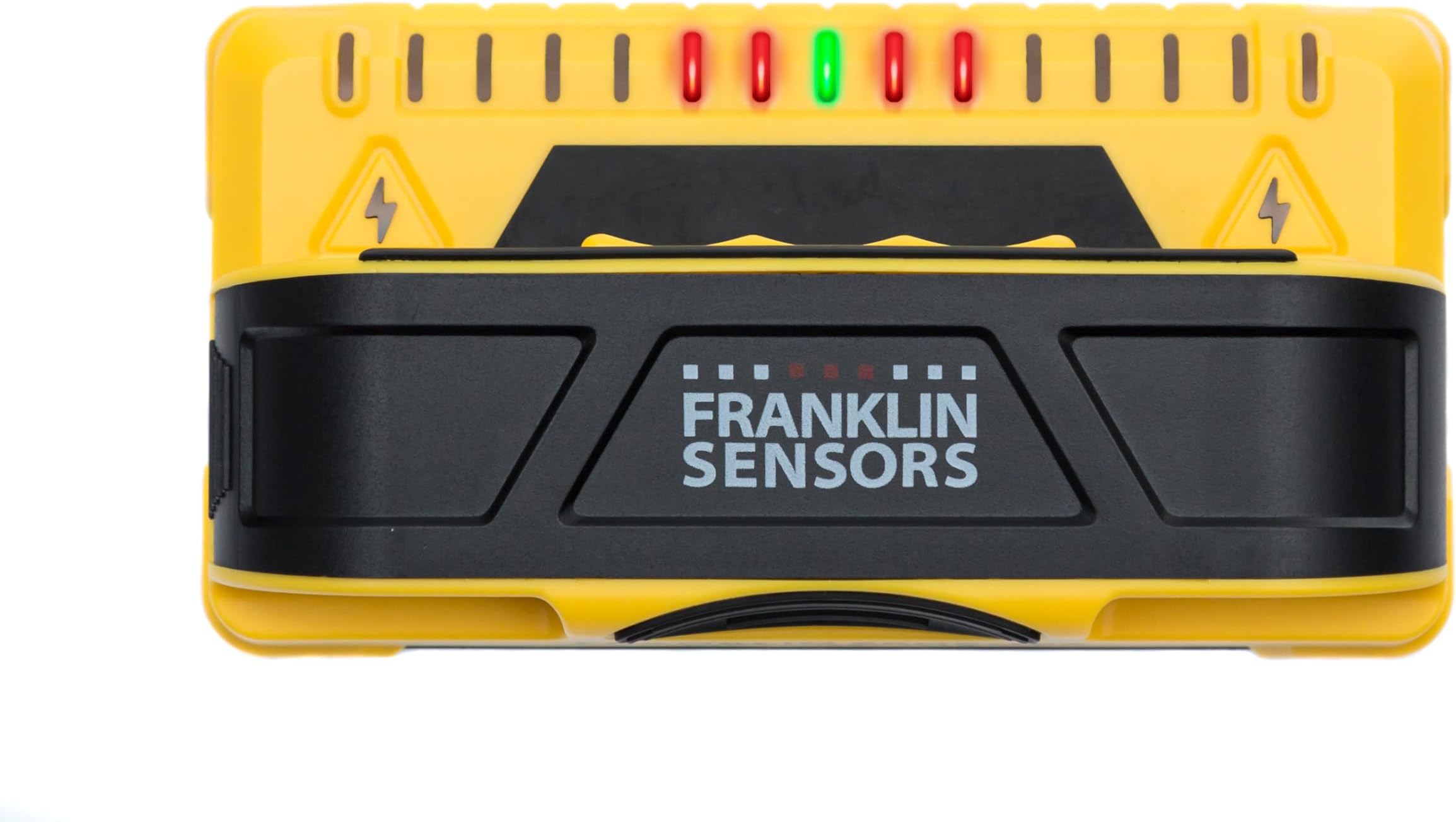
🔍 Find your studs, find your edge—precision that professionals trust.
The Franklin Sensors ProSensor M150 stud finder features 9 advanced sensors delivering unmatched accuracy with a 1.5-inch detection depth. It simultaneously displays stud centers and edges, detects live wires for safety, and requires no calibration. Lightweight and durable, it runs on standard AAA batteries and adapts seamlessly to various wall materials, making it the top choice for professionals and serious DIYers.


| ASIN | B0917TH83L |
| Batteries | 2 AAA batteries required. |
| Best Sellers Rank | 3,651 in DIY & Tools ( See Top 100 in DIY & Tools ) 40 in Scanners & Testers |
| Customer Reviews | 4.2 4.2 out of 5 stars (3,510) |
| Date First Available | 7 April 2021 |
| Item display length | 7.5 inches |
| Item display width | 7.5 inches |
| Item model number | ProSensor M150 |
| Manufacturer | Franklin Sensors |
| Material type | Plastic |
| Part number | FSM15002HD |
| Power source type | Battery Powered |
| Product Dimensions | 14 x 7.6 x 5.1 cm; 145.15 g |
P**N
Stud finder very accurate
Absolutely the best bit of kit I’ve bought in the last 12 months. The ability to find the center of a stud is a game changer for me. I love how it lights up green when the center is found, goes that extra bit of confidence. The electrical sensor works great too, but hard to know where exactly the electrical wire is, the sensor just lights up a yellow led shaped like lightning. I am presuming it’s the center of the device it is alerting for. Either way, it’s the best sensor I’ve owned. A++
P**L
Good for stud finding, but not good for cables
Good at stud detection, not so great at cable and electricity detection. It is easy to use and is light, though I am not sure it would survive many drops.
M**S
Excellent performance
Excellent product, hard to believe how much better this is than all the other so-called stud finder I have tried. Expensive, but at least you will not be wasting your money again.
S**T
Detected power no problem.
Used this to avoid power cables when putting shelves up in she’d. Power cables are running through the walls. Works well.
E**E
I was a bit cacky-handed with it at first, but it locates well
A**N
Electrical detection is not great
Reliable for finding studs through plasterboard, however, the electrical sensors are rubbish, sometimes detects, sometimes not, often detects when your at least 200mm away, can’t trust it for electrical detection but as a stud finder, great!
D**1
Didn't work
I just bought this and tried it for quite a while using new batteries. Didn't find any studs in walls, floors or ceilings. Sent it straight back. (It did seem to find some electrical cables but this isn't what I bought it for)
B**I
Great product
Great piece of kit. It is very easy to use and takes the guesswork out of finding studs and electrical cables in the walls. The only improvement I would.like to see to make it five out of five would be for it to identify where exactly the cables are, as far as I can tell it shows you that they are there but doesn't pinpoint their exact location. Having said all that Inlove this little de ice and it makes drilling walls much less stressful.
R**Y
Why is Franklin products so hard to get a hold of in Europe? .. this device is everything I wanted for a stud finder
A**R
Fungerar fantastiskt. Rekommenderas starkt!!!
G**Y
Best studfinder I've ever seen. I tried a couple of others but they weren't giving repeatable results and weren't very good at actually finding studs, which is a problem. The Franklin ProSensor X990 gives me repeatable results every time. Another feature I like is that the leds will begin to turn red in the direction of the stud you're about to go over, and then shows the center led as green when you're in the middle of the stud. Works every time and only takes a few seconds to find the stud. Plus it also has two leds shaped like lightning bolts that light up when there's a power cable in the wall that you're going over. Since I had bought a Teslong Inspect-5ft borescope and had to drill holes in the same wall for drywall anchors, I used the anchor holes to inspect behind the wall and confirmed that in two different walls that there were indeed electrical cables behind the wall. In one case it was easy to expect power due to the wall switch being in that area, but in another, there was no clear outside indication that were was a power cable behind the wall so I was surprised when the Franklin's power indicators first came on. This is now my go-to stud finder since its so quick and easy to use and always on target. Very accurate and very sensitive, but doesn't give false positives, and is even ergonomically designed so it feels comfortable while moving it across the drywall.
G**A
Pas efficace pour toutes les détections (chevrons).
M**K
I've had a few studfinders (Stanley, Zircon) and they have been completely useless. So useless, in fact, that I would say it would be more accurate to just throw a dart blindfolded at the drywall and drill there. Every finder I have had has been a mess of beeping, calibrating, false positives, and not knowing whether what you've found is something you should or shouldn't drill into. Maybe I'm just too dumb to use them, and that would be fair enough. What I can say is that I recently had a wall built, and I took the time to photograph and measure where the studs were before the drywalling was installed: none of my existing meters came anywhere close to detecting where the studs actually were. Enter the Franklin Sensors device. No beeps, no calibration, doesn't seem to care if you happen to have a hand resting on the drywalling etc. You stick it on the wall and you turn it on. That's it. I tested it on the new wall that I had built, and it found every stud exactly where I knew it was because I had photos to prove it. I also found that the Franklin was able to detect the metal studs used to hang ceilings from with great accuracy, and that, together with wooden studs in the walls, is all I need. Finally, a real advantage of the Franklin is that it shows the exact thickness of the stud, and you can see where it starts and ends. None of this uncertainty about whether you are finding the start, end or centre of the stud. As I said above, perhaps it's my lack of competence with other units, but this thing just works and that suits me just fine.
Trustpilot
1 week ago
5 days ago