
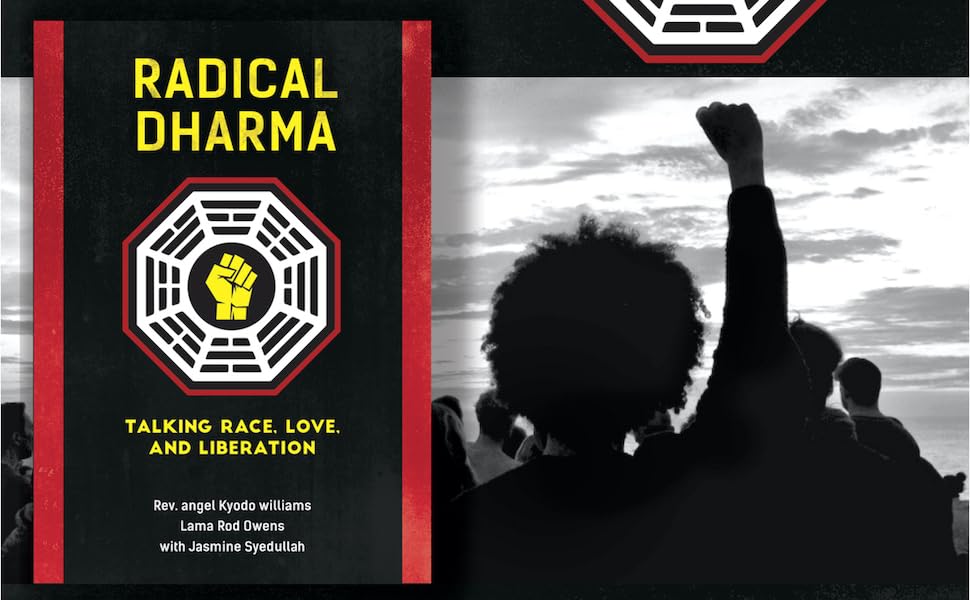
Radical Dharma: Talking Race, Love, and Liberation
Product ID: 45006138
Desertcart purchases this item on your behalf and handles shipping, customs, and support to Panama.
Without inner change, there can be no outer change. Without collective change, no change matters. The groundbreaking classic for engaged Buddhists and anyone ready to bridge the gap between inner work and outer practice—a powerful blueprint for collective liberation written in the Black prophetic tradition Authors Rev. angel Kyodo williams, Lama Rod Owens, and Dr. Jasmine Syedullah, PhD, unflinchingly show us that it’s long past time to step beyond the comforts of “good behavior” Buddhism…and that the time is now to step up and embody a truer Dharma rooted in love, justice, and power. A modern spiritual classic and fierce call to action, Radical Dharma is also a dynamic and deeply moving volume of essays and dialogues that will help you: Unite your inner and outer paths: How deep personal healing and systemic social transformation are intertwined Understand and confront white supremacy in your sangha or community: Why it’s essential to interrogate the “mind of whiteness” and lean courageously into discomfort, truth, and necessary reckonings Show up to your spiritual practice as your whole self: How to celebrate and affirm intersectional, queer, and Black identity, even (and especially) if you don’t see yourself reflected in your sangha See spiritual work as justice work: How to uplift and live the Dharma as teachings that transcend color, class, and caste Since its publication in 2016, Radical Dharma has ushered in essential conversations about race, love, and liberation—and ignited dialogue that’s broken out far beyond the American Buddhism and meditation worlds into our national collective movements. Offering their own histories and experiences, williams, Owens, and Syedullah forge a path toward an end to suffering and recast the concepts of engaged spirituality, social transformation, inclusiveness, and healing. Review: Amazing teachings that have given me language and changed my life. - Some time ago, I was involved with white "spiritual" communities of Eastern practices, mainly Buddhism and Daoism. However, there would come a time when I'd feel as if these teachers of these amazing spiritual teachings completely stopped at social justice issues. As a marginalized person, I felt that this lack of awareness of racial issues was offensive, insensitive, and alienating. I ended up leaving my spiritual communities, and for a while felt disillusioned by Eastern Spirituality in America as a whole. But I knew there had to be people out there who were like me -- people who felt hurt by the system, yet found a way to liberate themselves through Dharma practice. And after a short google search, I encountered this book and bought it right away. Within the first few pages, I couldn't believe it. The authors all spoke in a language that I wasn't familiar with, but still rang true to my heart. The first few pages hit me so hard that I started crying with hope, that people out there understood me, and were able to give me language for my pain. Since I finished the book, I've found my personal Dharma practice to be stronger and deeper, and I don't feel so alone. Thank you Rev angel Kyodo williams, Lama Rod Owens, and Dr. Jasmine Syedullah for this amazing work. I'm truly grateful. Review: How will the Dharma take root in the west? Read this book! - This book brings all practitioners into stark recognition of the fundamental dualism of racism, which we are steeped in by virtue of our culture and the systems created to sustain it. The authors open a path which supports both inner liberation and outer liberation, understanding Black liberation as part of the fundamental ground of our Dharma practice. Refusing an "us and them" paradigm, Rev. angel Kyodo williams, Sensei, and her co-authors are long-time committed practitioners who offer us all an incredible opportunity to move through to more authentic practice and connection. As a self-identified white practitioner of Buddhist meditation, Radical Dharma continually opens me to the constrictions that otherwise keep me separate. It challenges my attempts at perfectionistic performances of "goodness," and urges me toward true liberation rather than unwittingly imagining I can protect a corner of privilege while on an enlightening path. Radical Dharma encourages us all to move together toward collective liberation in an embodied, relational way, allowing the Dharma to penetrate us and offer it's healing potential for all. It is courageous, critical work. It offers us perhaps the most potent opportunity we have for the Buddha's Dharma to take root in the West, particularly in our country, because it wholeheartedly recognizes how split we are and have been.

| Best Sellers Rank | #458,663 in Books ( See Top 100 in Books ) #45 in LGBTQ+ Demographic Studies #49 in Buddhist History (Books) #231 in Discrimination & Racism |
| Customer Reviews | 4.7 out of 5 stars 612 Reviews |
S**Z
Amazing teachings that have given me language and changed my life.
Some time ago, I was involved with white "spiritual" communities of Eastern practices, mainly Buddhism and Daoism. However, there would come a time when I'd feel as if these teachers of these amazing spiritual teachings completely stopped at social justice issues. As a marginalized person, I felt that this lack of awareness of racial issues was offensive, insensitive, and alienating. I ended up leaving my spiritual communities, and for a while felt disillusioned by Eastern Spirituality in America as a whole. But I knew there had to be people out there who were like me -- people who felt hurt by the system, yet found a way to liberate themselves through Dharma practice. And after a short google search, I encountered this book and bought it right away. Within the first few pages, I couldn't believe it. The authors all spoke in a language that I wasn't familiar with, but still rang true to my heart. The first few pages hit me so hard that I started crying with hope, that people out there understood me, and were able to give me language for my pain. Since I finished the book, I've found my personal Dharma practice to be stronger and deeper, and I don't feel so alone. Thank you Rev angel Kyodo williams, Lama Rod Owens, and Dr. Jasmine Syedullah for this amazing work. I'm truly grateful.
D**G
How will the Dharma take root in the west? Read this book!
This book brings all practitioners into stark recognition of the fundamental dualism of racism, which we are steeped in by virtue of our culture and the systems created to sustain it. The authors open a path which supports both inner liberation and outer liberation, understanding Black liberation as part of the fundamental ground of our Dharma practice. Refusing an "us and them" paradigm, Rev. angel Kyodo williams, Sensei, and her co-authors are long-time committed practitioners who offer us all an incredible opportunity to move through to more authentic practice and connection. As a self-identified white practitioner of Buddhist meditation, Radical Dharma continually opens me to the constrictions that otherwise keep me separate. It challenges my attempts at perfectionistic performances of "goodness," and urges me toward true liberation rather than unwittingly imagining I can protect a corner of privilege while on an enlightening path. Radical Dharma encourages us all to move together toward collective liberation in an embodied, relational way, allowing the Dharma to penetrate us and offer it's healing potential for all. It is courageous, critical work. It offers us perhaps the most potent opportunity we have for the Buddha's Dharma to take root in the West, particularly in our country, because it wholeheartedly recognizes how split we are and have been.
D**Y
The most important book I’ve read all year.
What to do as a sentient and somewhat conscious being on this troubled planet today? If staying stuck in rage and paralyzed by fear does not appeal to you, reading this book may be helpful. Its authors discuss the work they have done and continue to do to in Buddhist communities. They address race, gender, sexual orientation, class, and religious background both from their own life experience as well as in the wider context of US history and the history of Buddhist communities in the US. They discuss the connections between individual practice, community, and political activism. And they do so in ways that are accessible to anyone who seeks liberation from the false ideas of separate identity. I imagine that having a basic understanding of Buddhist teaching probably would be helpful for readers but I found the writing very clear, and a brief glossary is included at the end of the book. Buddhist or not, here we are. What if we practiced loving kindness? What if we lived Radical Dharma?
E**R
A Worthwhile Discussion on Buddhism, Race, Gender Identity, and Sexual Preference
Radical dharma explores the intersections of race, racism, gender identity, and sexual preference in the US as those terms relate to Buddhism. There are both articles and moderated discussion groups with the three authors, all of whom are black,gay, bi or transgender intellectuals. One of the most interesting discussions involves race and the sangha, as Buddhism not based in East Asian communities is overwhelmingly populated by white middle to upper middle class educated members. I think that Rev. angel Kyodo Williams sensei both nails the problem on the head and highlights the conflicting viewpoints that run throughout the book when she states: "Race is the ultimate delusion in that it both does and does not exist in reality."With respect to sanghas the conversants note that problems arise when the sangha is not willing to turn into itself and explore what it means to be in a racialized society. Another one of the author's, Lama Rod, describes radical Dharma, within this context as having the bravery to have dharma talks and meditation practices that will focus on topics that make participants feel uncomfortable and learn how to deal with their suffering. One of the criticism's of Lama Rod's, with which I agree, is that many sangha's have become severely compromised by capitalism and need to provide a consumer oriented Buddhism. The result is too heavy a focus on selling classes and not offending sangha members which dilutes the authenticity of Buddhist practice. On the other hand, you need money to run a sangha, so where is the balance? My criticism of the viewpoints and discussions as that it is at times it is devalued by the overuse of racial and sexual labels. An example is the comment: "for white folks, though the coexistence of being historically lauded as the creators of what is right, making mistakes must be hard." I wanted to ask which "white folks?" There are immigrant white folks and holocaust survivor white folks and down and out white folks, should they be lumped into the white folks of the quote above and does the author seriously think that all white folks see themselves and their relation to race in the same way? The authors turn to greater complexity at times when they talk about racism and economics as co-repressive self-feeding factors. However, the essays and discussions veer between the "race as monolith" and "race as factorial" viewpoints. Overall, this book is of great value both in understanding applied Buddhism and the need to openly discuss racial issues within the sangha. I highly recommend this book.
L**O
Racial Justice & The Need for Collective Liberation
This book was transformative for me: as a white person who wants racial justice, as a Buddhist and mindfulness practioner, and as a human being. This book is a call for our collective liberation and is a necessary read for all spiritual people who want to live in a world where everyone is free. I strongly recommend it for fellow white people to own our history and be mindful in the present so we can move forward.
C**C
Expansive and heartful discourse on the intersection of Love and Justice
As a dharmic dabbler of interspiritual propensities, I found this book to be simultaneously rooted and uplifting. The authors leave no room to hide, and their invitation to squirm and wriggle as we consider the implications of our spiritual practice was a charge of the highest order. Do I want to contemplate love or do I want to put Love to practice? It was not the intention of the book, but I felt a tangible reconciliation in my own psyche of the Immaculate Heart of Christ and the Awakened Heart of Buddha. As the authors suggest, our liberation is bound to intersectionality and transcendent movements. For the first time, I read a Dharma book that touched all parts of my Self, and asked that I bring them all to the movement toward personal and collective liberation. I could see whiteness as a social construct, as illusory and real as these egos we bring to practice. Just as we delight in ego-transcendence, it is time to delight in the clear-seeing of whiteness, in order to come into greater intimacy with ourselves and others. Bravo! Namaste! Amen! Deep bows 🙏🏼 In Love, Chris
H**R
Like coming home for the first time.
This book is both beautifully simple, and deeply profound. Every few pages I set the book down to cry. Sometimes I cried with grief. Sometimes I cried at the relief of having my own deepest experiences splaid out on the page. Sometimes I cried with a deep hurt that I have never been able or free to give words to. This book is love in written form - an offering made from a place of the impossible commitment to free all souls, and from minds that are sharp and clear and also funny. More than once my skin crawled with goosebumps as I felt like in the pages of this book I had finally found a secret wonderful group of people committed to love and justice. I felt both included and welcomed, and charged with the heavy responsibility of undoing the injustice that is around me constantly. As a white woman, I cannot begin to express the depth of the gratitude I have for these authors, for the generosity, courage, sacrifice, wisdom, and above all, love in their sharing. I will read this book again, and again. 5 stars. Must read.
N**O
10/10 ⭐️
I love this book!!!
C**A
Good
Good quality
M**O
a must read
cant wait to readi it
S**H
Not anything-ist? Really? Read this!
Anyone who thinks they're not at all racist, sexist, homophobic or biased by gender identification; anyone who thinks they essentially don't discriminate unfairly in any way, needs to read this book. You might not agree with every opinion stated. But it will make you think. It will likely make you uncomfortable. If you have a social conscience, read it. Written from a Zen Buddhist point of view, but the Zen Buddhism is not at all overpowering or intrusive. Essential reading for any contemporary thinking person.
J**N
Wunderbar
Endlich mal ein Buch von Personen die selber qieer /poc und buddhistisch sind und schildern wie ihr Zugang beziehungsweise ihre Perspektive ist ich hab mich als queerer mensch der selber Buddhismus praktiziert sehr gesehen gefühlt aber es ist nicht nur ein Buch für queers und üpcs sondern für jeden mal zu empfehlen zu lesen auch was ist immer noch für Ausschlüsse im Buddhismus gibt
Trustpilot
1 month ago
2 weeks ago