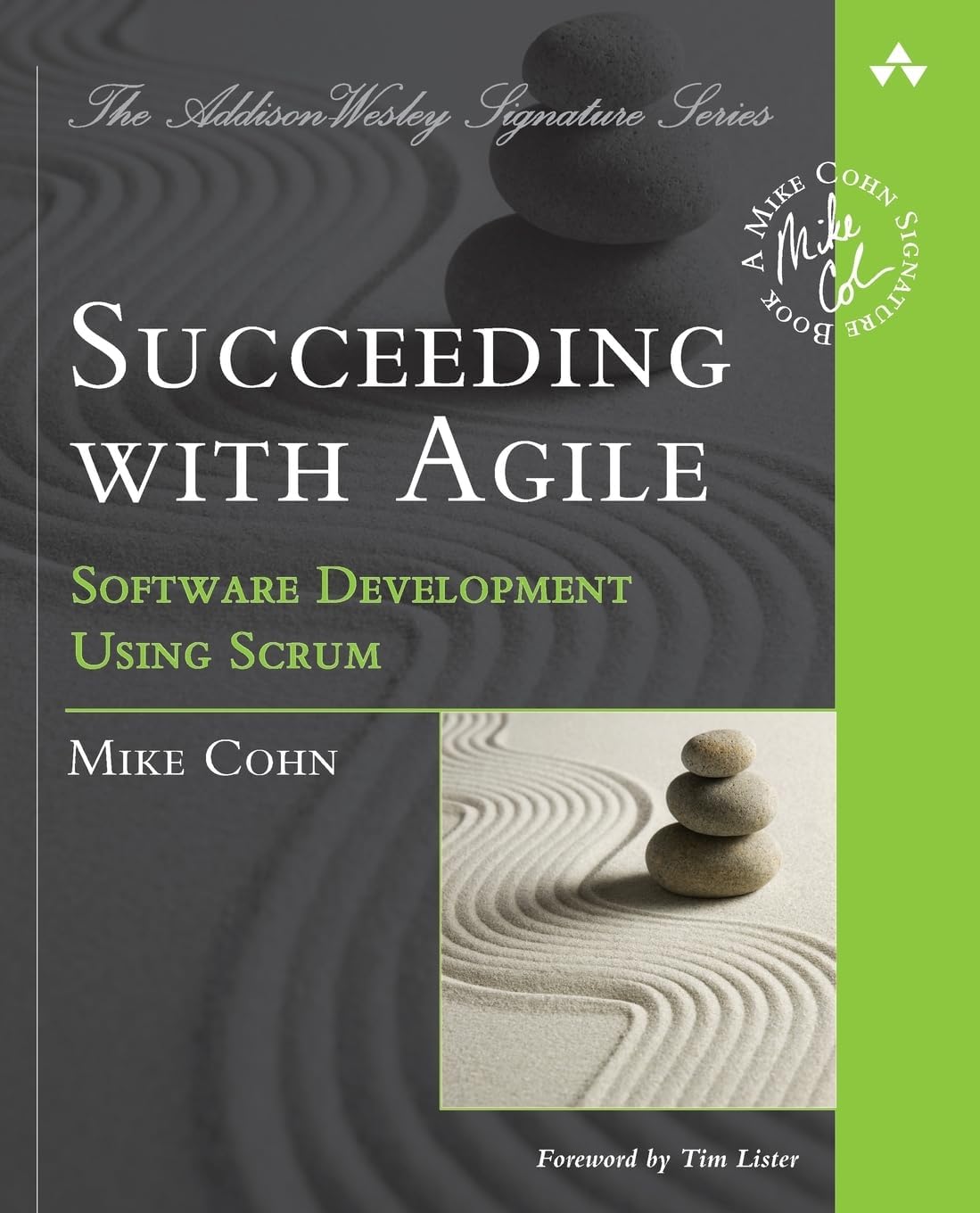
Succeeding with Agile: Software Development Using Scrum (Addison-Wesley Signature Series (Cohn))
Product ID: 4804534
Desertcart purchases this item on your behalf and handles shipping, customs, and support to Panama.
Proven, 100% Practical Guidance for Making Scrum and Agile Work in Any Organization This is the definitive, realistic, actionable guide to starting fast with Scrum and agile–and then succeeding over the long haul. Leading agile consultant and practitioner Mike Cohn presents detailed recommendations, powerful tips, and real-world case studies drawn from his unparalleled experience helping hundreds of software organizations make Scrum and agile work. Succeeding with Agile is for pragmatic software professionals who want real answers to the most difficult challenges they face in implementing Scrum. Cohn covers every facet of the transition: getting started, helping individuals transition to new roles, structuring teams, scaling up, working with a distributed team, and finally, implementing effective metrics and continuous improvement. Throughout, Cohn presents “Things to Try Now” sections based on his most successful advice. Complementary “Objection” sections reproduce typical conversations with those resisting change and offer practical guidance for addressing their concerns. Coverage includes Practical ways to get started immediately–and “get good” fast Overcoming individual resistance to the changes Scrum requires Staffing Scrum projects and building effective teams Establishing “improvement communities” of people who are passionate about driving change Choosing which agile technical practices to use or experiment with Leading self-organizing teams Making the most of Scrum sprints, planning, and quality techniques Scaling Scrum to distributed, multiteam projects Using Scrum on projects with complex sequential processes or challenging compliance and governance requirements Understanding Scrum’s impact on HR, facilities, and project management Whether you've completed a few sprints or multiple agile projects and whatever your role–manager, developer, coach, ScrumMaster, product owner, analyst, team lead, or project lead–this book will help you succeed with your very next project. Then, it will help you go much further: It will help you transform your entire development organization.


| Dimensions | 7.4 x 0.79 x 9.09 inches |
| Edition | 1st |
| Isbn 10 | 0321579364 |
| Isbn 13 | 978-0321579362 |
| Item Weight | 1.8 pounds |
| Language | English |
| Part Of Series | Addison-Wesley Signature Series (Cohn) |
| Print Length | 512 pages |
| Publication Date | October 26, 2009 |
| Publisher | Addison-Wesley Professional |
User
A good book for solving the problems you may encounter while using Scrum.
I recommend this book to those who are trying to spread Scrum into an organization.In the introduction to the book Mike Cohn states that the book is not for those new to Scrum or for purists. He says it is for those who have started Scrum and have run into problems.The book is divided into 5 parts:Part I Getting StartedPart II IndividualsPart III TeamsPart IV The OrganizationPart V Next Steps.Succeeding with Agile walks you through how to spread Scrum in your organization and how to get better at Scrum along the way.The author points out that being successful at rolling out Scrum can be difficult:"But there are certain attributes of transitioning to Scrum that make it more difficult than most other changes. They are as follows:* Successful change is not entirely top-down or bottom-up.* The end state is unpredictable.* Scrum is pervasive.* Scrum is dramatically different.* Change is coming more quickly than ever before.* Best practices are dangerous."Cohn also points out that departments outside of Engineering may have issues with Scrum:"Finance groups will have to reconcile company policies on capitalizing or expensing with the way Scrum projects run. Sales will want to consider altering how they communicate date and scope commitments and may change how they structure contracts. With more groups affected by a move to Scrum, there is more chance for resistance and certainly more chance for misunderstandings. These add up to make transitioning to Scrum harder than other changes."But for all of the difficulties, Scrum is very popular with stakeholders. Cohn says:"One reason stakeholders are so satisfied is that time-to-market is reduced when using an agile process like Scrum. This faster time-to-market is enabled by the higher productivity of agile teams, which is in turn the result of the higher quality seen on agile projects. Because employees are freed up to do high-quality work and because they see their work delivered sooner into the hands of waiting users, job satisfaction goes up. With higher job satisfaction comes more engaged employees, which leads to more productivity gains, initiating a virtuous cycle of continued improvement."Many organizations try to keep the role of Project Manager while also using Scrum. In the book, Mike Cohn argues against that:"On Scrum projects we acknowledge the untenable role of the project manager and eliminate it. Eliminating the role, though, does not mean we can do away with the work and responsibilities."He says that the responsibilities that were carried out by the Project Manager are shifted to the Team, the ScrumMaster and the Product Owner.The author notes that while the Scrum framework does not prescribe software development methodologies, Scrum teams have found certain practices improve the product. He writes:"...we will look at common technical practices used by Scrum teams to improve the quality of their work: test-driven development, refactoring, collective ownership, continuous integration, and pair programming. While I just referred to these as common practices, the truth is that they are not so common. These practices are well regarded and lead to higher quality, but because they can be hard to put into practice, they are used less often than they should be."Cohn also points out that planning is just as essential in Scrum as it is in other methodologies. He says:"Planning is a fundamental aspect of Scrum. Scrum teams commit to always working on the features with the highest value. To do this, the team and product owner must have an estimate of how much a feature will cost to develop; otherwise they are prioritizing on desirability alone. Similarly, it is important to estimate how long a feature will take to develop--a feature that misses a critical market window will deliver much less value. Clearly, for a Scrum team to live up to its promise of working in priority order, planning must be an essential practice."However, he points out that planning is not a one time acivity but is an ongoing one, where the plans are continually revised.Cohn also warns against trying to achieve quality by testing after the fact:"Scrum teams make testing a central practice and part of the development process rather than something that happens after the developers are 'done.' Rather than trying to test quality after a product has been built, we build quality into the process and product as it is being developed. W. Edwards Deming was an American professor and consultant best known for his work in Japan emphasizing the impact of quality on cost and productivity. He maintained that quality could not be added to a product later. He wrote that we should 'cease dependence on mass inspection to achieve quality. Improve the process and build quality into the product in the first place' (2000, 23)."Overall I learned a great deal from the book and enjoyed reading it.
User
The most practical guide to agile available
Mike Cohn continues in his tradition of writing some of the most practical books available in the agile environment. His vast experience is evident in his approach to presenting the many questions practitioners and newcomers alike consider as they move ahead with agile practices. Without being dogmatic he provides the pros and cons of the issues at hand, helping to understand why one approach might be more desirable than another. As one example, in presenting the difference between feature teams and component teams, it would have been very easy (and overly simplistic) for Mike to indicate that feature teams are the way to go. Instead, he acknowledges that feature teams are strongly recommended, but that component team might be the right choice in some situations, and he explains what those situations might be.This book also makes a great reference. Have a question about the role Human Resources play in an agile environment? Look it up in the index and get some pertinent information without a lot of wading through other non-related material.The littering of "Objection" and "Things To Try Now" notes again add some very practical applications, both in dealing with common obstacles encountered while implementing agile practices, and also in recommending ways to move the cause forward without a lot of fuss.One very minor style critique: while I appreciate the extensive use of supporting reference material, the manner in which these are inserted into the book can be just a bit tiresome, almost giving a feeling of reading a research paper. I'm not sure that there's any way around this, and there's no contest between getting the supporting references vs. losing some of that to attain a style objective: the extra detail wins hands down.As an indication of the overall quality of "Succeeding With Agile" we have decided at Winnow Management to now use this book as our primary recommended reading to our clients. Great work, Mike!
User
Per aspera ad astra
After reading this book I have emerged with a split personality of Dr. Jekyll and Mr. Hyde. The Agile methodology as presented by Mr. Cohn contains a very valuable information based on his personal experience that can be utilized on many development projects and is written in a very light, easy to read language that will not make you tired after reading 15 pages. However it also contains extreme simplifications that makes me wonder whether Mr. Cohn is trying to sell Agile a little too hard. In too many cases my own experience (20 years in PM and total 27 years in software development) goes against many examples presented in the book.Let me pickup just one few example from the book.Mr. Cohn makes the case (page 237) that "With written document we do not iterate over the meaning as we would in conversation".Written documentation is a living document which captures all conversation we had with our company sale people, with customer (as customer business people and end users who are people that will use the system for their daily work) that is the basis for user acceptance test. Such document does not have to be developed 100% before starting implementation but needs to be 100% created and approved (signed off by customer) long before you finish the last line of code.Verbal conversations capture a lot of details that need to be separated into reality and customer dreams. Try to go to the court of law and resolve these differences based on conversations ( or loose documentation) that took place over many days with many people.I will not go over the issue with defining folder length ( on the same page 237) which made me laugh and cry at the same time. It is example of poor definition and not the example of why we need less documentation. This book has many rather childish examples like this one (see booking hotel on page 236) promoting Agile when Agile can stand on its own rather well).Final thought: If you are seriously considering diving into the world of Agile development, you should read this book, no question about it.I believe that this book is worth the price, it is worth to spend time reading but be aware that like all software development methodologies is not a silver bullet and it is a bag of new, interesting ideas and a lot of ideas that might have limited application in your environment. So "improvise and overcome" (Heartbreak Ridge, Sergeant Thomas Highway).
User
Nothing better out there
I've been following and learning from Mike Cohn for over 10 years now and really just got around to reading this book cover to cover. A remarkable and very helpful work. I'm in the midst of an agile transformation right now and it's been invaluable.
User
Succeeding In Software Development
Mike Cohn is a great figure and force in the Software Development industry. He has once again taken his experiences and posted them in the form of a book for all to read and learn. I remember listening to Mike at the 2009 Scrum Gathering when we were asking him about Agile/Scrum Development and is it short lived (will the industry find something new). His response was, in the day of object-oriented programming, we used to say "we are doing OO". Today, objects won, we no longer have to say that, we just know that is the best way to program software. He hopes the same is true for Scrum. One day, we don't call it Scrum, we just call it Software Development.This book is filled with ideas/suggestions that are concrete examples of his experiences. He shares what worked and what did not work. I think anyone can take any challenge they have with Agile and find some solution or idea in this book. It is a must read for organizations who have moved from learning Scrum to learning to do it well. Great job Mike as always. Thank you for your common sense and practical approach to software development. This book is among the staples that will not only serve as a book to read, but a repository of ideas and suggestions that we can always look to when we encounter challenges.
User
This book is worth reading, but is highly over-rated.
Every now and then I'll find a book such as this one, that has stellar reviews but that in no way lives up to its hype. This is not even close to a 5 star book.My first criticism - the first 120 pages are about overcoming organizational resistance to Scrum.... no exaggeration, 1-2-0 pages on this. I didn't find any of this useful. This material could have been easily summarized in 10 pages at most.The next 200 pages get a lot better. Cohn discusses roles unique to Scrum, good technical practices, good team practices etc. I liked most of this - especially recommendation that teams should be feature driven vs component driven. Meaning that teams should be organized by functionality devilvered to the end-user vs. by layers of platform or application they are designing. This creates a more integrated product.I also like his discussion on automating testing - which I 100% agree with. Automate early and often.I didn't quite agree with his analogy that the product owner = traditional product manager, and ScrumMaster = traditional project manager. I've seen other interpretations of scrum where this is not the case.My more serious criticism is that Cohn does not go into enough detail regarding flushing out user requirements. He doesn't really go further than to say the Product Owner is external facing and should figure out what the user wants. I think getting the user requirements right is one of the most critical jobs of a product development team, and I think discussion of this was sorely lacking in the book given all of the other topics he touched on.One other thing I don't agree with , the use of user stories in place of requirements. I have not read his other book on User stories, but I have read several other books on requirements and I do not think it's a good idea for development teams to basically talk through what should be in a product. Important features should be written requirements that can be tested against and have only one interpretation. This is especially true for products have both hardware and software components.The examples he gave where written statements are mis-interpreted are laughable. No one would write requirements like the ones he uses in examples. To be clear, I'm not advocating waterfall and I do agree though that defining requirements at the onset of a project is impossible. I just don't agree with the user story approach.The last 100 pages discuss mostly the issues of implementing Scrum across the entire organization. Some of this deals with distributed teams, HR, facilities, etc. I didn't find most of this useful, aside from a point Cohn made regarding annual reviews being based off of team work rather than an individual assessment. He's definitely right about that.Overall, I felt Cohn had a somewhat dry and long-winded manner of writing. This book (~450 pages!) could have easily been about 200 pages shorter. He writes from the perspective of someone that coaches and helps organizations adopt Scrum - and this comes across very much in his writing.He does NOT write from the perspective of someone on a team actually developing a product, and the book suffers for this.I'd give this probably 3.5 stars. Not a bad book, some useful sections in the middle, but not a great book either. I may look into Cohn's book on planning, because his brief section on this was good.If you'd like to learn more about the nuts and bolts of implementing Scrum, I much preferred Exploring Scrum by Rawsthorne and Shimp and would point agilists to that book instead.
User
comprehensive and yet addresses the nuts and bolts of agile implementation
Mike gets into the difficult leadership and organizational issues of implementing agile development and proposes practical approaches based on his extensive experience. Mike reveals how difficult it can be to implement agile thinking and execution. He illustrates the old adage that people want to see changes but they personally don't want to change. Mike spends a lot of pages recommending his solutions to these kinds of issues.Anyone serious about implementing agile in their organization needs to read this book and draw up a realistic game plan which must involve executive commitment and excellent team leadership skills. It is true that agile is really a simple idea but very hard to do well because it really blows everything around it to bits. This books prepares you for this scenario if at all possible.Mike's list of references at the end of his book is extensive and alone is worth the price of the book.
User
Hard to believe - but an enjoyable read
I bought 5 books on Scrum, including this one and I expected all of them to be a bit of a slog through jargon and dry descriptions. Not so.This one is very well written. He is just plain practical in his recommendations. None of the fanatical "you must do this" of extreme programming, he simply makes the case for each step/process based on his experience. This one is particularly useful for me. I've been on a scrum team for over a year, recently became a scrum master and this book answers a lot of my questions about what should be going on. I just attended Mike's certified scrum master training and this book had me well prepared. Between the book and the class, I'm not even vaguely concerned about taking the exam.I actually can't think of any downsides to this book. it's well reasoned, well laid out, well written, well edited, thoroughly covers all the topics and it's from a guy who still spends a lot of time in the trenches, so his observations and recommendations are pretty current. This one will end up on my "frequently referenced" shelf.
User
Answers A Great Many Scrum / Agile Questions
There are a few Scrum / Agile / Lean books which everyone on a software team should read and this is one of them. The information in this book is like gold-dust. It's been learned the hard way by the author! The information is well thought out and presented. Buy it now!
User
Un muy buen libro sobre gestión del cambio a metodologías ágiles
Mike Cohn es un gurú de las metodologías ágiles del que había leido otros libros como User Stories Explained y Agile Estimating and Planning, ambos excelentes. Por ello decidí revisar que decía sobre la gestión del cambio, sin duda la parte más compleja de la adopción de metodologías ágiles, especialmente en empresas medias a grandes.El libro tiene un buen nivel de detalle sobre los diversos aspectos como patrones de extensión de agile, las resistencias al cambio individuales y organizativas, la autogestión de los equipos o como planificar sprints en contextos multi-equipo.Lo único que me retiene de ponerle 5 estrellas es quizás que podría ir algo más allá con los ejemplos de herramientas, pero sin duda es muy difícil contentar a todos los tipos de lectores, y ya es imposible afrontar con detalle todos los contextos de empresas donde se comienza a aplicar agile, pues "cada empresa es un mundo".Alex / Cynertia Consulting - Barcelona
User
Very good book
Very good book. But not for very beginners. The books from Mike Cohen will be very interesting. You will not get bored while reading. It is based on Practical real world examples.
User
Ottima lettura per chi conosce già bene Scrum
Veramente un ottimo libro ricco di spunti e esperienze concrete. È adatto a chi applica già la metodologia di sviluppo Scrum e vuole aumentare la scala dei propri team. Ho ritrovato molte situazioni che sto vivendo anch’io. E ci sono suggerimenti utili in proposito.
User
Great reference
This book has it all. As a veteran scrum master, my challenge in the last few months was to convert a team with little or no agile experience to scrum.The most useful part for me were the Objection tabs that helped me counter recurring arguments from team members and stakeholders against the methodology with solid arguments for.The Things to try tabs are a gold mine of ideas.
Trustpilot
3 weeks ago
1 week ago