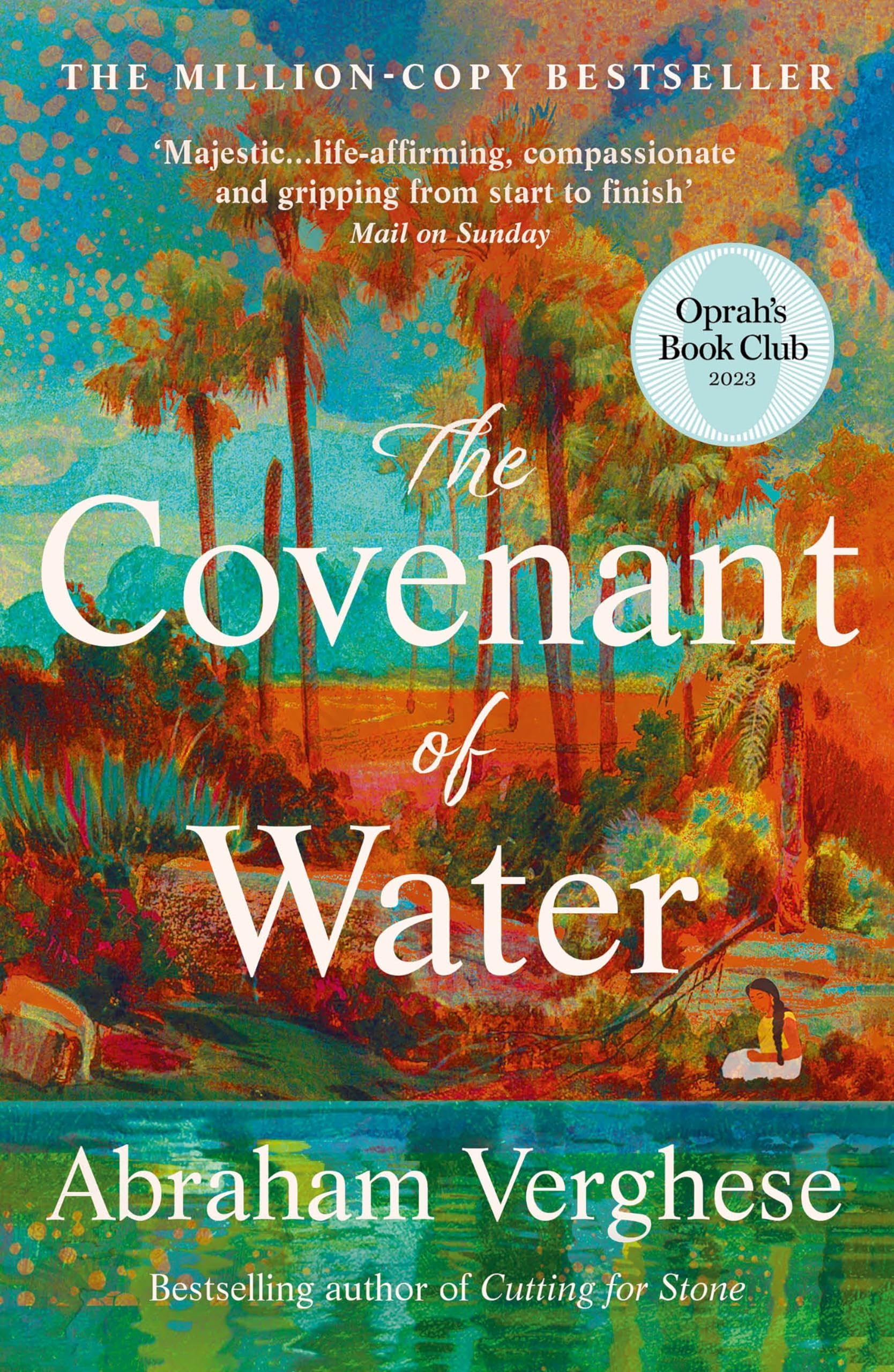
The Covenant of Water
Product ID: 617347930
⭐4.6/5 from 6,130 reviews
📅Published March 2024
📚Top #2 Medical Fiction
Buy anything from 5,000+ international stores. One checkout price. No surprise fees. Join 2M+ shoppers on Desertcart.
Desertcart purchases this item on your behalf and handles shipping, customs, and support to Panama.
📖 Unlock the story everyone’s talking about—don’t miss the literary event of 2024!
The Covenant of Water, published by Grove Press in March 2024, is a highly rated paperback blending medical fiction, mythology, and historical storytelling. With a 4.6-star average from over 6,000 readers and top rankings in multiple genres, it’s a contemporary bestseller that promises an epic, immersive reading experience.
| Best Sellers Rank | #11,743 in Books ( See Top 100 in Books ) #11 in Medical Fiction #78 in Mythology & Folk Tales #214 in Historical Fiction |
| Customer Reviews | 4.6 out of 5 stars 6,208 Reviews |
T**O
Modern Classic
Epic extraordinary journey
A**A
Overhyped nonsense by Oprah
Might be well written but the characters are utterly boring. Miserable storyline. None of it will make a difference to your life. Don't bother.
B**N
Brilliant
This book! It is definitely become my number one favourite book! I love historical fiction and this is a stunning family saga. The setting, the characters. The writing is so beautiful, Abraham Verghese has a command of the written word like no other. He crafts a sentence with pure joy.
M**H
Compelling reading
Very good book, set in India. Bought it for my husband's birthday. He has just finished all 758 pages and found it compelling reading.
O**R
Positive and entertaining story
Nice story. As usual with Verghese, there are lots of extensive surgical descriptions which don't really serve the narrative. At some points the story gets a bit sugary, but on the whole a beautiful book.
L**.
EpiC Book
One of the most remarkable books I have ever read throughout my life. It is truly epic. It has a transportive quality.
V**A
A splendid and astute social analysis
The Covenant of Water. Book Review: Reading Abraham Verghese's novel The Covenant of Water, the million-copy bestseller included in Oprah’s Book Club 2023 and published by Grove Press in the UK, has been an astounding experience for me for the last twelve days. The author took twelve years to write his magnum opus. The book explores the themes of love, compassion, empathy, human relationships, and commitment to a cause encircled by superstitions, fear, ignorance, slavery, detachment, spirituality, suffering, secrecy, and profound silence. While reading, the novel transported me to an unknown and known world: Kerala, which flows like the totality of all its thirty-six rivers, the serene plentiful lagoons, numerous backwaters and thousands of ponds adjacent to old houses, carrying its diverse smells, sounds, tastes, sights, touch, history, the struggle for equality, freedom, women’s liberation, literacy advancement, the health revolution, communist movement, Christianity’s involvement in education and social upliftment, the majesty of the temples, the culture, arts, and enlightenment through science and atheism. The novel is enriched with everlasting greenery, Malayali splendour, the humanness of the public, and equity visible everywhere. The book weaves the story of three generations of a family, the St Thomas Christians, from 1900 to 1977, in Travancore, Kerala. It starts with a twelve-year-old girl going to wed a forty-year-old widower whom she would meet for the first time in church during the wedding. The girl’s father, a priest, died years before, and her mother struggled to provide a life for her loving daughter. The groom was rich, having five hundred acres of land as the solace. The girl travelled alone with the broker to an unknown place by boat. The groom walked out of the church, seeing his would-be wife as she was still a child, slightly older than his motherless son. The priest, the wedding celebrant, had a hard time convincing the groom to accept the girl as his wife by tying the tiny thali around her neck, as St Thomas Christians continued to follow the traditions of the Brahmins. In her affectionate yet introverted, kind and wise husband's home, the twelve-year-old girl transformed into a compassionate, caring, lively, and wise matriarch whom others called Big Ammachi. She witnessed and brought far-reaching changes around her throughout her astonishing life span, which was compressed with happiness, hardships, deaths, pain, and sublimation. It is an absorbing, engrossing, spectacular novel full of humane touch, soft feelings and empathy. The starting is one of the best: “She was twelve years old, and she will be married in the morning. Mother and daughter lie on the mat, their wet cheeks glued together.” “The saddest day of a girl’s life is the day of her wedding,” her mother says. “After that, God willing, it gets better.” The universal truth stuns the reader and leads them to read further without interruption until the last page of this 715-page saga, witnessing the gradual transformation of the characters, the evolution of the story and the metamorphosis of the enriching philosophy beneath the theme. The characterisation of the main characters, Big Ammachi and her husband, their manager Shamuel, their son and daughter JoJo, Baby Mol, and Philipose, their son Ninan, Shamuel’s son Joppan, Rune, Digby, and Mariamma, is well developed, consistent, contrasting, and profound in terms of the themes of the novel. It vibrates with spontaneity and inner strength. More than anything, the novel is a perceptive and rigorous analysis of the complexities of the social system. A significant narrative is a struggle to interpret social customs, traditions, faith, religion, political affiliation, and a categorical value system, such as treating the Dalits as untouchables, in fact, slaves. “Because you loved my father, this is harder for you to grasp…You see yourself as being kind and generous to him. The “kind” slave owners in India, or anywhere, were always the ones who had the greatest difficulty seeing the injustice of slavery. Their kindness, their generosity, compared to cruel slave owners, made them blend to the unfairness of a system of slavery that they created, they maintained, and that favoured them.” The language is simple yet powerful, appropriate but timely, situational, elegant, and mesmerising, such as: “Below him, the tea bushes run in neat, parallel rows as though a giant comb has been dragged across the hillside.” Some of the ethereal and magical scenes in verisimilitude contexts suggest the serendipity and meaninglessness of life and, at the same time, its profound purpose, even the merging of contradictions. The deaths of JoJo and Ninan bring such a notion. Mariamma meeting her biological father and juxtaposing her palms against her mother, who she thought dead, is the most poignant scene in the story. The Covenant of Water is one of the greatest novels I have ever read. I cherished reading each word and each sentence on every page of this magnificent work. The joy I derived from it is unparalleled. It is a stupendous tribute to Kerala, its people and culture, language and courage, openness, vitality and diversity, soul-satiating greenery, gorgeousness, stillness, and enlightened living, respecting the right of the other person to cherish their rights. As a literary landmark, an epic tribute to the living and dead in God’s Own Country, The Covenant of Water shines like a bright star on the syzygy of English literature. I compare The Covenant of Watter with One Hundred Years of Solitude, Things Fall Apart, Brothers Karamazov, For Whom The Bell Tolls, The Remains of the Day and Valli, Sheela Tomy’s Malayalam novel, beautifully and elegantly translated into English by Jayasree Kalathil. Dr Abraham Verghese is the Vice Chair of the Department of Medicine at Standford University School of Medicine and the New York Times-bestselling author of Cutting for Stone, which has sold more than one and a half million copies. Varghese V Devasia Kozhikode 27 January 2025.
Trustpilot
4 days ago
1 week ago