
DOWNLOAD THE APP


Customer Services
Copyright © 2025 Desertcart Holdings Limited
DOWNLOAD THE APP


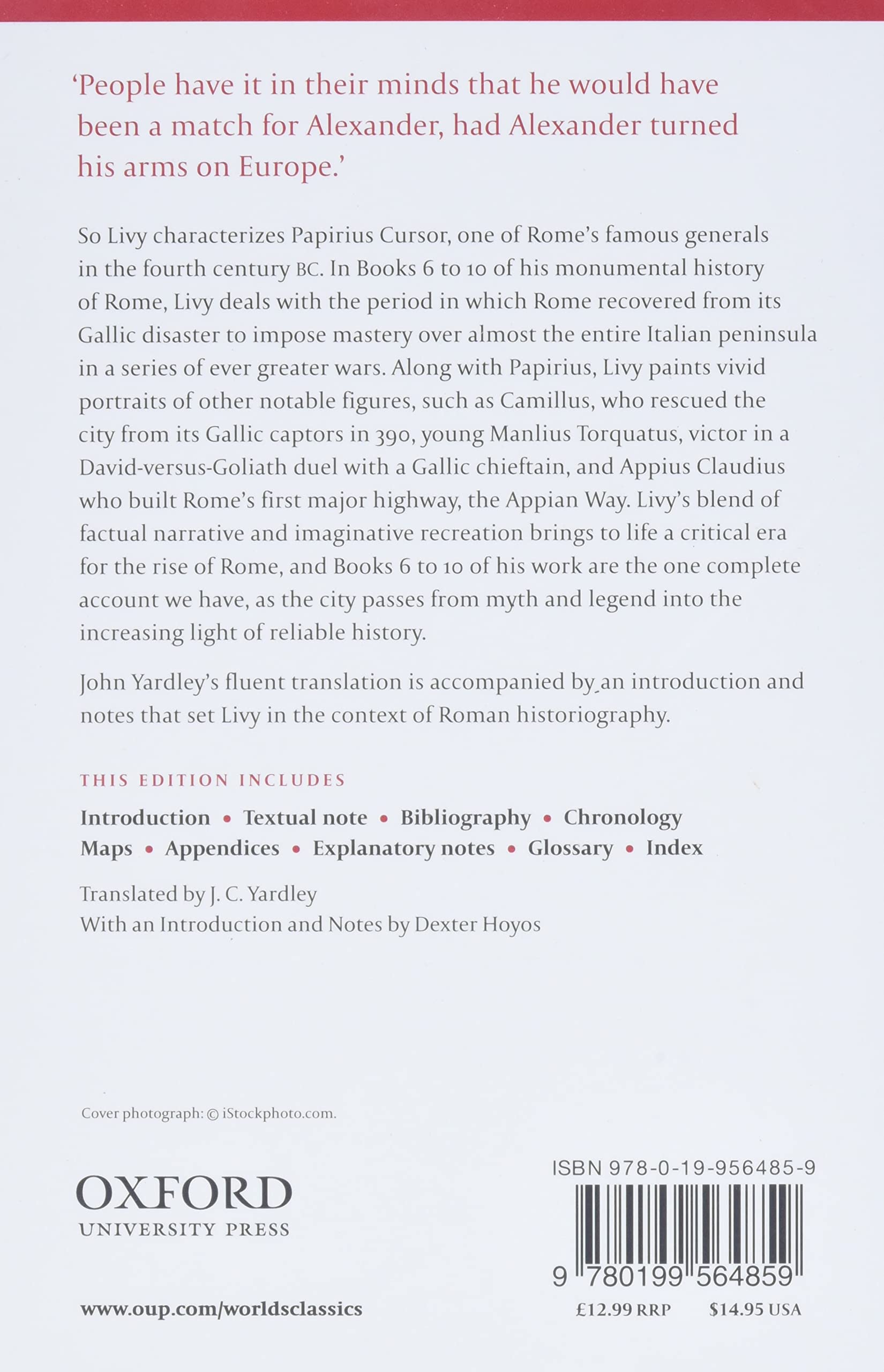
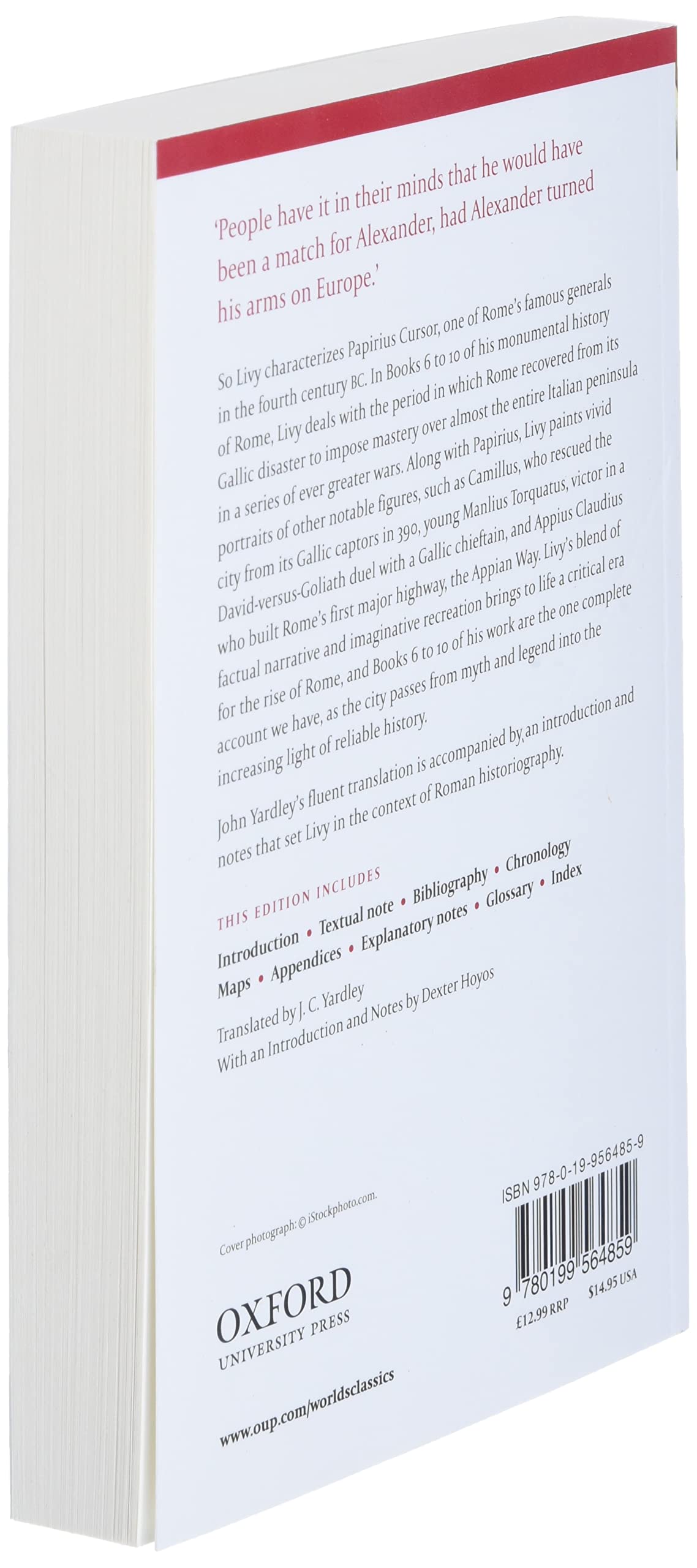

📖 Unlock Rome’s epic past—where history meets intrigue!
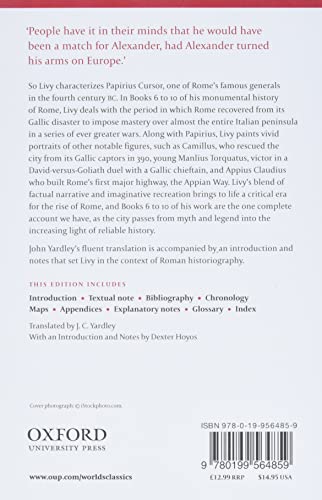
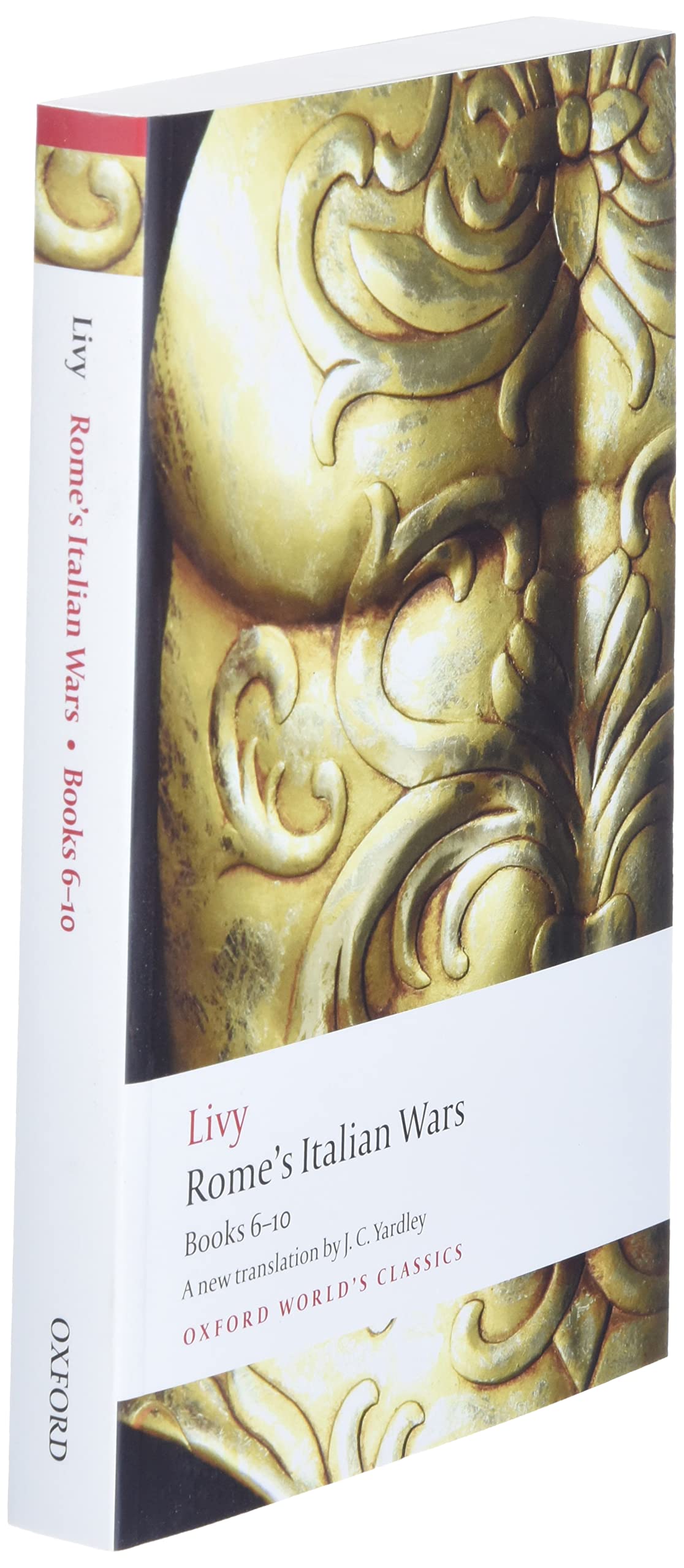
Rome's Italian Wars Books 6-10 is a newly translated, illustrated 5-volume set by Livy, featuring detailed maps, scholarly notes, and a compelling narrative of Rome’s critical military campaigns. With a 4.7-star rating and free delivery, this collection is a must-have for history enthusiasts and professionals seeking authoritative insight into Roman historiography.


| Best Sellers Rank | 462,542 in Books ( See Top 100 in Books ) 48,660 in History (Books) |
| Customer reviews | 4.7 4.7 out of 5 stars (82) |
| Dimensions | 19.3 x 2.29 x 12.7 cm |
| Edition | Illustrated |
| ISBN-10 | 019956485X |
| ISBN-13 | 978-0199564859 |
| Item weight | 1.05 kg |
| Language | English |
| Print length | 448 pages |
| Publication date | 4 April 2013 |
| Publisher | OUP Oxford |
P**S
Book
Good value
P**O
"Livy's guesses are often as good as ours". Recommended Roman history!
This truly is interesting: Livy is dealing with an important chunk of Rome's history here and the narratives are exciting and intriguing in almost equal measure. History in the making this is a contribution to Roman Historiography. It contains an introduction that itself is worth some of the cost of the book, textual notes, a chronology of events, maps and some useful appendices. It is also a new translation of Livy's work. Highly recommended.
T**2
An excellent new translation
Livy has always been a difficult historian to get to grips with, but in this new translation of his Books 6-10 we get a chance to make sense of what was going on in 4th Century BC Italy - at least as far as Livy wanted his readers in late 1st C BC/early 1st C AD to understand it. The big problem is that Livy - more than most of his contemporaries perhaps - was not what we call a professional historian. He wasn't interested necessarily in reaching some objective truth, but telling a good story. He does this, but it can at time be a repetitive read of squabbles between the plebs and patricians, and a series of Roman armies under the consuls going out to slaughter various uppity Latins/Etruscans/Samnites etc etc. He never asks why the other peoples of Italy might be objecting to Roman conquest (unlike, say Tacitus in his Agricola with Calgacus) and in that respect always to me seems to be the ancient world's equivalent of a Daily Mail columnist (a British tabloid for those non-UK readers). But in terms of this new translation - I'd heartily recommend it. Yardley and Hoyos are to be congratulated on the text, notes and glossary - all of which I found very useful indeed.
J**E
The Imperialist Republic
With this volume translations of all the surviving parts of Livy's History are now available in the Oxford World's Classics series. It is noteworthy, however, that this section (Books 6-10) has been left to the end. Perhaps the focus on the conquest of Italy by the martial Roman state might be considered of less interest, indeed less sympathy, to a modern readership than the foundation legends of Books 1-5 or the long and desperate Hannibalic Wars of the Third Century. The five Books or chapters of this edition cover Rome's history in the Fourth Century, the period immediately following the capture of Rome by the Gauls and concluding with the defeat of the tough mountain warriors of Samnium. Livy is a hugely influential figure in historiography. His narrative and annalistic approach concentrates on notable wars and political events focusing on the actions of `great men', a method followed by many subsequent historians. He was scholarly, religious (although sceptical at times) and intensely moralistic. His opening ten Books focus on the qualities which made Rome great (in his eyes) and contrasting those virtues with the decayed Rome of his own time (ironically the Rome of Augustus Caesar). The catalogue of Roman wars here accompanied by inevitable Roman victory is not without interest, but it is often the incidental anecdotes which spice the narrative. Incidents I enjoyed especially include the account of the apparent attempt of 170 Roman wives to poison their husbands (8.18), and one Roman general's pragmatic, if not cynical, attitude towards the omens proclaimed by `the keeper of the chickens' just before an important battle (10.40); but for me it is when Rome must face adversity that the narrative is most gripping: the account of the famous debacle of the Caudine Forks when the Samnites successfully trap and then spare an entire Roman army is the standout event of this volume (9.1-11). The translation is very readable and the accompanying notes are instructive and unobtrusive. There is an excellent introduction, useful appendices and index. The publication of this volume is timely and a worthy addition to the series.
P**Y
A very readable translation
Books 6-10 tell the story of Rome from 390 to 293 BC, and were most likely written by Livy in the early 20s BC. The history opens with the aftermath of the capture of Rome by an army of Gauls. Most of the narrative is concerned with Rome's repeated wars with their neighbours (thus the title of this edition). The other main theme of the history is the struggle between Rome's upperclass patricians and the plebeian commoners over rights and political power. This translation is very readable, and the later books become much more expansive and descriptive about the events they depict than the earlier ones. There is no mention of years in the books themselves, each year being denoted by the names of the consuls for that year. The events of each year are laid down before moving on to the next. Livy's real talent lies in the events he chooses to include: Publius Decius and his men sneak into the heart of a Samnite camp and as they face discovery raise the battle cry; Titus Quinctius is dragged from his bed in the middle of the night and taken by force to lead a band of deserters against Rome; a devastating plague turns out to be a mass poisoning plot concocted by a group of 170 married women; a dictator is elected to perform a ceremony of hammering a nail to restore men's minds to sanity, after which he resigns. The introduction is detailed and a great help in understanding the history itself, with the addition of a map and chronology of events.
S**6
Nothing like a good history book
D**P
As Magnificent it was reading the 1st volume of Titus Livy AB URBE CONDITA (Rome's history since its foundation), More Wonderful is continuing the voyage in this second volume that continues the tale of Civilization's once Greatest empire. Concise with a lot of information academic style sometimes for those not accustomed to it, but it happened to me as I find so interesting learning, I like that style and as it is read it goes in good continuity as a story told by someone (Livy) who tries to make the reader underdand why Rome is the greatest society in existence. And that feat to be comprenhensible with a good narrative style goes too to the translator that it goes smoothly on a modern language understood by all without the old english victorian transalions, although I like that old english but to better make classical literary texts as this one to be able to reach new generations and not to die is necessary from time to time to adapt it to the current language without changing the meaning of the author's words. A feat sometime really difficult but a dedicated translator can find the way to do it. Although vol 1 was translated by a different person both new translators did an Excellent job of renewing AB URBE CONDITA to a new generation.
C**W
Simple inexpensive glue back book. Nice footnotes at the back. I just hate how amazon ships books. What's with the paper bag? How could the book NOT be damaged during shipping. I'd pay an extra dollar or two for a carboard box so my books arrive undamaged. It didn't help that they tossed in a metal valve I'd ordered in the same bag to guarantee that the book would be damaged.
H**A
very pleased with delivery and quality
Trustpilot
1 month ago
3 weeks ago