
DOWNLOAD THE APP


Customer Services
Copyright © 2025 Desertcart Holdings Limited
DOWNLOAD THE APP
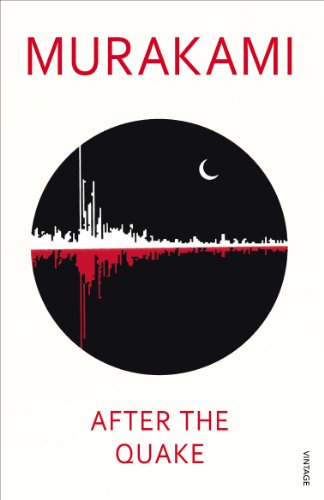

After the Quake [Haruki Murakami] on desertcart.com. *FREE* shipping on qualifying offers. After the Quake Review: Haunting ... enchanting ... - Two people look at the night sky. One sees darkness and dots of light. Another sees a thousand marvels. As the shock of an earthquake wears off, a sort of soul-quake takes place. After all, if we can't rely on the ground under our feet to remain solid, what can we be certain of? Sometimes we KNOW that in the brain, but it takes an earthquake or terrorist attack for us to FEEL it in the gut -- for the knowing to be meaningful. Something intangible but essential shakes loose in the people of Japan weeks after the Kobe earthquake. Like the rock mantle that once covered Kobe, neglected souls have liquefied. Now change is possible. For some, that means healing. For one, it means, not just losing, but unknowingly giving away his...soul(?). Another meets a heretofore hidden aspect of his Self. I guess it depends on what had been important in their lives and where they were headed before. The stories are told gently, subtly and with respect. A writer's self-inflicted chains are broken and he finds his freedom. A dumpy, overly modest, milquetoast doormat of a man finds his true power. With the help of a guru/limo driver, a rock of hatred that even the soul-quake left intact is only now able to be recognized and dealt with. I wouldn't presume to discuss Mr. Murakami's use of metaphor and allegory. I think each reader will find what s/he needs to find. ("When the student is ready....") That's one reason I'll be reading this book again soon: There's much to be found. AFTER THE QUAKE, I suggest, is best read slowly and often, with soft and open awareness; it's to be contemplated upon. Review: How tragedy affects us all - Murakami writes at his straightforward best in this collection of six short stories. Using the tragic 1995 Kobe, Japan earthquake as his jumping off point, Murakami beautifully and eloquently captures moments in the lives of a handful of Japanese citizens- none of them actually living in Kobe at the time of the quake- and illustrates how catastrophic events affect us all, even if we are not directly impacted. An unhappy wife becomes obsessed with news of the earthquake and suddenly decides to leave her husband, inspiring him to undertake a spiritual journey of his own. A young man, raised to believe that his father is God, decides to seek out his real father. An overworked business woman takes a much needed vacation and undergoes a spiritual reading that would profoundly change her life. Although none of the characters are directly impacted by the devastation in Kobe, the existential questions that such a disaster raises impacts each of their lives in a compelling and meaningful way. For the most part, Murakami abandons his surrealistic ways and keeps the stories grounded in reality, with only a hint or two of unexplained weirdness (a Murakami trademark). The main exception is "Super Frog Saves Tokyo", a story about a man who comes home from work to find a giant frog in his kitchen requesting help to save Tokyo from the Worm. Apart from this, the remaining stories occupy a Japan as normal as anything Murakami has written about, portraying the unsettled consciousness of a nation dealing with a disaster of historical proportions. "After the Quick" may be Murakami at his simplest, but it is also Murakami at his best.
| ASIN | 0099448564 |
| Best Sellers Rank | #1,344,210 in Books ( See Top 100 in Books ) |
| Customer Reviews | 4.4 4.4 out of 5 stars (1,264) |
| Dimensions | 5.04 x 0.35 x 7.76 inches |
| Edition | New Ed |
| ISBN-10 | 9780099448563 |
| ISBN-13 | 978-0099448563 |
| Item Weight | 3.74 ounces |
| Language | English |
| Print length | 144 pages |
| Publication date | January 1, 2003 |
| Publisher | Vintage Books |
D**P
Haunting ... enchanting ...
Two people look at the night sky. One sees darkness and dots of light. Another sees a thousand marvels. As the shock of an earthquake wears off, a sort of soul-quake takes place. After all, if we can't rely on the ground under our feet to remain solid, what can we be certain of? Sometimes we KNOW that in the brain, but it takes an earthquake or terrorist attack for us to FEEL it in the gut -- for the knowing to be meaningful. Something intangible but essential shakes loose in the people of Japan weeks after the Kobe earthquake. Like the rock mantle that once covered Kobe, neglected souls have liquefied. Now change is possible. For some, that means healing. For one, it means, not just losing, but unknowingly giving away his...soul(?). Another meets a heretofore hidden aspect of his Self. I guess it depends on what had been important in their lives and where they were headed before. The stories are told gently, subtly and with respect. A writer's self-inflicted chains are broken and he finds his freedom. A dumpy, overly modest, milquetoast doormat of a man finds his true power. With the help of a guru/limo driver, a rock of hatred that even the soul-quake left intact is only now able to be recognized and dealt with. I wouldn't presume to discuss Mr. Murakami's use of metaphor and allegory. I think each reader will find what s/he needs to find. ("When the student is ready....") That's one reason I'll be reading this book again soon: There's much to be found. AFTER THE QUAKE, I suggest, is best read slowly and often, with soft and open awareness; it's to be contemplated upon.
P**Y
How tragedy affects us all
Murakami writes at his straightforward best in this collection of six short stories. Using the tragic 1995 Kobe, Japan earthquake as his jumping off point, Murakami beautifully and eloquently captures moments in the lives of a handful of Japanese citizens- none of them actually living in Kobe at the time of the quake- and illustrates how catastrophic events affect us all, even if we are not directly impacted. An unhappy wife becomes obsessed with news of the earthquake and suddenly decides to leave her husband, inspiring him to undertake a spiritual journey of his own. A young man, raised to believe that his father is God, decides to seek out his real father. An overworked business woman takes a much needed vacation and undergoes a spiritual reading that would profoundly change her life. Although none of the characters are directly impacted by the devastation in Kobe, the existential questions that such a disaster raises impacts each of their lives in a compelling and meaningful way. For the most part, Murakami abandons his surrealistic ways and keeps the stories grounded in reality, with only a hint or two of unexplained weirdness (a Murakami trademark). The main exception is "Super Frog Saves Tokyo", a story about a man who comes home from work to find a giant frog in his kitchen requesting help to save Tokyo from the Worm. Apart from this, the remaining stories occupy a Japan as normal as anything Murakami has written about, portraying the unsettled consciousness of a nation dealing with a disaster of historical proportions. "After the Quick" may be Murakami at his simplest, but it is also Murakami at his best.
M**Y
The best short story author of all time?
I'm afraid to say that this book will be a classic because that turns people off of some books -- but this book is a classic of the short story genere. If you have never read Murakimi, you might think that reading a translated work by a great Japanese author is something that you ought to do, rather than something that you will enjoy. Sort of like yoga or ordering a healthy vegetarian concoction rather than a nice juicy steak. The opposite is true, this is great literature because he effortlessly grabs your attention and keeps it for the whole story. Just when you think you have the author figured out he sneaks up behind you and whaps you over the head with a completely different angle, making you question just about everything you ever thought that you knew. The last story even made me cry, which not many stories do and certainly not other stories by this author. Every story should be read many times, or at least I find that I do. I frequently reread stories from "The Elephant Vanishes" and plan to do the same with this one. In some reviews I find that people overanalyze the books; don't forget that just because the author is writing in the first person doesn't mean that the author is presenting the hero as somebody who you should emulate. If you spot a character flaw, with an author of this caliber it is pretty likely that you were intended to -- and if you read it again you might question your assumptions. This is the first book I have bought on a Kindle and I'm not too sure about the experience. With this author you should probably get the physical book so you can reread the stories. Also, the book is a bit smaller than I expected. This book was a nice antidote to the "Girl with the Dragon tattoo" that I finished reading just before.
A**Z
I must confess that I hadn't bought and read this book because I thought it was a chronicle; so, great was my surprise when I found a collection of short stories as marvellously written and mind-blowing as all Murakami's works have proved to be. Of course, the leif motif that gives rise to it is the 1995 Kobe earthquake that left open wounds in the Japanese imagery for the decades to come. In spite of this common characteristic, the stories presented range from the most disparate possible sources: a recently separated man, a young woman who doesn't know what to do with life, a delusional man who can't tell whether he contributed to save Tokyo from another earthquake (just to mention some). A continuum of uncertainty between what is thought to be real and what is thought to be a dream, after the quake is a magnificent to choice to puzzle oneself while reading it.
I**C
All the stories are so beautiful written around main theme of the book 'Earthquake' . Life goes on even as mother nature gets angry sometimes. Murakami does magic with words. Even the superficial characters in his stories are so humanized that you don't even realise the difference. Beautiful stories..ma must read if you are a Murakami fan
A**.
Small booklet but up to expectations! Murakami never fails
R**N
الكتاب ليس بحالة جيدة، كاني مشتريته مستعمل
S**O
Mi third Murakami read, once again, inside this surreal universe of familar places in Tokio, and Japan the reader would prabably never visit and yet get to know so well...
Trustpilot
3 days ago
2 days ago